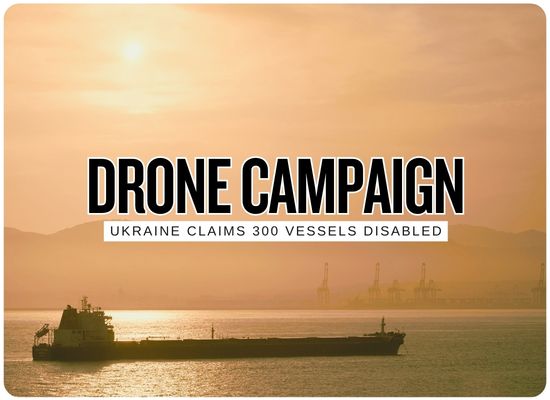
Ukraine Drone Commander Claims 300 Russia-Linked Vessels Disabled in 11-Week Campaign
🔔 Subscribe to ShipUniverse Weekly →
Ukraine’s Unmanned Systems Forces commander Robert “Madyar” Brovdi said on September 22 that his units had rendered 300 Russia-linked vessels unable to continue under their own power since Operation MoLoChKa began on July 6, including 134 vessels in the Sea of Azov and 166 in the Black Sea. Brovdi characterizes the targets collectively as Russia’s “shadow fleet,” although reported targets have included tankers, bulk carriers, cargo ships, tugs, ferries, a gas carrier and floating cranes. The 300-vessel figure is a Ukrainian military claim and has not been independently verified vessel-by-vessel. Russia has not confirmed the total. Brovdi’s original statement specifically describes the vessels as being taken out of a self-propelled condition, which is different from saying 300 ships were sunk or permanently destroyed.
300 Vessels Is the Claim. “Disabled” Is the Key Word.
Ukraine's drone commander says an 11-week aerial campaign has repeatedly attacked vessels supporting Russian logistics and exports. The reported goal is to stop ships from moving under their own power rather than sink them and risk major cargo or fuel spills.
The 300 Figure Is Unverified. The Shipping Disruption Is Not Hypothetical.
The strongest evidence surrounding the Ukrainian claim is not a confirmed list of 300 damaged ships. It is the series of measurable changes that have followed: navigation restrictions, cargo rerouting, falling exports, suspended liner bookings and wider war-risk requirements.
| Indicator | Reported Development | What Is Established | Verification Limit | Commercial Shipping Effect | Source / Date |
|---|---|---|---|---|---|
| UKRAINIAN CLAIM 300 Vessels Disabled | Brovdi says 134 vessels in the Sea of Azov and 166 in the Black Sea have been rendered unable to continue under their own propulsion. | Ukraine's Unmanned Systems Forces have conducted a sustained aerial-drone campaign against vessels in both basins since early July. | The full 300-vessel casualty count has not been independently verified ship-by-ship and is not confirmed by Russia. | If vessels require towage, repair or withdrawal from service, the effect extends beyond physical damage to fleet availability and voyage scheduling. | Brovdi / Ukrainian USF · September 22 |
| OBSERVED DISRUPTION Sea of Azov Restrictions | Shipping was restricted in July following repeated attacks, including limitations affecting access through the Kerch Strait. | Reuters sources described the episode as the largest disruption to Black Sea grain trade since the full-scale war began. | Russian ministries did not initially confirm all reported navigation restrictions publicly. | Azov cargoes faced delays and pressure to shift toward deeper Black Sea, Baltic or other terminals. | Reuters · July 14 |
| TRADE DATA Russian Grain Exports | August seaborne grain exports fell 61.9% year over year to approximately 2.0 million tonnes. | Azov and Black Sea grain shipments fell 73.1% year over year to approximately 1.3 million tonnes. | Export levels are influenced by multiple factors including harvest timing, infrastructure availability and market demand, not drone strikes alone. | Russian exporters increasingly looked toward Baltic, Arctic and other terminals for cargo that previously moved through southern ports. | Industry shipping data / Reuters · September |
| LINER RESPONSE MSC Novorossiysk Suspension | MSC suspended new cargo bookings to and from Novorossiysk after MSC Ulsan III was attacked by a drone. | The suspension affected one of the remaining international liner links serving Russia's principal Black Sea gateway. | A booking suspension does not mean all shipping at Novorossiysk stopped. | Cargo owners faced reduced liner options and additional routing and schedule uncertainty. | Lloyd's List · August 26 |
| INSURANCE RESPONSE Entire Black Sea High Risk | London's Joint War Committee expanded war-risk reporting requirements to cover the entire Black Sea. | The decision followed increased attacks on merchant vessels, ports and energy infrastructure throughout the basin. | Territorial waters of Bulgaria, Georgia, Romania and Turkey remain subject to separate treatment under the guidance. | War-risk scrutiny and voyage costs can rise even for ships not calling at Russian or Ukrainian ports. | Joint War Committee / Reuters · September 18 |
| REROUTING Baltic & Arctic Grain Shift | Russia has begun adapting fertilizer and coal terminals at ports including Ust-Luga, St. Petersburg and Murmansk to handle grain. | Nearly 90% of Russian seaborne grain exports previously moved through Black Sea routes. | Northern routes have different capacity, rail, seasonality and cost constraints. | Maritime disruption is beginning to change where cargo is loaded, not only which vessels carry it. | Reuters · September 21 |
Vessel Disruption & Rerouting Cost Analyzer
Model what happens when part of a regional trading fleet becomes unavailable and cargoes must wait, substitute tonnage or move through a longer route. Inputs are deliberately editable because the 300-vessel Ukrainian claim does not provide enough public data to calculate an actual financial loss.
We welcome your feedback, suggestions, corrections, and ideas for enhancements.
Please click here to get in touch