Europe Faces 760-Connection Shore-Power Gap Ahead of 2029 TEN-T Deadline
🔔 Subscribe to ShipUniverse Weekly →
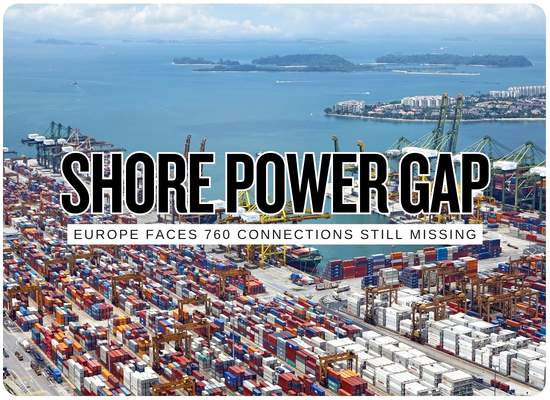
Europe's new TEN-T corridor work plans expose a large shore-power buildout still required before the end of 2029. The European Commission published the first generation of plans under the revised TEN-T framework on September 30, identifying compliance gaps and priority investments across the transport network. A cross-corridor analysis by Ports Europe indicates that roughly 760 of about 870 shore-power connections identified as necessary in the plans are still missing, leaving only around 110 presently counted as available. Under the EU Alternative Fuels Infrastructure Regulation, qualifying TEN-T maritime ports must by December 31, 2029 be equipped to provide shore-side electricity for at least 90% of relevant calls by large containerships and passenger vessels. The infrastructure race now coincides with a €200 million Connecting Europe Facility call covering the European Maritime Space and inland ports that closes today, October 6, at 17:00 CEST.
Roughly seven out of every eight identified shore-power connections still have to be delivered
The new corridor work plans put numbers around a deadline that had previously looked distant. Ports now have just over three years to close much of the remaining infrastructure gap.
The infrastructure gap in one bar
Approximate cross-corridor figures reported from the new work plans. Individual European Transport Corridors overlap geographically, so corridor rows should not simply be added together as unique port installations.
Share represented by approximately 110 existing connections against the reported 870-connection requirement.
The remaining infrastructure has to move through grid connection, procurement, civil works, commissioning and vessel compatibility.
Straight-line connections needed annually to close 760 by deadline.
Illustrative commissioning rate from October 2026 onward.
Roughly 3% of the work-plan requirement currently counted.
Roughly 7% of the identified shore-power connections.
AFIR requires qualifying TEN-T ports to provide sufficient shore-side electricity for at least 90% of relevant calls by container ships and passenger ships above 5,000 GT. The connection counts are the infrastructure interpretation appearing in the corridor implementation work.
Europe's Shore-Power Map Is Highly Uneven
| European Transport Corridor | Connections Reported In Place | Identified Requirement | Approx. Coverage | Approx. Remaining | Signal From 2026 Work Plan |
|---|---|---|---|---|---|
| Baltic Sea–Adriatic Sea | 2 | 67 | 3.0% | 65 connections | Among the largest proportional gaps identified in the corridor reporting. |
| Western Balkans–Eastern Mediterranean | 1 | 67 | 1.5% | 66 connections | Current connection count is effectively at the beginning of the deployment curve. |
| Mediterranean | 8 | 117 | 6.8% | 109 connections | Large port-project pipeline exists, but OPS deployment remains far below requirement. |
| North Sea–Rhine–Mediterranean | 13 | 142 | 9.2% | 129 connections | Largest absolute requirement among these selected corridor figures. |
| Baltic Sea–Black Sea–Aegean Sea | 21 | 120 | 17.5% | 99 connections | Deployment is further advanced than several southern corridors but remains incomplete. |
| Scandinavian–Mediterranean | Not stated in public summary | Not stated in public summary | ≈30% | ≈70% of requirement | Highest reported percentage among the recent corridor comparisons. |
| Atlantic | 0 in core ports | Not stated in public summary | 0% of core ports | Substantial | Work-plan reporting found no shore-power coverage at Atlantic core ports. |
The Mediterranean work plan contains 55 broader port projects valued at roughly €6.4 billion. That total is not a shore-power-only budget.
HaminaKotka is installing OPS at six container berths, with completion scheduled for August 2028.
European Maritime Space and inland-port works applications close October 6 at 17:00 CEST.
EU Shore-Power Deadline Pace Planner
Test how quickly connections would have to be commissioned to close the reported infrastructure gap before December 31, 2029.
Infrastructure that must be operational by the end of 2029 cannot wait until 2029 to begin. Grid agreements, substations, transformers, frequency conversion, cabling and berth construction can all sit on the critical path.
We welcome your feedback, suggestions, corrections, and ideas for enhancements.
Please click here to get in touch