Panama Canal Extends Long-Term Reservations to Panamax Locks With 288 Dry-Season Slots
🔔 Subscribe to ShipUniverse Weekly →

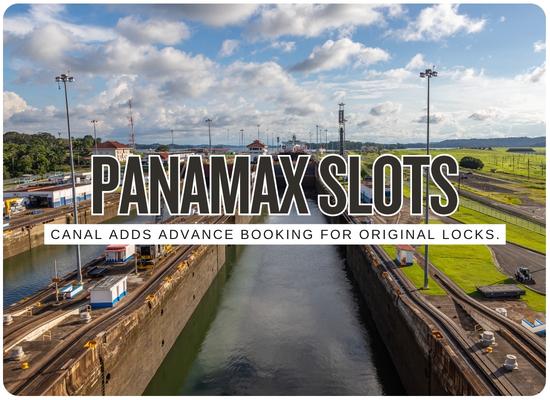
The Panama Canal Authority will extend its Long-Term Slot Allocation program to the Panamax locks for the first time, offering 51 packages containing 288 transit slots for booking dates from January 3 through April 3, 2027. The pilot is aimed at Super-category vessels using the original locks and will allocate 147 northbound and 141 southbound slots through sealed bidding on November 24. Each slot carries a $60,000 minimum bid, while capacity not assigned through LoTSA will continue to flow through the Canal's regular reservation and auction systems. The move brings long-range transit planning to a much broader mix of dry bulk, tanker, LPG, container and vehicle-carrier operators just as Panama enters another climate-sensitive dry-season operating window.

Panama Canal · LoTSA Panamax Pilot

The Original Locks Get a Long-Term Booking Market

288 Panamax transit slots packaged in advance

For the first time, operators using the Panamax locks will be able to bid for blocks of future transit capacity months ahead instead of relying entirely on the normal booking ladder and short-term auction market.

One auction. Three months of transit visibility.
Winning customers secure recurring Fixed packages for the opening months of 2027.
Auction Nov. 24, 2026
First Booking Date Jan. 3, 2027
Pilot Ends Apr. 3, 2027
Sealed bids begin at $60,000 per slot Auctions start at 10:00 Panama time in 30-minute segment-specific cycles. Higher bids receive priority and tied bids are resolved by submission time.
Packages Offered 51
Fixed packages divided by market segment and transit direction.
Northbound 147
Long-term slots allocated toward the Atlantic.
Southbound 141
Long-term slots allocated toward the Pacific.
Official Daily Equivalent 3 / Day
ACP describes the pilot allocation as equivalent to three daily Panamax slots.
Package Type Fixed
The Panamax pilot uses one flexibility level rather than multiple package classes.
In-Transit Time 48 hr
Applicable ITT condition for Panamax LoTSA reservations.
Eligible Super-Category Panamax Vessels
Maximum LOA is 294.44 meters / 966 feet and maximum beam is 32.61 meters / 107 feet. Customers require a valid Panama Canal Customer Code.
Not Eligible The Pilot Does Not Cover Every Panamax Vessel
Panamax Plus vessels, Full Daylight Restricted ships, tug-and-barge units and non-self-propelled vessels are excluded from LoTSA Panamax.
Who Gets the Long-Term Capacity?

One-Third of the Pilot Is Reserved for Dry Bulk

Panama is not offering the 288 slots as one undifferentiated pool. Capacity is divided by vessel market, direction and frequency so several major Panamax trades can compete for predictable transit windows.

Slot Allocation by Market Segment
Dry Bulk
33.3%
96 slots
Tankers
20.8%
60 slots
LPG
12.5%
36 slots
Full Containers
12.5%
36 slots
Vehicle / RoRo
12.5%
36 slots
Other Segments
8.3%
24 slots
Northbound 147
Slightly more capacity is allocated to Atlantic-bound transits, but the program is essentially balanced by direction.
Southbound 141
Pacific-bound customers receive almost the same amount of forward capacity.
Standard Super Reservation $50,000
Current published Panamax-lock reservation tariff for a Super vessel.
LoTSA Panamax Floor $60,000
Minimum sealed bid per long-term slot. Winning prices can be higher.
April 2026 Auction Surge ~$385K Avg.
Reuters reported average auction prices near this level during a temporary demand spike, with some individual auctions exceeding $1 million.
Derived floor value: 288 slots multiplied by the $60,000 minimum bid equals $17.28 million of theoretical minimum slot value if every slot sold at exactly the base price. Actual auction proceeds could be higher and this figure excludes Canal tolls and other maritime-service charges.
Ship Universe Panama Canal Slot Tool

Long-Term Reservation vs Auction Exposure

Model the commercial tradeoff between locking in Panamax transit capacity through LoTSA and relying on the normal reservation market with possible exposure to higher-priced auction slots.

transits
$000 / slot
Official minimum is $60,000. Actual winning bids are unknown until the November 24 competition.
$000 / slot
%
User-entered commercial assumption. ACP does not publish a future probability of regular slots becoming unavailable.
$000
Default references the temporary April 2026 average reported by Reuters. It is not a current or forecast auction quote.
%
Model assumes cancellations occur at least 15 days ahead and incur the official 80% charge.
Expected LoTSA Cost $594K expected portfolio cost including modeled early cancellations
Expected Regular / Auction Cost $803K weighted expected slot cost across regular reservations and auction exposure
Modeled Difference $209K positive value means the entered LoTSA case is lower-cost
Auction Exposure Break-Even 14.9% auction reliance at which the entered LoTSA bid equals expected market-slot cost
LoTSA Cost Per Planned Transit $99K expected modeled long-term booking cost divided by planned transits
Expected Auctioned Transits 1.5 planned transits multiplied by the entered auction-exposure probability
Expected Reservation Cost
This compares booking-strategy cost only. Panama Canal tolls, fuel, vessel time and other maritime service charges are excluded because they apply separately.
LoTSA Strategy $594K
Regular + Auction Strategy $803K
Selected Scenario Competitive LoTSA Scenario
The economic value of a long-term slot depends on the bid required to win it and the operator's view of future short-term availability. A higher LoTSA bid can still be rational if the expected probability and cost of last-minute auction exposure are sufficiently high.
LoTSA Bid $100K
Regular Slot $50K
Auction Case $385K
Auction Risk 25%
Scenario limitation: This is not a forecast of Canal auction prices or slot availability. The $385,000 default reflects a temporary April 2026 average reported during a demand surge. Actual auction bids can be much lower or higher. The model also assumes any LoTSA cancellation occurs at least 15 days ahead and therefore uses the 80% cancellation charge; later cancellations can cost 100% of the winning bid.
Feedback Welcome

We welcome your feedback, suggestions, corrections, and ideas for enhancements.

Please click here to get in touch
By the ShipUniverse Editorial Team — About Us | Contact