Oil Slides on Hormuz Talks, but Tanker Risk Still Owns the Market
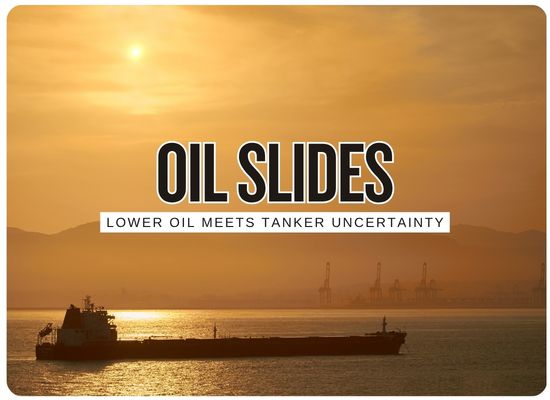
Oil prices moved lower as Iran-Oman talks gave traders a new reason to price in a possible partial reopening of the Strait of Hormuz. The selloff makes sense at the headline level: if a temporary corridor is announced, if mines are cleared, and if more ships can move safely, some geopolitical premium should come out of Brent and WTI. But the commercial oil market is not back to normal. Hormuz traffic remains far below pre-war levels, several oil companies are preparing to avoid Iran-blacklisted ships, Gulf producers are still using ship-to-ship workarounds outside the strait, and U.S. sanctions pressure keeps China, refiners, charterers, banks, insurers and cargo buyers in the compliance spotlight.
Ship Universe Oil Market Watch
Operator Impact Snapshot
Oil is trading lower on diplomacy, but the physical shipping market still looks stressed.
Talks pull crude lower
Brent and WTI fell sharply as Iran and Oman discussed a temporary Hormuz corridor and mine-clearance plan.
Traffic still thin
Only five commodity vessels were tracked through Hormuz on Tuesday, far below the volume needed for normal Gulf oil confidence.
Blacklist changes chartering
Several oil buyers are preparing to avoid ships on Iran’s blacklist, especially vessels tied to ship-to-ship transfer chains.
STS workarounds continue
Saudi, UAE and Qatar-linked flows are increasingly using Gulf of Oman transfer structures to keep cargo moving outside direct Hormuz loading risk.
China remains central
Sanctions pressure keeps Chinese buying, Iranian barrels, payment channels and vessel history at the center of oil-market compliance risk.
Reserve cushion is lower
The U.S. Strategic Petroleum Reserve has dropped near 290 million barrels, reducing one important emergency buffer.
Oil Market Board
Price Relief Meets Physical-Market Friction
The futures market is reacting to possible reopening, while the cargo market is still trying to de-risk ships and routes.
Brent fell more than $2 a barrel as Hormuz corridor talks reduced some geopolitical premium.
WTI also moved lower, tracking the same diplomacy-driven shift in risk pricing.
Preliminary Tuesday tracking showed only five commodity vessels through the strait.
The list targets vessels Iran says violated its Hormuz rules, with STS-linked vessels also exposed.
| Signal | Latest Detail | Oil Market Reading | Commercial Effect | Pressure Meter |
|---|---|---|---|---|
| Iran-Oman TalksDiplomacy discount | The two countries discussed a temporary navigational corridor and mine clearance through Hormuz. | Crude prices fell because traders started pricing partial reopening and a lower escalation probability. | A credible corridor could reduce freight premiums, but only if vessel traffic actually recovers. | Price Relief |
| Thin Hormuz TrafficPhysical-flow constraint | Only five commodity vessels were tracked Tuesday, down from a recent 10-day average of 15. | This is the counterweight to the price selloff. Physical flows remain constrained. | Refiners and traders still face allocation risk, fixture delays and timing uncertainty. | High |
| Blacklisted TankersCompliance contagion | At least three Indian refiners and one global energy major plan to avoid listed vessels or related STS transfers. | Iran’s list does not need to stop all flows to change behavior. It only needs to make buyers, insurers and charterers hesitate. | Expect deeper vessel-history checks, STS-chain review, stricter charter clauses and more delivered-basis buying. | Severe |
| Saudi Crude to ChinaSTS workaround | Two supertankers carrying about 4 million barrels of Saudi crude are bound for China after loading via transfers off Oman. | Oil is still moving, but with more operational steps and more risk sitting in the transfer chain. | Cargo buyers need clarity on title transfer, insurance, laytime, documentation and sanctions warranties. | High |
| QatarEnergy TenderTransfer outside Hormuz | QatarEnergy offered crude through STS transfers outside Hormuz, joining other Gulf producers shifting loading risk outward. | More Gulf exporters are treating offshore transfer capacity as a strategic release valve. | STS space, weather windows, inspection quality and marine warranty review become more valuable. | Medium High |
| U.S. Sanctions PressureIran trade channels | Washington widened pressure on countries and counterparties doing business with Iran, while China buying remains in focus. | The sanctions story can support crude prices if it removes barrels, but traders are also reading it as pressure toward negotiation. | Banks, traders, refiners and shipowners need tighter screening around Iranian origin, payment routes and beneficial ownership. | High |
| SPR BufferEmergency reserve cushion | U.S. SPR crude stocks fell to 289.7 million barrels, the lowest level since 1982. | A lower emergency reserve makes future disruption harder to absorb if Hormuz talks fail. | Energy buyers may keep more attention on commercial inventories, refining margins and product availability. | High |
Oil Risk Premium and Shipping Exposure Tool
Estimate the commercial impact of lower crude prices, Hormuz shipping risk, STS costs and blacklist exposure.
Price Relief Value
$5.5M
Estimated cargo-value reduction from the recent price move.
Shipping and STS Cost
$2.1M
War-risk, STS workaround and delay cost combined.
Net Commercial Effect
$3.4M
Price relief after subtracting added voyage and transfer costs.
Risk-Adjusted Exposure
$17.3M
Planning exposure based on cargo value, shipping friction and risk scores.
Oil Trade Signal
The model shows price relief, but shipping cost, STS complexity and blacklist risk remain high enough to keep the trade commercially sensitive.
We welcome your feedback, suggestions, corrections, and ideas for enhancements.
Please click here to get in touch