Höegh Autoliners Orders Six More Aurora-Class Car Carriers as China Export Boom Tightens RoRo Capacity
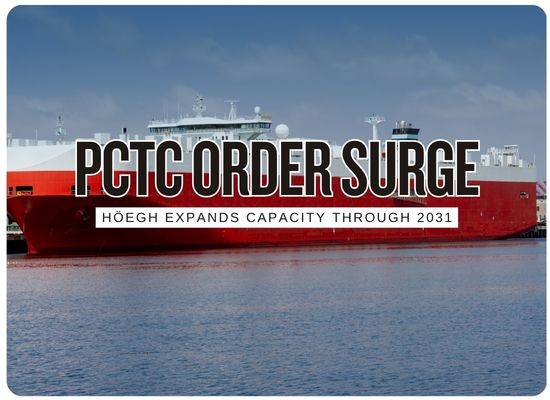
Höegh Autoliners has placed firm orders for six additional 9,100-CEU Aurora-class PCTCs at China Merchants Heavy Industry Jiangsu, extending its Aurora program from 12 to 18 vessels, with the new ships scheduled for delivery between 2029 and 2031. The company has also secured options for another four ships on the same commercial terms and reserved yard slots for four more, creating a path to as many as 26 Aurora-class vessels. The price of the new ships was not disclosed. Hours after announcing the order, Höegh completed a NOK 1.42 billion, approximately $152 million, private placement that was multiple times oversubscribed; the proceeds, together with debt financing, are intended to finance the expanded newbuilding program.
Operator Impact Snapshot
Höegh is extending one standardized 9,100-CEU design deep into the next decade while preserving additional yard capacity if vehicle exports and RoRo demand remain strong.
All six additional vessels will be built by China Merchants Heavy Industry Jiangsu.
Each Aurora is designed to carry up to 9,100 car-equivalent units.
The new order expands the original twelve-vessel program by another 50%.
Four options plus four additional reserved construction slots create another eight-vessel pathway.
Höegh says the equity proceeds and debt financing will fully finance the expanded newbuilding program.
Aurora Expansion Market Board
Höegh is committing to another production run while car exports, charter pricing and its own vessel utilization remain unusually strong.
| Signal | Latest Number | Current Position | Fleet Effect | Strategic Exposure | Next Milestone |
|---|---|---|---|---|---|
| New Aurora Order |
FIRM 6 × 9,100 CEU |
Delivery scheduled between 2029 and 2031 at CMHI Jiangsu. | Adds 54,600 CEU of nominal carrying capacity before any retirement of older tonnage. | Delivery occurs far enough into the future that vehicle trade patterns and competing fleet capacity can still change materially. | Construction schedule and vessel-by-vessel delivery sequence. |
| Additional Fleet Flexibility |
OPTION PATH 8 More Possible |
Four formal options plus four additional reserved building slots. | Aurora fleet could eventually rise from 18 firm vessels to 26. | Reserved slots give Höegh time to observe demand before committing to the entire expansion. | Four-ship option within six months; reserved-slot decision by December 31, 2027. |
| Chinese Vehicle Exports |
SURGING 5.096M Vehicles |
First-half 2026 exports increased approximately 65% year over year. | Rapid Asia-origin growth increases demand for deepsea PCTC capacity. | Tariffs, localization of vehicle manufacturing and trade restrictions could alter future seaborne growth. | Whether Chinese exports remain near the current record pace through 2027. |
| Höegh July Utilization |
FULL 1.4M cbm |
Höegh described current vessel capacity as fully utilized. | Strong utilization reduces the near-term risk of carrying excess fleet capacity. | Fleet expansion arriving from 2029 must be supported by continued cargo growth or older-vessel replacement. | Monthly volume and utilization through the remainder of 2026. |
| PCTC Charter Market |
TIGHT +60% |
Höegh said its July charter index was about 60% above Q1. | Expensive external tonnage increases the value of securing long-term owned capacity. | Charter rates can normalize rapidly if the orderbook begins outgrowing cargo demand. | Charter pricing as the 2026-28 delivery wave enters service. |
| Global PCTC Orderbook |
HIGH 147 Ships |
Approximately 21% of the existing fleet according to Höegh's Q2 market data. | Significant new capacity is already scheduled before Höegh's latest six ships arrive. | The main commercial question is whether Chinese and other vehicle exports continue absorbing new tonnage. | Fleet growth and scrapping through 2027-30. |
| Asian OEM Contract |
BACKLOG +$300M Revenue |
Major Asian vehicle manufacturer contract extended through December 2029. | Increased committed volumes overlap with the beginning of the latest Aurora delivery window. | Long-term cargo contracts help reduce exposure to future spot-market weakness. | Additional large customer renewals extending into 2030 and beyond. |
| Fuel Strategy |
MULTI-FUEL LNG + Future Conversion |
New six are LNG dual-fuel with DNV ammonia- and methanol-ready notation. | Ships can operate on established marine fuels while preserving future conversion flexibility. | Future ammonia availability, fuel cost, emissions regulation and conversion economics remain uncertain. | Development of commercial ammonia supply and engine conversion packages before 2030. |
| Standardized Production |
REPEAT DESIGN One Yard / One Class |
All 18 firm Aurora vessels are being built by CMHI Jiangsu. | Repeated hulls can simplify training, spares, maintenance and technical fleet management. | Concentrating construction at one builder increases exposure to yard execution and schedule performance. | Whether Höegh exercises its four options on the same commercial terms. |
| Financing |
COMPLETED $152M Equity |
Private placement was multiple times oversubscribed. Debt financing will supplement the equity. | Höegh says the financing structure will fully fund the expansion while leaving its dividend policy unchanged. | The actual shipbuilding contract value has not been publicly disclosed. | Future debt drawdowns and construction instalments. |
Aurora Fleet Renewal & Capacity Expansion Analyzer
Model the capacity effect of Höegh's six firm ships, its four options or the entire fourteen-vessel expansion pathway, including the impact of replacing smaller legacy PCTCs.
We welcome your feedback, suggestions, corrections, and ideas for enhancements.
Please click here to get in touch