Record $5.3M Panama Canal Bid Shows LPG Shipping’s New Queue Math
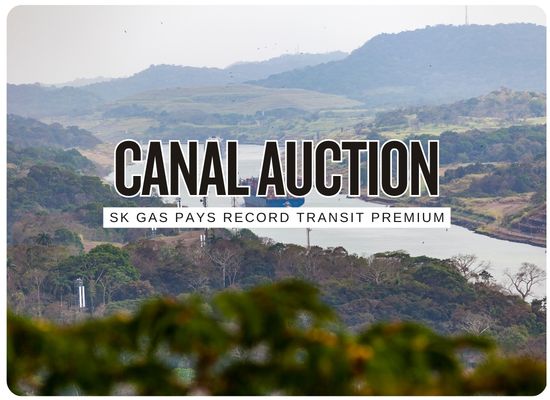
SK Gas has pushed Panama Canal priority pricing to a new record after agreeing to pay $5.3 million at auction so its LPG carrier G. Spirit can move northbound through the waterway on September 1. The bid breaks the previous $4.6 million record set earlier this month and shows how quickly the canal’s auction system has become a pressure valve for urgent energy cargoes, especially LPG moving between the Americas and Asia. The surge is being driven by a mix of lower canal water confidence, stronger demand for booked passages, Middle East disruption that has shifted energy sourcing patterns, and tighter upcoming operating limits as the Panama Canal prepares to reduce daily transits in September. For LPG shippers, the fee is not only a Panama Canal cost story. It is a freight-arbitrage story, because paying millions for a slot can still make sense when the alternative is losing a laycan, missing a pricing window, delaying an Asia delivery, rerouting, or tying up a very large gas carrier for days. Reuters reported that the canal will cap daily transits at 34 from September 4 and 32 from September 15, after rainfall from May through August ran 34% below average and watershed inflows were 44% below normal.
Canal Access Is Becoming a Cargo-Timing Auction
The record bid shows that the highest-value LPG voyages are now pricing certainty, not just distance.
Priority Slot Pricing
The $5.3 million bid resets the top end of Panama Canal auction pricing for urgent energy cargoes.
LPG Arbitrage Pressure
Large LPG shippers may pay extreme canal premiums when Asia delivery timing, freight economics and cargo spreads justify it.
September Slot Tightness
Planned transit caps make late-summer and early-fall booking discipline more important for ships without firm reservations.
Draft and Cargo Limits
Water-management measures can reduce how much cargo larger ships carry, adding a second constraint beyond the queue itself.
Reserved Ships Advantage
Vessels with secured transit windows avoid the most volatile auction exposure and may gain a commercial edge.
The operating signal is that Panama Canal access is becoming a financial decision. The question is no longer only whether a vessel can transit, but whether paying for certainty is cheaper than waiting, rerouting, missing the cargo window or losing the market spread.
Panama Canal Queue Premium Board
The record bid connects LPG cargo timing, transit-slot scarcity, water restrictions and route alternatives into one cost decision.
The $5.3 million auction result should be read as a scarcity price for certainty. The canal is still operating, but the commercial difference between a reserved vessel and an unreserved vessel has widened sharply as LPG demand, slot competition and water-risk planning all press on the same system.
Record auction fee agreed by SK Gas for priority Panama Canal access.
Scheduled northbound transit date for the LPG carrier G. Spirit.
Reported wait time for vessels arriving without reservations.
Planned daily cap from September 15 after an initial reduction to 34.
Commercial Pressure Table
| Pressure Area | Latest Signal | Commercial Read | Stakeholders | Status |
|---|---|---|---|---|
| Auction pricing | SK Gas agreed to pay $5.3 million for priority passage. | The top end of slot pricing is now being set by cargo timing and energy-market urgency. | LPG shippers, owners, charterers, brokers, cargo traders | High |
| Prior record | The new bid breaks the $4.6 million record set earlier this month. | Two record bids in one month show that this is no longer a one-off pricing outlier. | Gas carriers, canal users, freight desks, insurers | High |
| LPG cargo timing | The G. Spirit secured a northbound slot for September 1. | For LPG cargoes, a missed slot can affect destination timing, price exposure and vessel scheduling. | SK Gas, LPG buyers, terminal operators, VLGC owners | Positive |
| Unreserved waits | Waiting times for vessels without reservations have reached up to 11 days. | The auction fee competes against delay cost, demurrage, missed laycan risk and rerouting cost. | Unreserved vessels, agents, terminals, cargo owners | Watch |
| Transit caps | The canal plans to reduce daily transits to 34 from September 4 and 32 from September 15. | Lower daily capacity raises the value of confirmed slots as Q4 planning begins. | Container lines, gas carriers, bulkers, tankers, ports | High |
| Neopanamax limits | Draft restrictions have been adjusted and rescheduled as water conditions change. | Even when a vessel secures a slot, cargo intake and loading strategy may still be constrained by water depth. | Large container ships, LNG carriers, LPG carriers, planners | Medium |
| Water risk | Rainfall and watershed inflows are well below normal during a strengthening El Niño cycle. | The canal is becoming a weather-exposed routing asset, not a fixed-cost shortcut. | Carriers, traders, insurers, ports, shippers | Watch |
| Alternative routing | Some LPG exporters are testing ship-to-ship transfer strategies to keep Asia cargoes moving. | Shippers are starting to compare auction fees against STS, Cape routing, delay and schedule-risk options. | LPG exporters, STS providers, terminals, surveyors, charterers | Medium |
We welcome your feedback, suggestions, corrections, and ideas for enhancements.
Please click here to get in touch