Shipping’s Profit Signals Are Still Flashing Green Despite Hormuz Risk
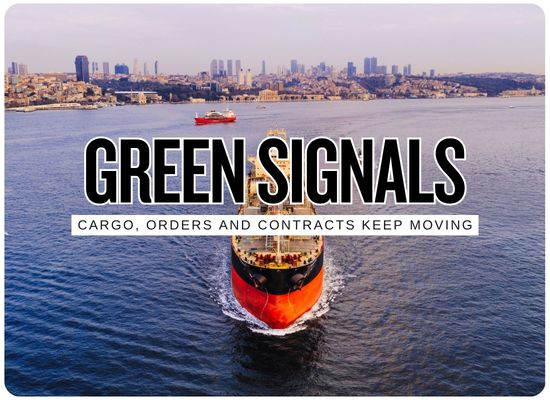
Shipping markets are still flashing multiple positive financial signals even with Hormuz risk, Red Sea disruption, and geopolitical uncertainty in the background. The latest Port of Los Angeles volume shows U.S. import demand remains strong, with July reaching 960,464 TEUs and another large August expected. At the same time, global ship ordering is accelerating at the fastest pace since the pre-2008 boom, Sinokor’s massive tanker accumulation has been rewarded by war-driven tanker demand, NBOSCO’s feeder order points to continued investment in regional container networks, Nigeria’s removal from U.S. extra port-security requirements reduces a compliance friction point for West Africa-linked trades, and fresh offshore service contracts show energy project spending still moving.
Ship Universe Market Pulse
Operator Impact Snapshot
Several maritime money signals are still positive despite active route risk.
U.S. import flow remains strong
Los Angeles posted its second-highest July volume, helped by consumer goods, manufacturing cargo, and data-center related equipment.
Ship ordering is accelerating
The global orderbook is expanding at a pace last seen before the 2008 financial crisis, a clear signal that owners still see value in future tonnage.
Tanker asset plays are being rewarded
Sinokor’s aggressive VLCC accumulation looks better in a market where Hormuz risk has pushed up demand for available crude tanker capacity.
Feeder investment keeps moving
NBOSCO’s feeder newbuilding activity shows regional container capacity remains investable, especially around China-linked shortsea networks.
Risk friction is easing in one lane
Nigeria’s removal from extra U.S. port-security requirements reduces one compliance burden for ships trading between Nigerian ports and the United States.
Hormuz still caps confidence
The positive signals are real, but owners, insurers, charterers, and banks still have to price war-risk, rerouting, crew safety, and schedule disruption.
Money Signal Board
Cargo, Capital, Tankers, Feeders, Compliance and Offshore Work
The bullish data points are coming from different parts of shipping, not one isolated trade.
Second-highest July volume, including 499,552 TEUs of imports.
Year-over-year growth in gross tonnage terms, the fastest pace since the pre-Lehman boom.
Clarksons-counted merchant ship orderbook total, equal to 405.9 million gross tons.
| Signal | Latest Figure | Money Reading | Remaining Limit | Strength Meter |
|---|---|---|---|---|
| Los Angeles VolumeU.S. import demand | 960,464 TEUs in July, including 499,552 import TEUs. | Retail, manufacturing, grid equipment and data-center cargo are still feeding the container system. | The current pace may moderate later as front-loaded cargo fades. | High |
| Shipbuilding OrderbookOwner capital cycle | 9,012 ships and 405.9m gt on order, up 27% year over year. | Owners are still committing serious capital to future capacity, renewal and fuel flexibility. | The risk is over-ordering if freight markets cool before deliveries arrive. | High |
| Sinokor TankersVLCC capacity bet | The market has described the buying spree as a roughly $6B-plus to $7B tanker bet. | The strategy gained value as Hormuz disruption increased the price of executable tanker capacity. | Tanker strength remains exposed to war-risk, sanctions screening, vessel history and crude-flow normalization. | High |
| NBOSCO FeedersRegional container renewal | Fresh feeder ordering includes a reported $123M newbuilding quartet and earlier four 1,900 TEU firm ships with options. | Regional container trades are attracting capital even while mainline networks face disruption. | Feeder profitability depends on intra-Asia demand, port rotation density and final delivery timing. | Medium High |
| Nigeria Security ReliefU.S. port-entry compliance | Nigeria was removed from extra U.S. port-security requirements after 12 years. | This reduces a procedural burden for operators with Nigerian port calls before U.S. arrivals. | Other commercial and security risk factors around West Africa still need separate treatment. | Medium |
| Offshore ServicesEnergy project demand | Recent signals include DOF APAC awards, L&T’s large Middle East offshore order and GRSE’s ONGC PSV contract. | Subsea, construction, PSV, engineering, installation and support-vessel demand are still generating fresh backlog. | Margins depend on vessel availability, project execution risk, labor, steel, finance cost and regional energy spending. | High |
Shipping Money Signal Scorecard
Balance port volume, ship ordering, tanker upside, feeder investment, compliance relief and offshore backlog against Hormuz risk.
Demand Strength
96%
Port-volume strength compared with a 1 million TEU benchmark.
Capital Deployment
$8.8B
Modeled tanker, feeder and offshore capital or contract value entered above.
Risk-Adjusted Score
67%
Positive market strength after subtracting Hormuz and war-risk pressure.
Green-to-Red Spread
+18 pts
Difference between positive money signals and risk pressure.
Market Signal
The model shows positive money signals that still outrun the risk drag, but Hormuz pressure is high enough to keep pricing volatile.
We welcome your feedback, suggestions, corrections, and ideas for enhancements.
Please click here to get in touch