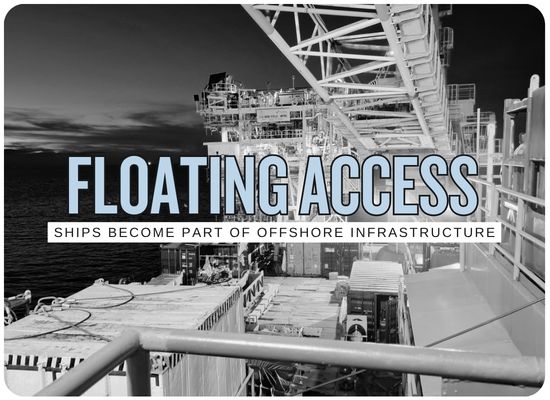
The Offshore Ship Is Becoming Part of the Platform
Motion-compensated gangways are no longer isolated pieces of deck
equipment. On the newest offshore service vessels they sit inside a
system of dynamic positioning, accommodation, elevators, warehouses,
cranes and emergency access that can turn the ship itself into part of
the offshore facility.
$10M modeled mission package€50K–€75K/day premium CSOV market120 POB on IWS SkywalkerOctober 6, 2026
Model basis: $10 million is a ShipUniverse scenario for a complete
installed access-and-cargo mission package. It is not a disclosed
industry-standard vendor price.
The floating access platform
Vessel
Hotel + DP + Workshop
People live here, cargo is staged here, and the vessel holds
position beside the asset.
compensated access
Offshore asset
Turbine / Platform / FPSO
Personnel and cargo arrive continuously without conventional
crew-transfer logistics.
Offshore support vessels used to deliver people and equipment, then move
away. Walk-to-work changes that relationship. The vessel can remain on
dynamic positioning beside the installation while technicians live
onboard, move through an elevator and access tower, cross a compensated
bridge and return repeatedly throughout the campaign.
Cargo follows a parallel path. Tools and spares are stored aboard the
vessel, staged close to the access system and transferred by a
motion-compensated crane. The vessel becomes hotel, warehouse, workshop,
logistics hub and personnel bridge in one asset.
The commercial question is therefore no longer the price of a gangway.
It is whether an owner should invest in an integrated mission system that
allows an existing or new vessel to sell offshore access as a service.
Today's market signal
IWS has ordered four more ships, and the access package is coming with them
October 6, 2026
MacGregor wins repeat Skywalker crane-and-gangway order
Additional CSOVs
4
Additional IWS Skywalker-class vessels.
Firm vessel order
~$301M
Approximate total yard price for the four ships.
Delivery
2029–30
Fixed-price turnkey newbuild program.
The repeat order matters more than the first installation.
IWS is extending the same general access-and-cargo architecture into a
larger fleet after operating the first Skywalker vessels. The mission
package is becoming part of the vessel concept rather than an optional extra.
What $10 million represents
The modeled package is much more than a bridge
ShipUniverse modeled allocation. These are scenario assumptions, not
vendor quotations.
Installed scenario
$10M
Complete offshore-access mission system
The model combines the access hardware with the structural,
electrical, control, certification and commissioning work needed to
turn equipment into an operable vessel capability.
Gangway + access tower / elevator
$4.5M
3D motion-compensated crane
$2.1M
Foundations + deck reinforcement
$0.9M
Power + control + DP interfaces
$0.8M
Engineering + class + training
$0.9M
Commissioning contingency
$0.8M
This should not be confused with a complete CSOV conversion.
Hornbeck's HOSMAX 280 conversion into a dual-purpose C/SOV and flotel
was estimated at $96 million. A full conversion can involve
accommodation, lifesaving systems, electrical work, vessel
modifications and other systems far beyond the access package itself.
Why "floating access platform"
Six vessel systems now combine into one offshore operating function
Function 1
Station keeping
DP replaces the fixed foundation
Thrusters and control systems keep the vessel inside the position
envelope required for the gangway to remain connected.
Function 2
Accommodation
Technicians live at the worksite
Modern CSOVs can carry large technician complements, allowing the
work force to remain offshore instead of commuting from port every day.
Function 3
Logistics
Warehouse and deck become the field store
Parts, tools and consumables stay beside the technicians instead of
requiring a separate daily supply chain from shore.
Function 4
Personnel access
Motion compensation creates the moving bridge
Active compensation counters vessel movement while the offshore
structure remains inside the gangway's operating envelope.
Function 5
Cargo access
A compensated crane moves the work package too
The commercial advantage increases when people and equipment can
cross the vessel-to-installation gap from the same base.
Function 6
Emergency egress
In some applications the connection is part of the escape system
Aker BP's Munin and Fenris operating concept keeps the W2W
connection available while personnel are on unmanned installations.
The strongest example
Aker BP designed the platform around the vessel
Olympic Notos / Yggdrasil
The ship supplies functions that Munin deliberately does not have
Firm vessel contract
5 years
Plus options for another five years.
Munin living quarters
None
Offshore personnel live on the W2W vessel.
Munin helideck
None
Planned campaigns rely on the vessel-access model.
Primary escape route
W2W
Gangway remains connected while personnel are onboard.
This is the architectural shift.
The platform no longer needs to duplicate every human-support function
offshore because some of those functions can remain mobile on the vessel.
The charter market
Owners are being paid for access capability, not just hull and horsepower
Premium European CSOV rate
€50K–€75K/day
Typical Q2 2026 charter range reported by CMB.TECH.
Windcat Q2 CSOV TCE
$64,451/day
Reported average for the quarter.
Normand Valiant contract
$62M
Two-year Petrobras W2W accommodation contract.
Simple contract-day equivalent
~$84.9K/day
ShipUniverse calculation of $62M divided by 730 firm days.
The rate is not the value of the gangway alone.
Charterers are buying a complete offshore service capability including
vessel availability, crew, accommodation, DP performance, access,
logistics and mission equipment.
The engineering envelope
A retrofit succeeds only if the vessel and gangway work as one system
Safeway reach
18–28 m
IWS height range
10–32 m
Safeway elevation
10 m
Gangway rating alone does not determine vessel uptime.
DNV's workability approach combines hull motion, DP station keeping,
waves, wind, current, gangway geometry, receiving-platform height and
operational safety limits. A high-spec gangway on a poor motion
platform can still produce poor access availability.
Retrofit versus purpose-built
The mission system has to fit the hull that carries it
Representative walk-to-work design references
Published examples, not direct product-equivalence comparisons
Characteristic
Safeway Seagull retrofit reference
IWS Skywalker purpose-built CSOV
Why it matters
Reference vessel
Generic 75 m PSV
90 m CSOV
Hull motion drives gangway workability
Gangway envelope
18–28 m boom reach
10–32 m access height
Determines which structures can be reached
System weight
~90 t excluding HPU
Integrated at newbuild stage
Structural and stability consequence
Deck footprint
~5 × 6 m
Purpose-designed mission layout
Real installation needs access and exclusion zones too
Power
~260 kW installed HPU
Integrated electric architecture
Power generation and redundancy must be checked
Accommodation
Depends on donor PSV
120 persons onboard
POB can become the real commercial constraint
Storage
Existing vessel dependent
400 m² open + ~400 m² sheltered
Access value rises when the ship also carries the work package
The next expansion
Walk-to-work no longer requires a fixed platform
DNV-certified floating-to-floating capability
A moving vessel can now maintain compensated access to another moving vessel
MacGregor's Horizon floating-to-floating configuration uses LiDAR-based
relative-motion tracking to feed the compensation system while both
assets move independently. The capability extends the floating-access
concept toward FPSOs, floating rigs, offshore service fleets and
floating wind.
Position reference
LiDAR
Certification
DNV-ST-0358
Upgrade path
Retrofit capable
The buyer base is widening
The U.S. government is now procuring vessels as offshore inspection bases
Required positioning
DP2
Minimum capability in the federal Atlantic inspection requirement.
Continuous-charter capability sought in the earlier market research.
Access guidance
IMCA M254
Revision 1 or equivalent specified in the requirement.
Mission-critical equipment
Once people depend on the gangway, control logic becomes a safety system
Vessel motion
DP footprint and vessel response must remain inside the gangway's
compensation envelope throughout personnel transfer.
Hydraulics / drive
Actuator behavior, friction and mechanical response can alter the
motion-control assumptions built into software.
Software logic
IMCA has documented incidents involving uncontrolled gangway motion
and a separate retraction problem associated with control logic.
Emergency release
The system has to handle loss of position, connection limits,
emergency stop behavior and safe disconnection without trapping personnel.
This is why $10 million of equipment cannot be judged by hardware cost alone.
The commercial asset is the verified operating envelope of the complete
vessel-access system, including what happens after a failure.
Which ships should be converted
The best donor vessel is already close to being an access platform
Strong candidate
DP2 vessel with good station keeping, favorable hull motions,
substantial accommodation, usable deck area, structural margin,
electrical capacity and a commercial path to repeat W2W campaigns.
Marginal
Adequate DP but limited accommodation, weak cargo flow, major
foundation work, restricted landing-height coverage or significant
downtime required for conversion.
Poor candidate
Poor motion response, insufficient redundancy or power, inadequate
lifesaving capacity, limited deck structure, or no realistic
long-duration charter market to recover the investment.
Research anchors
Data behind the floating-access model
MacGregor / IWS, October 6, 2026
Repeat order for Horizon gangways and 3D motion-compensated cranes
on four additional Skywalker-class CSOVs.
IWS Fleet / MarineLink, October 1, 2026
Four new Skywalker-class vessels at approximately $301 million total,
with 2029–2030 deliveries.
Integrated Wind Solutions
90 m Skywalker design, 120 POB, 10–32 m access range, open and
sheltered storage, daughter craft and hybrid-power architecture.
CMB.TECH Q2 2026
€50,000–€75,000/day premium European CSOV charter range,
$64,451/day Windcat Q2 TCE and increasing oil-and-gas W2W adoption.
Aker BP / Olympic Notos
Five-year W2W contract plus five-year option; unmanned Munin design;
W2W used as the primary escape route while personnel are aboard.
Safeway Seagull
Generic 75 m PSV retrofit reference, 18–28 m reach, 10 m vertical
stroke, approximately 90 t system weight and 5 × 6 m footprint.
DNV
W2W operability analysis combining station keeping, vessel motion,
environment, gangway limitations, receiving-structure geometry and HSE limits.
MacGregor floating-to-floating certification
DNV-certified personnel transfer between independently moving
offshore vessels using LiDAR-based relative-motion tracking.
Solstad, August 2026
Normand Valiant two-year Petrobras W2W accommodation contract with
approximately $62 million gross value.
U.S. DOI / BSEE Draft RFP, September 2026
Current federal procurement work for DP2 W2W vessel support of
Atlantic offshore facility inspections.
IMCA M254 Revision 1
Updated W2W guidance covering vessel and gangway selection,
competence, operational planning, maintenance and emergency preparedness.
Hornbeck Offshore SEC filing
$96 million HOSMAX 280 C/SOV-flotel conversion, illustrating how
total-vessel conversion cost can substantially exceed mission-package cost.
Interactive owner model
Floating Access Platform Economics Tool
Test whether an integrated W2W package creates enough incremental
commercial contribution to recover its capital and support costs.
The model deliberately uses incremental contribution rather than the
vessel's full charter rate.
Commercial case
$10.0M
220 days
$30K/day
$800K
Annual break-even activity
The base case clears the modeled ownership hurdle
At the selected incremental contribution, the package needs fewer
active W2W days than the assumed annual utilization.
91 days/yr
modeled break-even activity
Break-even days at different incremental contribution levels
$20K/day
136 days
$30K/day
91 days
$50K/day
54 days
Annualized capital cost
$1.92M
Capital recovery over the selected economic life.
Annual ownership hurdle
$2.72M
Annualized capital plus selected support cost.
Gross annual W2W contribution
$6.60M
Active W2W days multiplied by incremental contribution.
Annual surplus after hurdle
$3.88M
Contribution remaining after annualized ownership cost.
Simple CAPEX payback
1.72 yrs
Initial investment divided by contribution less annual package OPEX.
Modeled project NPV
$20.78M
Includes selected annual contribution and residual value.
Ownership hurdle per active W2W day
$12.4K
Annual ownership hurdle divided by selected active days.
Package vs reference vessel value
13.3%
Installed package cost divided by the selected vessel value.
The model does not assume that published CSOV charter rates are created
entirely by the W2W package. Incremental contribution is deliberately
user-defined because the value attributable to access capability depends
on the donor vessel, charter structure, accommodation, crane package,
region and competing employment. The $10 million default is a
ShipUniverse scenario, not a vendor quotation. Taxes, financing fees,
off-hire risk, future major overhauls and vessel-wide conversion costs
are excluded.