OPEC Warns Shipping and Insurance Now Consume More Than One-Third of Energy Cargo Value
🔔 Subscribe to ShipUniverse Weekly →
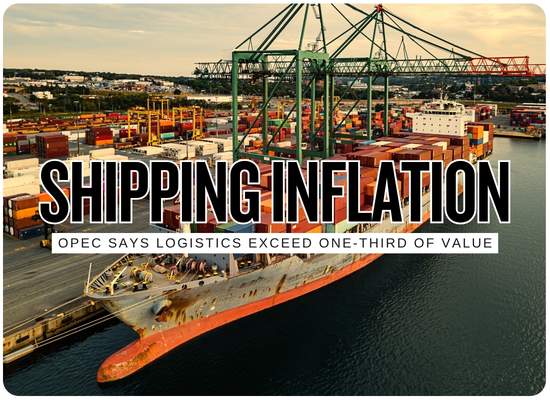
OPEC and non-OPEC ministers meeting in Riyadh on October 12 warned that disruption to maritime energy flows has pushed combined shipping and insurance costs to “more than one third of the commodity value”, an unprecedented level that is obstructing the movement of crude oil and petroleum products. The ministers said those costs are being transmitted across the oil value chain, increasing the burden on both producing and consuming countries, adding inflationary pressure and weighing on global economic growth. The warning comes as tanker scarcity, Hormuz security risks, Gulf of Oman shuttle operations and longer Atlantic-to-Asia voyages have pushed some crude transport costs from a few dollars per barrel before the crisis to $25, $30 and even $40 per barrel. OPEC did not publish a route-by-route methodology behind its one-third figure, so it should be treated as a ministerial assessment of extreme current trades rather than a weighted average for all global oil movements.
Maritime Logistics Has Become Part of the Energy Price
OPEC and non-OPEC ministers are no longer describing shipping disruption as a secondary transport problem. They say freight and insurance have reached levels large enough to obstruct oil flows, raise inflation and damage global economic growth.
Shuttle voyages, STS transfers, rerouting and longer distances reduce effective vessel availability.
Scarce tanker capacity forces charterers to pay extraordinary voyage and daily rates.
War-risk and security exposure are added to already elevated transport economics.
Freight becomes a major component of the delivered barrel instead of a minor logistics charge.
Refiners, manufacturers, trucking, aviation and consumers absorb higher fuel and input costs.
The Maritime Cost Shock Is Repricing the Oil Market
High tanker costs are now changing which barrels can economically reach which refineries. The result is regional gluts, regional shortages and a logistics premium that can survive even when physical crude supply improves.
| Market Signal | Current Reading | Earlier / Normal Reference | What Changed | Market Consequence | Macroeconomic Transmission |
|---|---|---|---|---|---|
| OPEC Shipping + Insurance | UNPRECEDENTED >1/3 Commodity Value | OPEC did not provide a historical percentage benchmark in its October 12 statement. | Maritime-route interruptions have pushed transport and insurance into a major part of delivered energy economics. | OPEC says crude and product movement is becoming less timely and less efficient. | Costs are transmitted through producers, refiners, consumers and energy-intensive industries. |
| Middle East → Asia VLCC | RECORD RANGE >$1.2M/day | Roughly $30,000/day in January. | Gulf shuttle demand, security exposure and longer vessel employment reduced effective VLCC supply. | Freight rose from a minor component to roughly 27% of delivered barrel value on some current trades. | Higher crude landed cost supports higher refinery feedstock costs and ultimately fuel prices. |
| U.S. Gulf → Asia | FREIGHT SQUEEZE ~$40/bbl | Approximately $10M–$15M per voyage near the beginning of 2026. | Recent supertanker cost exceeded $80M per voyage as global vessel availability tightened. | Cheap Atlantic Basin crude can become uneconomic for Asian buyers even when the crude itself is discounted. | Refiners lose access to lower-cost feedstock and must compete for barrels closer to home. |
| Black Sea → India Urals | NEW RECORD $27M–$30M | About $19M in September. | Suezmax freight surged again in early October amid Black Sea risk and global tanker scarcity. | Reuters calculations put Russian crude transport costs to Asia around $30/bbl or more. | Producers retain less of high benchmark prices while buyers still face elevated landed costs. |
| Americas Heavy Crude | STRANDED BARRELS Regional Glut | Heavy crude normally moves toward diesel-oriented refineries in Asia, Europe and the U.S. | High freight has made long-haul exports uneconomic even as Asian and European refiners seek heavy barrels. | Canadian, Colombian and Ecuadorian heavy grades have fallen more than $10/bbl despite strong global fuel demand. | Logistics creates simultaneous oversupply in one region and scarcity in another. |
| Global Economy | INFLATION CHANNEL OPEC Warning | Freight historically represented a comparatively small component of delivered energy cost. | The cost shock now affects the energy value chain rather than only shipowners and charterers. | OPEC says producing and consuming countries are carrying the burden simultaneously. | Ministers explicitly warn of added inflationary pressure and weaker global economic growth. |
Higher freight can reduce the netback received for a barrel even when benchmark crude prices are high.
Plants can lose access to economically attractive crude grades because transportation destroys the arbitrage.
Higher landed crude and product costs feed through to diesel, gasoline, aviation fuel and freight-intensive goods.
Persistent transport-driven energy inflation complicates efforts to bring headline and business input costs lower.
Shipping & Insurance Burden Analyzer
Model how freight and war-risk insurance change the delivered economics of an energy cargo, and compare the result with OPEC's one-third logistics warning.
We welcome your feedback, suggestions, corrections, and ideas for enhancements.
Please click here to get in touch