How Much Longer Can Merchant Shipping Operate Through Hormuz Before the Risk Model Breaks?
🔔 Subscribe to ShipUniverse Weekly →
The Point Where Hormuz Freight Can No Longer Buy Another Voyage
Merchant shipping has already demonstrated that extraordinary risk does not automatically stop trade. Tankers have continued through Hormuz while ships were being hit, crews were being injured and insurers were charging premiums that would once have been economically unthinkable.
That resilience can be misleading. The system is no longer relying on a normal voyage from loading terminal to buyer. It depends on military awareness, carefully managed transits, dedicated shuttle tankers, enormous war-risk premiums, high crew compensation and offshore cargo transfers outside the Strait.
Each adaptation keeps barrels moving but consumes additional people, capital and vessel-days. That means Hormuz can remain physically navigable while its commercial carrying capacity continues to deteriorate.
Commercial shipping is operating through conditions that would normally stop a voyage
Hormuz breaks commercially when one of six gates refuses the next voyage
The ship cannot sail without a willing and qualified crew
Higher wages can increase willingness only up to a point. Deaths, injuries, family pressure, fatigue and repeated exposure can remove crew availability even if freight remains profitable.
Expensive cover is survivable; unavailable cover is different
War-risk premiums can be absorbed when freight is exceptional. Commercial continuity becomes much harder if underwriters withdraw, exclude particular vessel profiles or demand terms the owner cannot accept.
Record rates currently subsidize the danger
The same shortage that makes the voyage hazardous also produces enormous earnings. If freight falls before the risk cost falls, the transit can become commercially unattractive very quickly.
A successful Hormuz crossing still needs somewhere to hand off the cargo
Shuttle tankers depend on tugs, hoses, fenders, crews, anchorage space and mother ships around Fujairah and Sohar. Moving the transfer farther away consumes more VLCC-days.
A non-fatal strike can still remove weeks of useful vessel capacity
Hull damage, a blackout, engine-room damage or fire can create survey, repair, deviation and off-hire exposure without producing a total loss.
Owners may eventually have the contractual ability to say no
BIMCO war-risk clauses can permit refusal of employment that would expose vessel, cargo or crew to defined war risks, depending on the actual charter wording and circumstances.
Crew compensation now looks less like a wage premium and more like hazard pricing
The market is paying directly for willingness to enter the risk zone
At today's tanker rates, the Strait can consume more than $20 per barrel before the cargo reaches its buyer
Vessel time plus high-end war-risk insurance
At $1.6 million a day, even a survivable casualty carries enormous time value
Vessel-time exposure before repair cost
A ten-day interruption at a $1.6 million daily market rate represents $16 million of gross vessel-time exposure. The figure does not include physical repair, survey, deviation, salvage, cargo delay or deductible costs.
Every mile the transfer moves away from Hormuz requires more ships to move the same oil
Tracked traffic is falling without a formal closure
The Strait can remain geographically open while vessel participation collapses
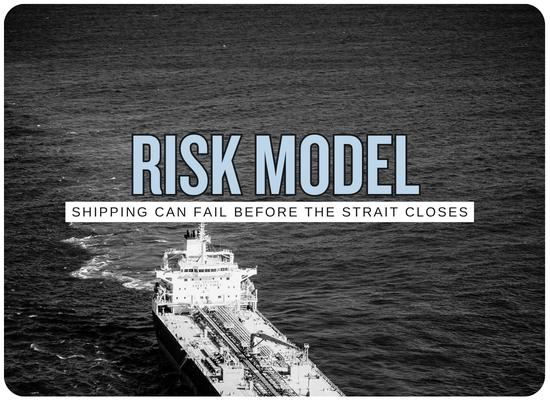
The risk model can fail six different ways without the Strait ever being declared closed
| Constraint | Still operating | Stress signal | Break condition | Current direction |
|---|---|---|---|---|
| Crew | Hazard pay attracts personnel | Multiples of normal pay required | Qualified crews refuse or cannot be sourced | Severe |
| Insurance | Cover available at high premium | Seven-figure / eight-figure premiums | Cover unavailable or commercially unacceptable | Severe |
| Freight | Exceptional rate pays extraordinary costs | Freight alters crude economics | Voyage cost exceeds cargo / charter margin | Stretched |
| STS | Shuttles hand cargo outside Strait | Fujairah / Sohar near practical limit | No transfer slot or enough shuttle tonnage | Constrained |
| Damage | Individual ships repaired or replaced | Fire, blackout and engine-room damage | Lost vessel-days exceed replacement inflow | Escalating |
| Contract | Risk allocated between owner and charterer | War clauses and disputes invoked | Owner legally refuses employment | Case specific |
The system does not need to collapse everywhere at once
Risk can still be priced
Owners find crews, insurers quote cover, cargoes find ships and STS infrastructure retains spare capacity.
Only certain ships and cargoes still make economic sense
National fleets, older vessels, specialist owners and cargoes with unusually high margins continue while mainstream tonnage withdraws.
Traffic falls despite no formal closure
Crew, insurance, STS and freight constraints reduce the number of commercially executable voyages below available cargo demand.
Another dollar of freight cannot buy another reliable transit
The binding constraint becomes physical, human or insurance capacity rather than price. At that point the market cannot clear simply by offering a higher day rate.
Data behind the Hormuz risk model
Hormuz Risk Model Breakpoint Tool
Estimate how much economic and tanker-capacity headroom remains before an additional delay or casualty pushes a selected Hormuz shuttle voyage beyond its commercial tolerance.
We welcome your feedback, suggestions, corrections, and ideas for enhancements.
Please click here to get in touch