Saronic vs Anduril: Software Defined Naval Shipyards Become the Next Arms Race
🔔 Subscribe to ShipUniverse Weekly →
I think the Saronic versus Anduril story is really a contest over the future factory model, because autonomous warships will need shipyards that behave more like software-defined production systems than traditional waterfront job shops.
The new naval shipyard is becoming a software stack
Saronic and Anduril are attacking naval manufacturing from different starting points. Saronic is building around autonomous surface vessels and a greenfield Port Alpha concept in Brownsville. Anduril is bringing its broader autonomy manufacturing model into maritime production through undersea systems, surface-vessel partnerships, a Seattle assembly and integration hub, and potential investment at the historic Sparrows Point industrial site near Baltimore.
The comparison matters because the Navy’s future fleet is expected to include more unmanned platforms, more modular payloads, more distributed production, and more software-defined capability. A traditional shipyard can still win hull work, but the highest-value industrial question is shifting: which yard can control design data, robotics, modular construction, production software, payload configuration, quality evidence, and workforce training as one connected system?
The shipyard of 2035 may not be won by the biggest basin alone. It may be won by the yard that connects design, robotics, modules, software baselines, test data, suppliers, workforce training, and autonomy integration into one production architecture.
Saronic and Anduril signal board
Greenfield scale at Port Alpha
Saronic’s Port Alpha plan is the clean-sheet model: a multibillion-dollar Brownsville shipyard built for software-defined shipbuilding, autonomous maritime systems, large waterfront scale, advanced manufacturing, and high-volume jobs across welding, machining, robotics, software engineering, and naval architecture.
Software factory logic moves into maritime
Anduril brings an ArsenalOS manufacturing philosophy, autonomy software, tactical compute, undersea vehicles, autonomous surface vessel partnerships, a Seattle low-rate vessel hub, and possible Baltimore-area expansion into legacy industrial waterfront capacity.
Distributed production becomes official strategy
The Navy’s latest shipbuilding language points toward modular digital designs, more distributed production across yards and suppliers, and unmanned systems that can be produced at volume and adapted in real time.
The bottleneck shifts from hulls to production systems
Robotic welding, automated material flow, software configuration, digital twins, inspection evidence, additive manufacturing, and workforce training all become investable markets because they decide whether unmanned vessels can scale.
Saronic versus Anduril comparison map
This is not a simple winner-take-all comparison. Saronic’s model looks more like a purpose-built autonomous shipyard. Anduril’s model looks more like a defense software and autonomy manufacturer extending into maritime platforms through facilities, partners, and production software.
| Category | Saronic angle | Anduril angle | 2035 investment read |
|---|---|---|---|
| Facility strategy | Port Alpha greenfield shipyard in Brownsville, plus existing Louisiana production and testing expansion | Seattle low-rate ASV hub, undersea production base, Arsenal-1 manufacturing logic, possible Sparrows Point USV site | Greenfield scale versus networked reuse of legacy and high-tech factories |
| Manufacturing philosophy | Software-defined shipbuilding focused on autonomous maritime vessels | ArsenalOS-style software-defined manufacturing applied across autonomous systems | The yard operating system becomes a strategic asset |
| Robotics focus | Path Robotics welding partnership at Franklin shipyard and likely automation expansion at Port Alpha | Broader autonomous-system production model, with robotics and software tied to high-rate defense manufacturing | Robotic welding is only the first visible automation layer |
| Modularity | Autonomous vessels with modular payload capacity, including larger Marauder-class concepts | Containerized payload testing, AUV modularity, autonomous surface vessel partnerships | Standard payload zones may become more valuable than unique hull designs |
| Software baseline | Echelon command-and-control layer and autonomy stack tied to Saronic vessel family | Lattice, Lattice Mesh, Lattice SDK, ArsenalOS, and autonomy architecture across air, land, sea, and undersea systems | Shipyard production and mission software start to merge |
| Workforce | Large maritime workforce buildout, with welding, machining, robotics, software, and naval architecture jobs | Defense-tech manufacturing workforce plus maritime specialists, shipbuilders, software teams, autonomy engineers, and integration crews | The winning yard needs hybrid labor, not only classic ship trades |
| Risk profile | Massive greenfield execution, labor scale, waterfront buildout, supplier ramp, new yard commissioning | Maritime scale-up, vessel-production learning curve, facility conversion, Navy surface-vessel competition uncertainty | Both models depend on turning software speed into shipyard repeatability |
Saronic is currently more visibly tied to the Navy’s MUSV prototype lane, while Anduril’s reported Baltimore-area interest remains a potential investment, not a finalized shipyard project. The investment story is still useful because both companies point toward the same industrial shift: autonomous naval platforms need a new production model.
The software-defined shipyard stack
The most advanced yard is not just the one with robots. It is the yard that links design, build, test, payload configuration, and sustainment into one controlled data loop.
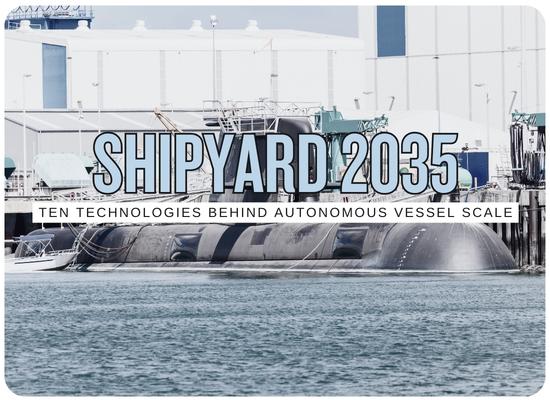
10 technologies behind the software-defined naval shipyard
These are the technologies that make the Saronic versus Anduril comparison useful as a “shipyard of 2035” investment report.
-
01
Robotic welding
AI welding cells that adapt to shipyard variation
Saronic signal
Saronic’s Path Robotics collaboration points directly at welding as the first automation wedge in autonomous-vessel production. The likely target is not replacing every welder, but using intelligent welding cells where repeated vessel families create enough pattern for automation.
Anduril signal
Anduril’s broader manufacturing model rewards designs that can move quickly from digital engineering into repeatable production. For maritime, that makes weld automation attractive if vessel geometry becomes standardized enough to support factory-style cells.
Investment market
AI welding software, robotic arms, weld-cell integrators, fixtures, scanning, seam tracking, weld QA, procedure qualification, and shipyard-safe robotics maintenance.
Hidden constraint
Robots do not fix unstable designs. Welding automation works best when modules repeat, tolerances are controlled, fit-up quality is predictable, and inspection evidence is accepted by the buyer.
-
02
Modular construction
Blocks, payload bays, and mission zones as factory products
Saronic signal
Port Alpha’s scale makes the most sense if vessel families can be built as repeatable modules: hull sections, machinery packages, payload decks, autonomy cabinets, sensor mounts, and mission spaces.
Anduril signal
Anduril’s ASV and undersea approach leans naturally toward modular autonomy, payload flexibility, and partner-built hull capacity. That makes interface discipline more important than owning every production step.
Investment market
Modular naval architecture, interface-control software, fixtures, transport-ready blocks, containerized mission payloads, standardized utility connections, and distributed module suppliers.
Hidden constraint
Distributed construction fails if interfaces drift. The module market is only valuable when power, cooling, data, structure, cyber, access, and test points are standardized early.
-
03
Configuration software
The vessel baseline becomes a controlled software product
Saronic signal
Saronic’s Echelon positioning suggests a vessel family controlled through a common command-and-control layer. In production terms, that creates pressure for every hull, payload, and software version to be tracked cleanly.
Anduril signal
Anduril’s ArsenalOS concept is explicitly built around linking modeling, simulation, design, testing, bills of material, work orders, production, and lifecycle data. That is the software-defined manufacturing model naval yards will study closely.
Investment market
Manufacturing execution systems, product lifecycle management, shipyard ERP, digital configuration control, cyber-secure software baselines, versioned payload integration, and audit trails.
Hidden constraint
A yard can build fast and still fail if the configuration record is messy. Autonomous vessels need clean traceability from hull hardware to mission software to payload version.
-
04
Digital twins
Virtual vessels that keep design, test, and sustainment connected
Saronic signal
A clean-sheet yard gives Saronic a chance to build digital twins into the facility from the beginning: vessel geometry, production flow, autonomy tests, utility loads, and support records.
Anduril signal
Anduril’s software-first manufacturing language points toward large-scale modeling, simulation, digital design, and verification before production ramps. Maritime twins could extend that logic into hull form, payload integration, autonomy behavior, and maintenance.
Investment market
Ship digital twins, yard digital twins, simulation environments, autonomy test data, virtual commissioning, predictive maintenance, lifecycle data models, and model-based systems engineering.
Hidden constraint
A digital twin that does not touch production is mostly a sales graphic. The valuable twin drives work packages, test plans, inspection records, and sustainment decisions.
-
05
Autonomous logistics
Materials move through the yard without constant human chasing
Saronic signal
Port Alpha’s acreage and planned scale make material movement a core design issue. Large autonomous-vessel output requires plates, modules, engines, batteries, sensors, payloads, cables, tools, and finished assemblies to arrive at the right cell on time.
Anduril signal
Anduril’s high-rate manufacturing philosophy depends on predictable flow. A converted waterfront site such as Sparrows Point would likely need smart logistics to turn legacy industrial acreage into a modern vessel factory.
Investment market
Autonomous forklifts, AGVs, RFID, yard traffic software, smart carts, crane scheduling, automated warehouses, material kitting, supplier portals, and digital laydown management.
Hidden constraint
Shipyards lose time in the space between workstations. Robotic welding is wasted if plate, brackets, pipe spools, cables, tools, and inspection staff arrive late.
-
06
Automated QA
Inspection evidence moves closer to the work
Saronic signal
High-volume autonomous-vessel production will need fast quality capture: weld scans, dimensional checks, coating records, cable tests, software baseline checks, and payload acceptance evidence.
Anduril signal
Anduril’s software-defined production model makes QA data part of the product record. That is especially important for defense systems where speed has to survive government acceptance, cyber review, and operational testing.
Investment market
Machine vision, laser scanning, automated weld inspection, metrology, NDT, digital QA records, acceptance dashboards, test benches, and AI-assisted defect triage.
Hidden constraint
AI inspection tools are only useful if buyers trust the evidence. The real moat is acceptance-grade data, not simply defect detection.
-
07
Additive manufacturing
Printed tools, fixtures, spares, and low-volume mission hardware
Saronic signal
A new yard can integrate additive manufacturing into prototype support, tooling, jigs, brackets, repair parts, cable guides, payload adapters, and low-volume mission-specific hardware without fighting old workflows.
Anduril signal
Anduril’s rapid design-to-production culture naturally favors additive manufacturing where it shortens iteration loops. For maritime systems, the strongest fit may be tooling, fixtures, autonomy-hardware mounts, undersea payload adapters, and fast spares.
Investment market
Metal AM, polymer AM, hybrid CNC-AM, powders, wire feedstock, reverse engineering, scanning, part libraries, test coupons, and certification workflows.
Hidden constraint
Additive manufacturing is not a substitute for approval. Naval parts still need material control, process qualification, inspection, configuration records, and safety review.
-
08
Payload integration
Containers, sensors, weapons, comms, and autonomy kits plug into the build
Saronic signal
Saronic’s large autonomous vessels emphasize modular payload capacity. That creates a yard requirement for payload bays, container interfaces, command links, power margins, cooling, and off-hull control integration.
Anduril signal
Anduril has described at-sea testing of autonomy, mission autonomy, and containerized payloads on surrogate vessels while working with shipbuilding partners. That makes payload integration a core maritime production lane.
Investment market
Containerized payloads, payload racks, power conversion, cooling skids, sensor masts, weapons modules, tactical communications, autonomy compute, interface-control documents, and payload test labs.
Hidden constraint
The payload is only modular if the interface is modular. Custom power, cooling, cyber, and control fixes on every hull destroy the production advantage.
-
09
Cyber manufacturing
Secure production data becomes part of the defense product
Saronic signal
A software-defined shipyard must protect vessel designs, autonomy code, payload interfaces, supplier data, factory telemetry, test records, and command-and-control baselines from the start.
Anduril signal
Anduril’s model is built around software-defined defense systems. As that model moves into maritime production, cyber control of the factory and the product become inseparable.
Investment market
OT cybersecurity, zero-trust factory networks, secure digital thread, SBOM management, classified production zones, supplier access controls, software signing, and cyber-accredited test labs.
Hidden constraint
The factory can become an attack surface. If production data or software baselines are compromised, the vulnerability may be built into every vessel that leaves the yard.
-
10
Workforce systems
Hybrid shipbuilders who can weld, code, inspect, and operate robots
Saronic signal
Port Alpha’s job mix points beyond traditional labor. Welding and machining still matter, but robotics technicians, software engineers, naval architects, advanced manufacturing planners, inspectors, and autonomy integration teams become part of the yard workforce.
Anduril signal
Anduril’s defense factory model also depends on a hybrid workforce. Maritime expansion adds shipwrights, waterfront trades, integration teams, testing crews, software operators, and supplier coordinators.
Investment market
Training platforms, AR work instructions, robotic welding academies, shipyard apprenticeships, digital QA training, software-in-production courses, safety certification, and workforce analytics.
Hidden constraint
The hardest shortage may not be welders alone. It may be people who understand shipbuilding, automation, naval quality, software configuration, and maritime operations at the same time.
Technology copy map for traditional yards
Legacy yards do not need to copy every startup behavior. They do need to copy the pieces that reduce rework, speed repeatable production, and make software-heavy vessels easier to update.
| Technology | Fastest practical pilot | Full 2035 version | Supplier opportunity |
|---|---|---|---|
| Robotic welding | Repeatable brackets, panels, skids, and small modules | AI welding cells linked to CAD, QA, and fixture libraries | Robotics integrators, welding software, fixtures, inspection tools |
| Modular construction | Standard payload bays and machinery skids | Distributed module network across multiple yards and suppliers | Naval architects, module fabricators, interface-control teams |
| Configuration software | Digital work orders and controlled build records | Single yard operating system for design, build, test, and sustainment | MES, PLM, ERP, digital thread, cyber-secure configuration tools |
| Digital twins | Production flow and vessel equipment twins | Live yard and fleet twin tied to maintenance and upgrades | Simulation firms, model-based engineering, lifecycle analytics |
| Autonomous logistics | RFID, kitting, smart carts, and material status dashboards | Automated warehouses, AGVs, crane scheduling, digital laydown control | Warehouse automation, yard logistics, AGVs, industrial IoT |
| Automated QA | Laser scans, weld records, coating checks, and test dashboards | Acceptance-grade inspection evidence generated during production | NDT, metrology, machine vision, AI defect review, QA software |
| Additive manufacturing | Tools, fixtures, brackets, adapters, and training parts | Certified metal spares and mission-specific payload hardware | Metal AM, powders, scanning, digital part libraries, qualification labs |
| Payload integration | Standard power, data, cooling, and structural interfaces | Mission containers swapped across manned and unmanned fleets | Payload integrators, power conversion, cooling, comms, autonomy compute |
| Cyber manufacturing | Supplier access control and software signing | Zero-trust factory with secured OT, digital thread, and product baselines | OT cyber, classified networks, SBOM, software assurance, secure PLM |
| Workforce systems | Digital work instructions and robotics upskilling | Hybrid shipyard academy for trades, software, QA, autonomy, and robotics | Training firms, AR tools, apprenticeship systems, skills analytics |
Investment heat gauge
The highest-pressure markets are the ones that turn unmanned-vessel production from a prototype race into a repeatable industrial system.
Three investment lanes to watch
The yard operating system lane
This lane includes manufacturing execution software, digital thread, PLM, ERP, configuration control, supplier portals, cyber baselines, and acceptance evidence.
- Strong fit for software firms that can handle defense audit trails and physical production at the same time.
- Best value comes from connecting design, production, QA, software baseline, and sustainment data.
- Main trap is building another dashboard that does not change shop-floor decisions.
The automated production-cell lane
This lane includes robotic welding, cutting, additive manufacturing, automated inspection, fixtures, material handling, and modular fabrication cells.
- Strong fit for vessels with repeated hull families, standard payload zones, and stable design baselines.
- Best value comes from reducing rework and increasing throughput, not replacing every trade worker.
- Main trap is buying automation before redesigning the work package around automation.
The payload and autonomy integration lane
This lane includes mission modules, containerized payloads, autonomy compute, secure comms, power and cooling kits, software test pipelines, and simulation labs.
- Strong fit for MUSVs, larger autonomous ships, undersea platforms, and hybrid manned-unmanned fleet operations.
- Best value comes from making mission upgrades faster than hull construction.
- Main trap is treating payloads as bolt-on equipment instead of production-system variables.
Red flags in shipyard of 2035 pitches
The phrase “software-defined shipyard” can hide weak execution. These checks separate real production advantage from marketing language.
| Red flag | Problem underneath | Investor check |
|---|---|---|
| Robotics without repeatable vessel geometry | Automation loses value if every hull, bracket, joint, or module keeps changing | Ask which work packages repeat enough to automate at scale |
| Digital twin disconnected from production | The model may be visually impressive but irrelevant to build rate | Confirm that the twin drives work orders, material, QA, and sustainment decisions |
| Software baseline separated from ship delivery | The hull may be finished before autonomy, payload, cyber, and control software are stable | Review software acceptance criteria alongside hull acceptance criteria |
| Greenfield site without workforce proof | A giant yard can stall if welders, machinists, software engineers, QA staff, and planners do not arrive | Look for training pipelines, wage strategy, apprenticeship depth, and local labor capacity |
| Legacy site reuse without process redesign | Old industrial acreage does not automatically become an advanced naval factory | Check material flow, utility capacity, robotics zones, security, and waterfront testing access |
| Supplier network outside the digital loop | Internal yard speed can be defeated by late, undocumented, or off-interface supplier parts | Demand supplier data integration, interface control, inspection evidence, and schedule visibility |
| Autonomy demo treated as production maturity | A vessel can perform well in testing but still be hard to build by the hundreds | Separate autonomy performance from production repeatability, QA, and sustainment readiness |
Shipyard of 2035 Investment Fit Meter
Use this quick tool to score whether a shipyard modernization concept looks like a real software-defined production opportunity or a technology demo wrapped around old workflows.
This tool is a practical screening aid, not investment advice. Real diligence should include classified requirements, customer commitments, Navy acceptance rules, facility permits, labor supply, union agreements, capital cost, waterfront access, cyber controls, safety rules, supplier contracts, and lifecycle economics.
Bottom line for shipyard investors
Saronic and Anduril are not just competing over unmanned vessels. They are pressuring the entire naval industrial base to rethink the shipyard as a software-defined production system. The core technologies are robotic welding, modular construction, digital configuration, digital twins, autonomous material handling, automated QA, additive manufacturing, payload integration, cyber-secure manufacturing, and hybrid workforce systems.
The yards that win by 2035 will not simply be the ones with the most waterfront. They will be the ones that turn software, robotics, modules, suppliers, inspection data, and trained labor into a repeatable production machine for autonomous naval platforms.
We welcome your feedback, suggestions, corrections, and ideas for enhancements.
Please click here to get in touch