Commercial Standards vs MIL-SPEC: 12 Systems Navies Could Buy Cheaper Without Sacrificing the Mission
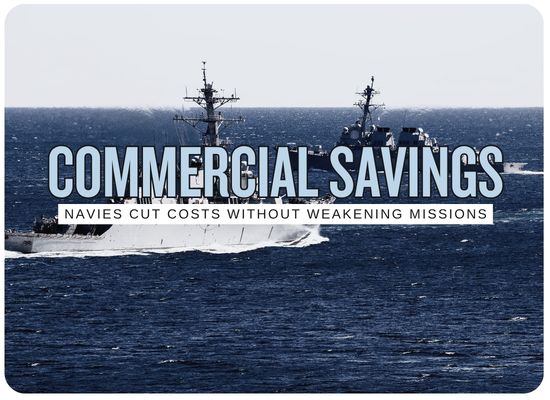
I think the most interesting part of commercial ship standards is not that they are cheaper, but that they force navies to decide which systems truly need warship-grade survivability and which ones simply need to work reliably at sea.
The cheaper system is not always the weaker system
The Navy’s Medium Landing Ship approach is a useful signal because it does not treat every onboard system as a one-off military invention. The program’s vessel-construction-manager model is built around commercial practices, a proven ship design, cost discipline, and faster delivery. That is a major shift for a service that has repeatedly struggled with design growth, late changes, cost overruns, and delayed ship deliveries.
The practical opportunity is not to commercialize the entire warship. The opportunity is to identify ship systems where commercial marine standards, class-approved equipment, and proven offshore or ferry-sector suppliers can meet the mission at lower cost. That saves military-grade spending for the places where shock, fragmentation, cyber, emissions, redundancy, damage control, weapons integration, and combat survivability actually change the requirement.
Procurement signal board
Commercial marine supply chains already exist
HVAC, pumps, doors, sewage systems, galleys, accommodations, cranes, lighting, navigation equipment, and many electrical components already have mature marine suppliers and class-approved pathways.
Standard equipment can reduce design churn
Commercial practices work best when buyers stop changing the design late and allow shipyards to purchase class-standard equipment in repeatable lots.
COTS does not mean careless
Commercial equipment still needs marine suitability, documentation, spares, training, corrosion resistance, cybersecurity review, installation quality, and shipboard maintenance access.
Survivability changes the economics
Shock, vibration, EMI, battle damage, fire boundaries, NBC protection, secure communications, magazine safety, and combat-system interfaces are where commercial shortcuts can create mission failure.
The buyer filter navies should use
Commercial standards work best when the system supports the ship but does not define the ship’s combat survival. The evaluation should start with mission consequence, not habit or tradition.
12 systems navies could buy cheaper without sacrificing the mission
These categories are strong candidates for commercial or commercial-plus procurement, especially on landing ships, auxiliaries, patrol ships, logistics vessels, support ships, training ships, and lower-end combatants.
- ❶ HVAC Commercial marine HVAC can handle most comfort and machinery-space needs Chillers, air handlers, fans, ducting, controls, dampers, filters, pumps, and refrigeration units can often come from commercial marine or offshore supply chains. The savings case is strongest in living spaces, workshops, stores, and non-critical equipment rooms. The naval add-ons are fire dampers, smoke control, shock mounts, EMI discipline, CBRN boundary logic, redundancy, and survivability zoning where the system supports combat operations.
- ❷ Pumps Standard marine pumps are attractive until damage-control duty begins Freshwater, chilled water, fuel transfer, lube oil, bilge, ballast, sewage, and service-water pumps are available from mature commercial suppliers. The cost trap is mission role. A comfort-cooling pump can be commercial. A firemain, dewatering, fuel, or damage-control pump may need naval shock, redundancy, separation, firefighting compatibility, manual operation, and proven performance after vibration or impact.
- ❸ Generators Commercial gensets can work when load profiles are honest Marine generator sets are widely available, supportable, and familiar to shipyards. Commercial practice can reduce cost on landing craft, patrol ships, auxiliaries, and support vessels if the electrical load is stable and the mission does not require combat-grade resilience. Military requirements change everything when the generator must support radars, communications, weapons, damage-control loads, low acoustic signature, shock survival, blackout recovery, or complex power quality.
- ❹ Galley Food-service equipment should not become a custom defense project Ovens, steamers, dishwashers, refrigeration, prep tables, sinks, garbage handling, and storage can often be bought from commercial marine or institutional suppliers. The military boundary is mostly safety and endurance: fire suppression, sanitation, corrosion resistance, spare parts, ship-motion restraint, electrical compatibility, and maintenance access. For most vessels, the galley should be rugged and marine-rated, not overdesigned like a combat sensor.
- ❺ Doors and hatches Commercial doors save money outside core damage-control boundaries Watertight doors, weather doors, internal doors, and accommodation doors have strong commercial marine supply chains. Commercial doors make sense in low-risk zones, non-critical compartments, and support spaces. MIL-SPEC requirements matter around fire zones, flooding boundaries, citadels, magazines, machinery spaces, CBRN protection, blast concerns, and any passage that must function after shock or battle damage.
- ❻ Navigation Commercial bridge electronics are strong for non-combat navigation ECDIS, radars, GPS, AIS, autopilot interfaces, voyage data recorders, gyrocompass support, speed logs, and weather routing tools are mature commercial markets. Navies can save money when the mission is safe navigation and bridge watchkeeping. The military shift happens when navigation must survive jamming, spoofing, cyber attack, emission control, combat-system integration, classified routing, degraded GPS, or weapons-quality positioning.
- ❼ Cranes Commercial deck handling gear fits many logistics missions Davits, knuckle-boom cranes, cargo cranes, stores cranes, RHIB launch systems, and vehicle ramps often have commercial or offshore equivalents. The savings case is strongest for cargo handling, ship’s boats, stores, and routine mission loads. The military boundary appears when the crane supports ammunition, unmanned systems, mine warfare, aviation, launch and recovery in higher sea states, shock survival, or rapid operations under threat.
- ❽ Communications Some comms can be commercial, but secure C2 cannot be casual Commercial satellite terminals, internal telephones, public-address systems, Wi-Fi-like maintenance networks, crew connectivity, and non-tactical data systems can lower cost. Secure combat communications are different. Encryption, emissions control, anti-jam links, classified networks, cyber accreditation, redundancy, battle-damage routing, and joint-force interoperability can turn a cheap communication system into an unacceptable risk.
- ❾ Sewage Marine sanitation systems are a clean commercial candidate Sewage treatment plants, vacuum toilets, greywater systems, holding tanks, macerators, odor control, and discharge controls are strong commercial marine categories. The naval additions are shock mounting, redundancy, corrosion control, repair access, spare parts, environmental compliance, and the ability to keep habitability functioning during extended deployment. This is a classic commercial-plus area rather than a full military custom build.
- ❿ Accommodations Habitability can borrow heavily from ferries and offshore vessels Bunks, lockers, modular cabins, mattresses, desks, seating, showers, laundry, flooring, insulation, and noise-control materials have a large commercial market. Navies can save money by avoiding custom furniture and one-off layouts. The military boundary is flame spread, smoke toxicity, restraint during shock, hygiene, crew survivability, rapid repair, and the ability to maintain morale on long deployments.
- ⓫ Lighting LED lighting and controls can be standardized quickly Commercial marine LED fixtures, emergency lights, dimmers, controls, navigation lights, and machinery-space lighting can reduce cost and simplify spares. The military boundary appears in darken-ship modes, shock, EMI, night-vision compatibility, emergency circuits, watertight zones, low-smoke materials, and damage-control routing. The best approach is commercial fixtures where possible with naval requirements only where mission consequence justifies them.
- ⓬ Stores and workshops Commercial outfitting can reduce one-off shipyard work Shelving, benches, tool storage, workshop machinery, lockers, modular stores, cargo racks, cold rooms, and spare-parts management systems can use commercial marine or industrial designs. This is an overlooked savings lane because small custom decisions multiply across compartments. Military treatment is needed when stores hold ammunition, classified equipment, hazardous materials, weapons spares, or mission-critical repair parts.
Commercial fit matrix
The strongest savings are in systems with broad marine markets, low combat consequence, and simple support chains. The weakest candidates are systems tied to damage control, secure command, weapons, shock survival, or classified mission data.
| System | Commercial savings potential | Commercial-plus requirement | MIL-SPEC boundary |
|---|---|---|---|
| HVAC | High | Marine-rated chillers, fans, controls, corrosion protection, spare parts | CBRN, smoke control, shock, combat-system cooling, survivability zoning |
| Pumps | High | Marine duty, corrosion resistance, service access, common spares | Firemain, dewatering, fuel safety, redundancy, shock, battle damage |
| Generators | Medium to high | Marine gensets, power quality, maintainability, fuel compatibility | Combat loads, low acoustic signature, blackout recovery, shock, EMI |
| Galley | Very high | Marine restraints, sanitation, fire suppression, corrosion protection | Damage-control boundaries, emergency feeding, fire-zone integration |
| Doors and hatches | Medium to high | Commercial marine watertight or weathertight construction | Fire boundaries, flooding boundaries, CBRN, magazines, blast, shock |
| Navigation | Medium | Class-approved bridge electronics, cybersecurity, spares, training | GPS-denied ops, classified routing, weapons-quality positioning, EMCON |
| Cranes | High | Marine/offshore cranes, sea-state ratings, load monitoring, maintainability | Ammunition, unmanned systems, aviation, shock, launch under threat |
| Communications | Selective | Commercial satcom, internal comms, crew networks, secure maintenance access | Encrypted C2, anti-jam, classified networks, battle-damage routing |
| Sewage | Very high | Marine sanitation plant, vacuum toilets, discharge compliance, spares | Shock, extended deployment redundancy, damage-control access |
| Accommodations | Very high | Marine furniture, modular cabins, low-maintenance materials | Flame spread, smoke toxicity, shock restraint, crew survival pathways |
| Lighting | High | Marine LEDs, emergency fixtures, waterproofing, common spares | Darken ship, EMI, night vision, emergency circuits, shock |
| Stores and workshops | High | Commercial outfitting, racks, benches, lockers, tool control | Ammunition, hazardous materials, classified spares, shock restraint |
Savings potential gauge
The closer a system is to habitability, routine marine operations, and commercial ship support, the stronger the commercial procurement case becomes.
Where military survivability changes everything
This is the boundary buyers should not blur. Some systems become expensive because they must keep working after events that commercial ships are not designed to fight through.
| Survivability factor | Commercial system risk | Military requirement that changes the answer |
|---|---|---|
| Shock | Equipment may detach, deform, leak, or fail after underwater explosive effects | Shock qualification, structural restraint, mounting design, post-shock function |
| Vibration | Commercial gear may wear faster or fail under shipboard machinery vibration | Vibration testing, mounting analysis, fatigue resistance, machinery compatibility |
| EMI and EMC | Electronics may interfere with sensors, comms, navigation, or combat systems | Emission and susceptibility limits, filtering, grounding, cable separation |
| Power quality | Standard equipment may not tolerate shipboard voltage, frequency, transients, or grounding practices | Shipboard power interface compliance, load studies, protection coordination |
| Fire and smoke | Materials may create toxic smoke, flame spread, or compartment damage | Low-smoke materials, fire-zone compliance, suppression integration |
| Flooding | Doors, cables, pumps, and penetrations may fail to preserve watertight integrity | Watertight boundaries, pressure ratings, compartment isolation, emergency access |
| Cyber | Commercial controls may introduce network vulnerabilities or remote-access risk | Cyber accreditation, secure configuration, patch control, network segmentation |
| Combat integration | A commercial component may not support mission data, weapons timing, or classified interfaces | Secure C2, fire-control links, EMCON, redundancy, battle-damage routing |
Three buying lanes for navies
Commercial standard lane
This lane uses class-approved, marine-rated, widely supported equipment with minimal customization.
- Best fit for galleys, sewage, accommodations, stores, workshops, basic lighting, and non-critical HVAC zones.
- Strongest benefit is lower price, faster supply, easier spares, and broader vendor competition.
- Main risk is over-customization after award.
Commercial-plus lane
This lane starts with commercial marine equipment, then adds selected naval protections.
- Best fit for pumps, cranes, doors, navigation, generators, and machinery controls.
- Strongest benefit is mission suitability without turning every component into a custom military system.
- Main risk is underestimating shock, EMI, cyber, fire, and damage-control requirements.
Full military lane
This lane keeps MIL-SPEC or equivalent naval requirements because failure threatens combat survival.
- Best fit for weapons, magazines, secure communications, combat systems, firemain, damage control, CBRN systems, and mission-critical power.
- Strongest benefit is survivability and operational trust.
- Main risk is applying this lane too broadly and making the entire ship unaffordable.
Red flags in commercial-standard shipbuilding claims
Commercial practices can reduce cost, but only when the buyer keeps discipline. The savings disappear when commercial systems are repeatedly modified until they become custom military equipment without the full survivability proof.
| Red flag | Problem underneath | Diligence question |
|---|---|---|
| Commercial label without marine proof | Equipment may be industrial or building-grade, not ship-grade | Is it class-approved, marine-rated, corrosion-resistant, and supported globally? |
| Late Navy changes to a proven design | Commercial savings vanish when standard spaces, interfaces, and suppliers are redesigned | Which requirements are frozen before construction? |
| No shock or EMI boundary map | Buyers may not know which commercial systems need naval testing | Which compartments and systems require shock, vibration, EMI, or power-interface compliance? |
| Cyber ignored in commercial controls | HVAC, pumps, navigation, cranes, and sewage controls can become network risks | Does the equipment have secure configuration, patch control, and network segmentation? |
| Maintenance access forgotten | Cheap equipment becomes expensive if crews cannot reach, remove, or repair it | Can maintainers replace the part at sea or in a forward port? |
| Spares split across too many vendors | Commercial variety can create logistics clutter | Is the program standardizing equipment families across the class? |
| Commercial-plus becomes custom anyway | The buyer pays for commercial speed but receives military customization delay | Are added requirements mission-critical or just inherited habit? |
Buyer scorecard for commercial vs MIL-SPEC decisions
- ❶ Mission consequence Start with failure impact If failure affects comfort, maintenance, or routine logistics, commercial standards may be enough. If failure affects survival, combat command, fire, flooding, weapons, or secure data, military requirements should stay.
- ❷ Market depth Buy where commercial suppliers already compete Strong commercial markets create price discipline, faster delivery, better spares, and less dependency on a single defense vendor.
- ❸ Class standardization Repeatability beats one-off optimization Savings increase when the navy locks standard equipment across hulls and stops customizing every compartment.
- ❹ Survivability map Draw the military boundary early Shock, vibration, EMI, power quality, fire, smoke, flooding, cyber, and battle-damage requirements should be mapped before suppliers quote.
- ❺ Supportability Cheap equipment must be easy to sustain A commercial system should have global parts, clear manuals, training, known service intervals, corrosion resistance, and simple removal paths.
- ❻ Requirement discipline The buyer must protect the design Commercial practices fail when requirements keep changing after the shipyard, vendor, and configuration baseline are already set.
Commercial vs MIL-SPEC Fit Checker
Use this quick tool to estimate whether an onboard system is a good commercial-standard candidate, a commercial-plus candidate, or a full military-spec candidate.
This tool is a practical screening aid, not procurement advice. Real decisions should include class rules, Navy specifications, shock and vibration data, EMI review, cyber assessment, power studies, damage-control zoning, logistics support, and mission-risk analysis.
Commercial standards can help navies buy certain ship systems cheaper, faster, and with broader supplier competition. The best candidates are systems with deep marine markets and lower combat consequence: galley, sewage, accommodations, stores, lighting, many HVAC zones, selected pumps, cranes, and non-tactical navigation or communications.
The boundary is survivability. When a system touches shock, vibration, EMI, fire, flooding, secure command, weapons, cyber, CBRN protection, magazines, or damage control, military requirements still earn their cost. The goal is not to replace MIL-SPEC with commercial practice everywhere. The goal is to stop using full military treatment where commercial marine equipment can already protect the mission.
We welcome your feedback, suggestions, corrections, and ideas for enhancements.
Please click here to get in touch