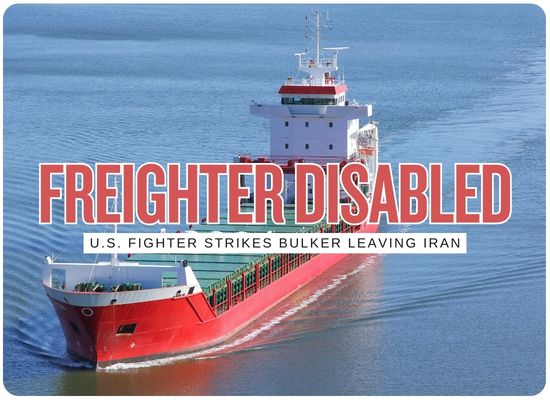
A U.S. military fighter jet struck the stern of the Panama-flagged bulk carrier Ocean Molica in the Gulf of Oman on October 10 after U.S. Central Command said the vessel ignored repeated warnings and attempted to violate the American naval blockade on traffic entering or leaving Iranian ports. CENTCOM said the precision munition disabled the ship's propulsion without injuring the crew and that the vessel had previously departed an Iranian port. Panama's maritime authority has opened a flag-state inquiry into the crew's condition and the structural state of the ship. Reuters said it was unable to immediately reach the vessel's operator for comment.
Gulf of Oman · October 10, 2026
Warning → Precision Strike → Propulsion Loss
CENTCOM says the commercial bulker had already departed an Iranian port, ignored repeated U.S. warnings and continued through regional waters before an American fighter struck the ship's stern.
1
Iranian Port Departure
CENTCOM has not publicly identified the Iranian port or disclosed the vessel's cargo in its statement.
→
2
Repeated Warnings
U.S. forces say the crew was instructed to comply with the blockade but continued its transit.
→
3
Fighter Strikes Stern
CENTCOM described the weapon only as a precision munition and did not identify the fighter type.
→
4
Propulsion Disabled
CENTCOM says propulsion was fully disabled and no crew members were injured.
Vessel
OCEAN MOLICA
A 1996-built Panama-flagged bulk carrier identified under IMO 9139270.
Deadweight70,296 DWT
Panamax-size bulk carrier.
Gross Tonnage36,559 GT
Published vessel-particular figure.
Length225 m
Beam is approximately 32 meters.
Built1996
Approximately 30 years old.
IMO9139270
Permanent vessel identifier.
FlagPanama
Flag state has opened inquiries.
Name discrepancy:
CENTCOM calls the vessel Ocean Molica and says it is also known as "Arika Sun." Industry databases associated with the same IMO number list the historical name as Akira Sun. The matching IMO, MMSI and call sign indicate the records concern the same ship.
Commercial Ships Disabled Since July 144
Current blockade phase, according to CENTCOM.
Ships Turned Around135
Vessels CENTCOM says complied with enforcement directions.
IRGC-Linked Tankers Destroyed10
CENTCOM's characterization of separate enforcement actions.
Crew Injured on Ocean Molica0
CENTCOM reports no injuries from the strike.
Blockade Enforcement Timeline
Ocean Molica Is an Escalation, but Not a New Precedent
U.S. forces have already used naval guns, aircraft cannon, Hellfire missiles and precision-guided munitions to stop merchant vessels that CENTCOM says refused blockade instructions.
Apr. 19
M/V Touska
USS Spruance fired several 5-inch rounds into the Iranian-flagged cargo ship's engine room after CENTCOM says the crew ignored warnings for six hours. U.S. Marines then boarded the vessel.
Naval Gun + Boarding
May 6
M/T Hasna
An F/A-18 Super Hornet fired its 20mm cannon at the unladen tanker's rudder after CENTCOM says it failed to comply.
Fighter Cannon
May 8
Sea Star III + Sevda
An F/A-18 from USS George H.W. Bush used precision munitions against the smokestacks of two unladen tankers heading toward an Iranian port.
Precision Air Strike
May 29
M/V Lian Star
CENTCOM says the crew received more than 20 warnings before a U.S. aircraft fired a Hellfire missile into the vessel's engine room.
Hellfire
Jul. 15
M/T Belma
During the renewed blockade, a U.S. aircraft fired Hellfire missiles into the unladen tanker’s smokestack as it headed toward Kharg Island.
Hellfire
Oct. 10
Ocean Molica
A fighter jet struck the stern of the Panama-flagged bulker with a precision munition after it had departed Iran and allegedly ignored repeated warnings.
Precision Air Strike
Important Correction
Kinetic Enforcement Started Months Ago
Ocean Molica is not the first commercial vessel deliberately disabled by U.S. forces. CENTCOM says nine non-compliant commercial vessels were disabled during the original April-June blockade period.
What Is Different Now
Foreign-Flagged General Cargo Is Still Exposed
The October action shows that direct kinetic enforcement is not limited to Iranian-flagged vessels or tankers. A Panama-flagged dry-bulk ship leaving Iran was also treated as subject to the blockade.
The Commercial Operating Environment Around Hormuz
Commodity Vessels · Oct. 67
Kpler count through Hormuz, the lowest daily figure since July 23.
Crude Through Hormuz10.1M bpd
Approximately 74% of pre-war volumes in the latest Reuters/Kpler snapshot.
Recent Attack Wave12+
Attacks, attempted attacks or harassment events recorded from September 28 through October 5.
Pre-War Oil Exposure~20%
Share of global oil consumption previously moving through Hormuz.
Ship Universe Gulf Diversion Cost Tool
Commercial Cost of Turning Away or Diverting
Estimate the additional voyage time, bunker consumption and vessel operating cost created when a commercial ship complies with a security instruction and diverts away from its original route.
NM
knots
MT/day
USD/MT
USD/day
Can represent charter hire, opportunity cost or another operator-defined daily vessel value.
days
Total Added Voyage Time
2.7 days
sailing deviation plus entered waiting or clearance time
Additional Fuel
75 MT
modeled fuel consumption during the added sailing and waiting period
Additional Vessel-Time Cost
$67K
total added voyage time multiplied by entered daily vessel cost
Total Modeled Diversion Cost
$116K
bunker plus vessel-time cost under the entered assumptions
Cost Per Extra Nautical Mile
$232
modeled total diversion cost divided by additional distance
Added Cost Mix
Diversion cost can remain material even when no physical damage occurs. The exposure comes from extra steaming, fuel, schedule disruption and vessel time.
Additional Voyage Time2.7 days
Bunker Cost$49K
Vessel-Time Cost$67K
Selected Scenario
Regional Diversion
The model is designed to quantify the commercial cost of complying with an instruction to turn away or reroute. It does not model attempts to evade military restrictions or recommend a navigation strategy in an active conflict zone.
Extra Distance500 NM
Speed12.5 kt
Fuel Burn28 MT/d
Wait1.0 d
Scenario only:
The defaults are generic dry-bulk assumptions and are not intended to reconstruct Ocean Molica's actual economics. The calculation excludes cargo claims, war-risk premium changes, salvage, repairs, crew costs, port charges, off-hire after damage and any contractual consequences of failing to complete the original voyage.
Feedback Welcome
We welcome your feedback, suggestions, corrections, and ideas for enhancements.