Taiwan Offshore Wind Financing $1.7B Deal Signals a New Phase for Marine Contractors
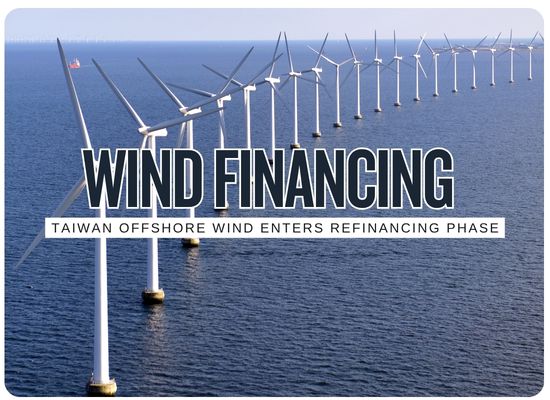
Taiwan’s offshore wind market received another financing signal as Formosa 2 completed a NT$58.9 billion refinancing package, a transaction described by project partners as the first offshore wind refinancing in Taiwan and the wider Asia-Pacific region. The 376 MW project, backed by Synera Renewable Energy and JERA Nex bp, has been operating since 2023 and uses 47 Siemens Gamesa 8 MW turbines off the coast of Zhunan Township in Miaoli County. The refinancing drew broad lender participation, including Taiwanese banks, international banks, and export credit agencies, showing that completed offshore wind assets in Taiwan are starting to attract post-construction capital structures rather than only greenfield project debt. The deal lands as Taiwan continues expanding offshore wind capacity, with new auction rounds, supply-chain commitments, vessel charters, cable work, emergency towage coverage, and long-term service requirements building around the next phase of offshore construction and operations.
Offshore Wind Financing Moves Into the Operating-Asset Stage
Taiwan’s refinancing market is beginning to matter for vessel demand, O&M services, cables, subsea work, towage, and marine logistics.
Refinancing Milestone
Formosa 2’s NT$58.9 billion refinancing shows that Taiwan’s offshore wind assets are moving beyond construction debt into operating-stage capital management.
Lender Confidence
Participation from local banks, international banks, and export credit agencies points to deeper capital-market confidence in proven Taiwanese offshore wind assets.
Marine Service Demand
Operating wind farms require long-term CTV, CSOV, emergency towage, cable, subsea inspection, turbine service, and port-support capacity.
Round 3 Buildout
Taiwan’s next offshore wind phase keeps attention on installation vessels, local fabrication, foundation transport, cable work, and grid-connection schedules.
Cost and Weather Risk
Typhoon windows, installation delays, cable availability, vessel day rates, grid readiness, and construction inflation remain core risk items.
Operator Readout
The financing is a signal that Taiwan’s offshore wind market is becoming more bankable after construction, but marine execution still drives the real economics. The strongest commercial opportunities sit around long-term service vessels, subsea maintenance, emergency response, port logistics, turbine support, and cable reliability.
Taiwan Offshore Wind Financing Board
Formosa 2’s refinancing is part of a larger shift from construction growth to financed operations, service vessels, and long-term marine support.
Formosa 2 matters because it is already operating. That makes the transaction different from a classic greenfield financial close. Lenders are no longer just underwriting construction risk, turbine installation, cable pull-in, and grid connection. They are also looking at operating cash flow, availability, O&M cost, weather downtime, turbine performance, and the long-term reliability of Taiwan’s offshore service chain.
Refinancing facility completed for Formosa 2, widely reported in the roughly $1.7B to $2B range depending on currency conversion.
Formosa 2 operating capacity, using 47 Siemens Gamesa 8 MW turbines off Miaoli County.
Financial institutions participated in the refinancing group, including domestic banks, international banks, and ECAs.
Taiwan installed offshore wind capacity reported by MOEA as of late March 2026.
Financing and Marine Supply Chain Signals
| Signal | Latest Development | Marine Market Meaning | Suppliers Affected | Watch Level |
|---|---|---|---|---|
| Formosa 2 refinancing | Operating offshore wind asset completed a NT$58.9B refinancing package. | Operational offshore wind cash flows are becoming financeable at scale in Taiwan. | Lenders, sponsors, O&M contractors, insurance advisers, asset managers | High |
| Domestic bank depth | Taiwanese banks participated heavily alongside international banks and ECAs. | More local liquidity can support future refinancings, follow-on projects, and contractor working-capital confidence. | Local banks, EPC firms, vessel owners, marine suppliers, developers | Positive |
| Round 3 expansion | Taiwan launched a new 3.6 GW offshore wind auction round in 2026. | New capacity keeps pressure on installation vessels, foundation fabrication, cables, substations, and grid readiness. | HLV owners, cable contractors, turbine OEMs, ports, fabricators | High |
| CSOV demand | Siemens Gamesa booked two CSOVs from Marco Polo Marine’s PKR Offshore for Taiwan wind work. | Commissioning and service vessels are becoming a long-duration offshore wind requirement in Taiwan. | CSOV owners, hybrid propulsion suppliers, walk-to-work systems, crew providers | High |
| Emergency towage | Marco Polo Marine secured a 15-year emergency towage and salvage charter in Taiwan. | Authorities are building emergency-response support around dense offshore wind areas and Taiwan’s coastal waters. | Tug owners, salvage firms, insurers, port authorities, emergency contractors | Medium |
| O&M reliability | Operating assets need turbine uptime, cable inspections, subsea access, spare parts, and weather-window planning. | Long-term value depends on keeping availability high after construction is complete. | CTV operators, ROV firms, blade repair teams, cable survey firms, port bases | Watch |
| Corporate offtake trend | Taiwan projects increasingly use corporate power purchase structures alongside traditional utility-backed models. | Industrial power buyers can support bankability, but contracted delivery performance becomes more visible. | Developers, lenders, industrial buyers, energy traders, grid planners | Medium |
| Construction risk memory | Earlier Taiwan projects faced delays, cost pressure, and installation complexity. | Financing confidence will depend on avoiding repeat overruns in Round 3 projects. | EPC contractors, heavy-lift firms, insurers, lenders, developers | Watch |
Planning note: Taiwan’s offshore wind market is entering a more mature capital cycle. The next opportunity is not only new construction. It is the operating-life economy around vessels, repairs, emergency response, subsea inspection, port bases, availability guarantees, and refinancing-ready asset performance.
Offshore Wind Marine Service Value Estimator
Estimate the annual marine service market around an operating offshore wind asset or project cluster.
Estimated yearly marine support value around the selected wind asset.
Estimated annual value from downtime avoided through better service coverage.
Estimated annual marine-service value divided by turbine count.
Estimated 10-year service opportunity before inflation and major replacements.
The modeled project supports a meaningful long-term service market.
Long-term service opportunityThis tool is for editorial and commercial sensitivity only. It does not replace project O&M budgets, lender models, turbine availability data, charter quotes, port contracts, insurance terms, vessel specifications, weather studies, cable integrity reports, or professional financial advice.
We welcome your feedback, suggestions, corrections, and ideas for enhancements.
Please click here to get in touch