Dutch Ports Face Sept. 4 Shutdown as FNV Strike Threatens Rotterdam, Amsterdam and Zeeland Cargo Flows
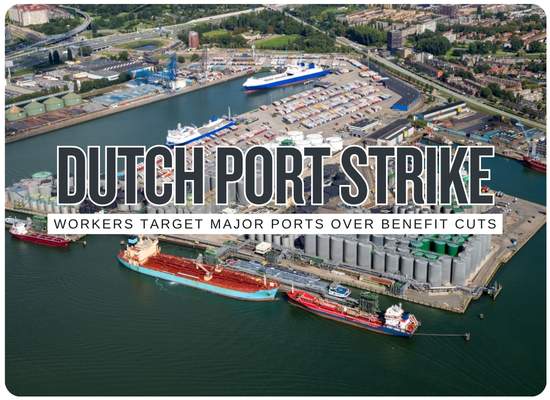
Dutch port workers are preparing a coordinated national strike on Friday, September 4, 2026, with FNV Havens calling on members in Rotterdam, Amsterdam and Zeeland to stop handling ships between 11:15 a.m. and 7:00 p.m. The planned 7-hour, 45-minute stoppage is part of a broader union campaign against approximately €6.5 billion in planned social-security savings. FNV says participating workers will stop loading and unloading vessels as well as lashing, towing and cargo-control work. The dispute centers partly on the government's plan to reduce the maximum Dutch unemployment-benefit period from the current 24 months to one year, alongside reforms to disability benefits. The government has already withdrawn an accelerated increase in the state pension age, but the broader savings target remains. For shipping, the largest exposure is Rotterdam, Europe's biggest seaport, which handled 428.4 million tonnes and 14.2 million TEU in 2025 and normally receives about 75 seagoing vessels per day.
Operator Impact Snapshot
The scheduled stoppage is shorter than a full-day strike, but the activities FNV intends to stop sit directly at the vessel-terminal interface. Ship handling, cargo operations, towing and cargo-control delays can quickly move from the quay into barge, rail and truck schedules.
FNV says participating port workers will stop handling ships during the announced national action period.
Rotterdam handles roughly 75 seagoing vessel visits per day and is the largest concentration of FNV port membership.
Members working in Amsterdam and Zeeland have also been called into the national strike.
FNV is demanding withdrawal of the broader savings package affecting unemployment and disability protections.
The coalition plan would reduce the maximum WW payment period from the current 24 months to one year.
September 4 Port Disruption Dashboard
The commercial effect will depend on participation at individual terminals and marine-service companies, but the strike has the potential to interrupt several linked stages of a port call at the same time.
| Operation | Strike Exposure | Immediate Port Effect | Possible Vessel Consequence | Hinterland Consequence | Recovery Factor |
|---|---|---|---|---|---|
| Container Handling | Direct loading and unloading |
HIGH Quayside moves involving participating workers can stop during the announced strike window. |
A deepsea vessel may miss its planned completion time or departure window. | Containers unavailable for truck, barge or rail collection can miss onward transport slots. | Yard congestion and crane scheduling can extend the effect after work resumes. |
| Mooring / Vessel Movement | Direct marine services |
HIGH FNV specifically identifies vessel handling and towing among activities that can be delayed. |
Ships can arrive on schedule but remain unable to berth or sail at the planned time. | Terminal berth rotation shifts and following ships can inherit the delay. | Availability of non-striking personnel and tug or mooring capacity will determine recovery speed. |
| Cargo Inspection | Direct cargo controls |
DELAY Cargo requiring participating inspection personnel may remain uncleared. |
Cargo can physically arrive but remain unavailable for release. | Truck appointments and warehouse deliveries can be pushed into later shifts. | Inspection backlogs can outlast the official strike period. |
| Truck Operations | Indirect terminal dependency |
SECONDARY Road transport may continue, but cargo availability can become the limiting factor. |
Minimal direct effect on the vessel itself. | Missed pickup windows, waiting time and rescheduled driver or chassis capacity. | Congestion may build immediately before and after the strike window. |
| Inland Barges | Indirect terminal connection |
NETWORK Barges can lose terminal windows when boxes are not discharged or loading slots move. |
Deepsea vessels can retain cargo intended for scheduled barge transfer. | Rhine corridor and inland terminal schedules can inherit the disruption. | Barge slot scarcity can magnify a short terminal interruption. |
| Freight Rail | Indirect fixed departure windows |
NETWORK Containers not released on time can miss scheduled train departures. |
Vessel discharge timing becomes linked to available next-train capacity. | Germany, Central Europe and inland logistics hubs can receive cargo later. | Fixed train schedules can make missed departures more costly than several hours of terminal delay. |
| Liquid Bulk | Site Specific participation dependent |
VARIABLE Effect depends heavily on which terminal, tug, mooring and inspection personnel join the action. |
Tankers may experience berth or marine-service delays even if terminal equipment remains available. | Pipeline and storage operations may be less exposed than container-linked inland chains. | Facility-specific contingency staffing becomes decisive. |
| Post-Strike Recovery | After 19:00 schedule displacement |
WATCH Work resumes into a queue rather than necessarily returning immediately to the original schedule. |
Ships awaiting berths may compete with vessels already scheduled for the evening shift. | Trucks, barges and trains may require rebooking or new collection windows. | Participation rate, terminal utilization and arrival bunching will determine the backlog. |
Dutch Port Strike Delay and Cost Calculator
Estimate the commercial effect of a September 4 port disruption on a vessel call. Enter the expected operational delay, vessel cost, affected containers or cargo units, inland transport disruption and post-strike recovery time to build a planning-level exposure estimate.
We welcome your feedback, suggestions, corrections, and ideas for enhancements.
Please click here to get in touch