ADNOC Locks In Five VLCCs as Gulf Disruption Turns Tanker Access Into a Strategic Asset
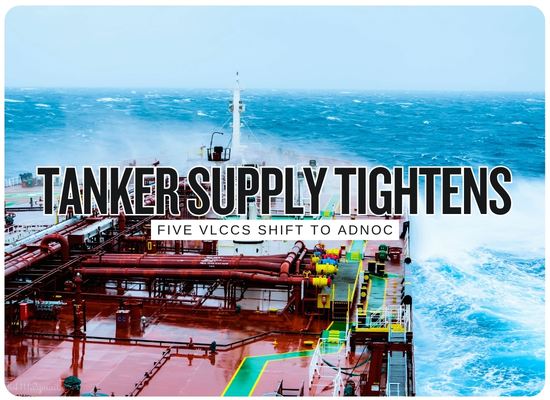
ADNOC has acquired five very large crude carriers from Frontline for about $590 million, adding immediate owned capacity while tanker availability is being reshaped by disruption around the Strait of Hormuz, the Red Sea and nearby export routes. The package reportedly includes two VLCCs built in 2012 at roughly $115 million each and three built in 2015 at about $120 million each, producing an average acquisition price near $118 million per ship. The move comes as ADNOC has also relied on a large block of chartered crude tankers to protect internal transfers and customer deliveries, while sparse Hormuz traffic, attacks on ADNOC-linked VLCCs and uncertainty around Bab el-Mandeb have made control of suitable tonnage more valuable than fleet size alone.
Five VLCCs Give ADNOC More Control Over a Tighter Tanker Market
The acquisition strengthens owned crude-shipping capacity at a time when route disruption, vessel damage, longer voyages and precautionary chartering are reducing the number of ships operators can treat as genuinely available.
Ships can remain in the global fleet while becoming unavailable for preferred routes, loading windows or risk profiles.
Regional uncertainty increases the value of ships that can be controlled directly instead of fixed voyage by voyage.
Limited transits are continuing, but vessel movement is still well below a normal high-volume operating pattern.
The reported prices show substantial capital is still required to secure immediate crude-carrying capacity.
The purchase gives ADNOC more authority over voyage timing, internal transfers and direct customer deliveries.
The Purchase Is About Control as Much as Capacity
ADNOC is adding physical ships, but the larger gain is greater authority over the timing and commercial terms of its crude movements.
Five Ships Reduce Dependence on a Less Predictable Charter Market
A VLCC normally carries close to two million barrels of crude. Five additional ships therefore provide a substantial block of transportation capacity that can be assigned to internal movements, export programs or customer deliveries without competing for every voyage in the spot market.
That flexibility becomes especially important when route risk removes ships from normal trading patterns. Some owners may reject Gulf exposure, demand higher compensation, wait outside the region, alter AIS behavior or favor longer and more profitable alternatives. The vessel count may remain unchanged while the pool of commercially usable ships contracts.
The Vessel Ages Reveal a Near-Term Deployment Strategy
The reported package consists of existing ships rather than distant newbuild deliveries. That gives ADNOC access to capacity now, during a period of disruption, instead of waiting several years for yard slots and construction.
The tradeoff is age. Ships built in 2012 and 2015 require closer attention to fuel performance, vetting acceptance, special-survey timing, machinery condition and future emissions exposure. The purchase can still make strategic sense if near-term logistics control outweighs the higher maintenance and efficiency burden associated with older tonnage.
Transaction Effects Across the Tanker Market
The table separates the immediate operational benefits from the costs and market signals that owners, charterers and suppliers may need to monitor next.
| Market Lane | Current Readout | Immediate Effect | Commercial Advantage | Cost or Exposure | Next Signal |
|---|---|---|---|---|---|
Owned Crude Capacity |
Strategic | Five VLCCs add a large block of deployable crude transportation capacity without waiting for new construction. | ADNOC can assign ships directly to preferred cargoes, internal transfers or customer commitments. | Ownership transfers operating cost, drydock exposure and asset-value risk onto the buyer. | Deployment patterns after delivery and the proportion used for internal versus third-party employment. |
Spot Charter Dependence |
High Impact | The purchase lowers the number of voyages that must be covered through a volatile charter market. | Less exposure to sudden freight spikes, owner refusals and restricted vessel availability. | Owned ships can become less economical if the spot market weakens materially. | VLCC spot earnings, one-year charter levels and Gulf-loading availability. |
Hormuz Logistics |
High Risk | Owned tonnage gives greater scheduling control during sparse and irregular strait traffic. | Faster coordination with ADNOC terminals, customers and internal logistics teams. | ADNOC retains direct exposure to vessel damage, crew risk and transit disruption. | Daily VLCC transits, attack frequency, escort arrangements and insurer restrictions. |
Red Sea Diversion |
Watch | Disruption around Bab el-Mandeb can lengthen voyages and keep tankers employed for more days. | Owned capacity can absorb some scheduling changes without renegotiating every fixture. | Longer voyages raise fuel consumption, crew time and maintenance usage. | Southbound VLCC activity, Houthi warnings and use of Cape routing. |
Secondhand Asset Values |
Firm | The reported prices reinforce the value of prompt-delivery VLCC tonnage. | Owners of comparable ships gain stronger asset-value support and sale optionality. | Buyers are committing major capital to vessels already approaching later-life survey cycles. | Comparable VLCC sales, demolition activity and availability of modern resale candidates. |
Marine Equipment Demand |
Positive | Fleet additions create recurring demand for management, spares, inspections, coatings and retrofit work. | Regional suppliers may gain from a larger controlled fleet operating close to ADNOC’s logistics base. | Older vessels may require heavier near-term spending than recently delivered tonnage. | Dry-docking awards, propulsion upgrades, safety retrofits and condition-monitoring contracts. |
Frontline Fleet Renewal |
Watch | The seller can release capital from existing tonnage while continuing its broader fleet-renewal strategy. | Capital can be shifted toward newer, more efficient VLCC exposure. | Disposing of ships during a strong market gives up some future operating leverage. | Frontline’s remaining VLCC mix, newbuilding deliveries and future asset sales. |
ADNOC is treating tanker access as part of energy-security infrastructure. The transaction does not create new global vessel supply, but it transfers five ships from the open market into a fleet with a strong incentive to protect Gulf export continuity.
VLCC Ownership and Charter Exposure Estimator
Estimate the crude capacity controlled by a fleet, the annual charter cost of covering the same vessel demand and the amount of transportation capacity exposed to open-market availability.
This combines owned and chartered vessel capacity under the selected assumptions.
Nominal barrels controlled through owned ships per voyage cycle.
Nominal barrels dependent on chartered ships per voyage cycle.
Calculated from the entered vessel count, daily rate and annual charter days.
Share of the selected fleet requirement covered by owned VLCCs.
Fleet Control Profile
Most selected capacity remains dependent on chartered ships. Additional ownership, longer period coverage or diversified loading options could reduce exposure during disruption.
This estimator is intended for editorial and preliminary planning use. It does not account for financing, operating expenses, ballast positioning, voyage duration, bunker cost, insurance, vetting restrictions, vessel age, route-specific premiums or residual asset value.
We welcome your feedback, suggestions, corrections, and ideas for enhancements.
Please click here to get in touch