Romania Maps 11.5 GW Black Sea Wind Buildout as Six Offshore Zones Move Toward Concessions
🔔 Subscribe to ShipUniverse Weekly →
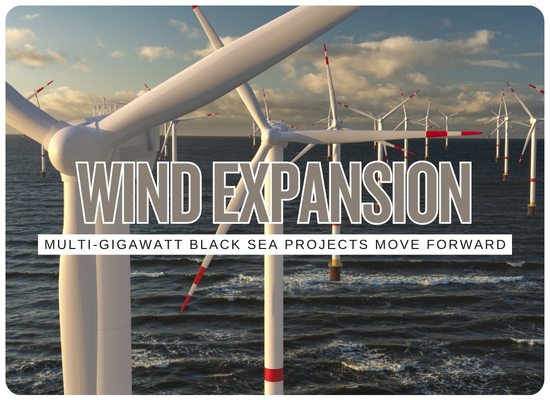
Romania has published the first detailed map of the offshore wind areas it intends to develop in its sector of the Black Sea, identifying six zones with an estimated combined capacity of 11.5 GW. The draft government decision, released for public consultation on July 22, divides the offshore pipeline into three development phases covering roughly 4,000 square kilometres. The first phase consists of three fixed-bottom areas totaling 3.1 GW and is intended to support Romania’s national target of around 3 GW of offshore wind operating by 2035. A second 2.4 GW phase also appears technically suitable for fixed foundations but currently overlaps sensitive military areas, while the final 6 GW zone reaches water depths of about 135 metres and could eventually require a combination of deep-water fixed foundations and floating wind technology. Once the government formally adopts the list, the Energy Ministry can select areas for competitive concession procedures under Romania’s offshore wind law, although inclusion on the map itself does not grant construction or development rights.
Operator Impact Snapshot
The proposed offshore map creates a multi-stage marine construction market spanning fixed foundations, offshore substations, export cables, installation vessels, heavy-lift port operations and eventually floating-wind systems.
Combined development potential across three phases covering roughly 4,000 km² of Romanian Black Sea waters.
Three priority areas are intended to support Romania’s approximately 3 GW offshore wind target for 2035.
Two additional areas remain constrained by military-use zones and an active firing-range safety perimeter.
The later-stage zone reaches approximately 135 metres and may introduce floating platforms, moorings and dynamic cables.
Inclusion in the draft list does not itself grant development rights. Competitive concessions and permits still follow.
Romania Offshore Wind Market Dashboard
The six-area map ranges from relatively conventional fixed-bottom projects to a large deep-water zone that could materially expand the vessel, cable, foundation and port-service requirements of Romania’s offshore energy market.
| Area / System | Scale | Technical Profile | Development Position | Commercial & Marine Exposure |
|---|---|---|---|---|
| Phase 1 · Area 1 | 1.9 GW 631 km² | Priority fixed-bottom area. Phase 1 depths generally range from approximately 55 to 75 metres, with modeled wind speeds around 7.7–7.9 m/s at 150 metres. |
PRIORITY
Largest of Romania’s three first-stage zones and a major component of the country’s 2035 offshore target. |
Large potential packages for turbines, foundations, array cables, offshore substations, installation vessels, surveys and port staging. |
| Phase 1 · Area 2 | 600 MW 149 km² | Fixed-bottom area within the approximately 1,000 km² combined first-stage development footprint. |
PRIORITY
Included in the short-term group proposed to support deployment through 2035. |
Potential work for geotechnical survey vessels, turbine installation contractors, foundation suppliers and subsea-cable companies. |
| Phase 1 · Area 3 | 600 MW 168 km² | Similar fixed-bottom profile to the other first-stage areas. |
PRIORITY
Combined with Areas 1 and 2, Phase 1 reaches 3.1 GW. |
Another sizeable offshore construction package involving cables, turbines, foundations, substations and marine logistics. |
| Phase 2 · Areas 4 & 5 | 2.4 GW combined | Water depths are approximately 46–76 metres and are considered technically compatible with fixed-bottom foundations. |
DEFERRED
Military-area conflicts and the safety perimeter around an active firing range must be addressed before concession activity progresses. |
Commercial timing remains uncertain, but eventual development could materially extend demand for fixed-foundation installation and cable-laying capacity. |
| Phase 3 · Area 6 | 6.0 GW 2,195 km² | Water depths reach roughly 135 metres, moving the project environment beyond the shallower profile of the first two phases. |
POST-2035
Planned as a later-stage zone with deep fixed-bottom and floating technologies both potentially relevant. |
Could create a future market for floating platforms, mooring systems, anchors, towing vessels, dynamic cables and deep-water installation services. |
| Concession Framework | Competitive Law 121/2024 | Romania’s Energy Ministry is the competent authority for offshore wind concession areas. |
PRE-AWARD
Mapping an area does not automatically give a developer construction or exploration rights. |
Developers still require concession rights, environmental approvals, development authorization, grid arrangements and generation licensing. |
| Oil & Gas Coexistence | 4 Blocks identified overlap | Proposed wind areas overlap or interact with Istria, Midia, Luceafărul and Neptun hydrocarbon acreage. |
MARINE PLANNING
Offshore wind layouts must account for subsea infrastructure, access corridors and existing energy operations. |
Creates work for marine spatial planning, subsea surveys, cable-route engineering, inspection and offshore coordination services. |
| Transmission System | Multi-GW connection requirement | Large-scale offshore development requires significant transmission expansion and new offshore-to-onshore connections. |
CRITICAL PATH
Grid availability is one of the principal infrastructure requirements identified in Romania’s offshore roadmap. |
Offshore substations, high-voltage export cable, transformers, reactive compensation, grid studies and onshore substations. |
| Romanian Ports | Strategic construction + O&M | Offshore wind components require heavy-duty quays, storage space, high bearing capacity and suitable marine access. |
SUPPLY CHAIN
Port readiness will influence the share of assembly, fabrication and maintenance work performed domestically. |
Heavy lift, turbine preassembly, foundation storage, cable handling, crew transfer, service-operation vessels and long-term O&M bases. |
Black Sea Marine Buildout Analyzer
Convert Romania’s mapped offshore wind capacity into an indicative turbine fleet, foundation requirement, inter-array cable demand, installation-vessel workload, annual generation and project capital scale. All marine assumptions can be adjusted for different development scenarios.
We welcome your feedback, suggestions, corrections, and ideas for enhancements.
Please click here to get in touch