World’s Largest All-Electric Container Ship Enters Commercial Service in China
🔔 Subscribe to ShipUniverse Weekly →
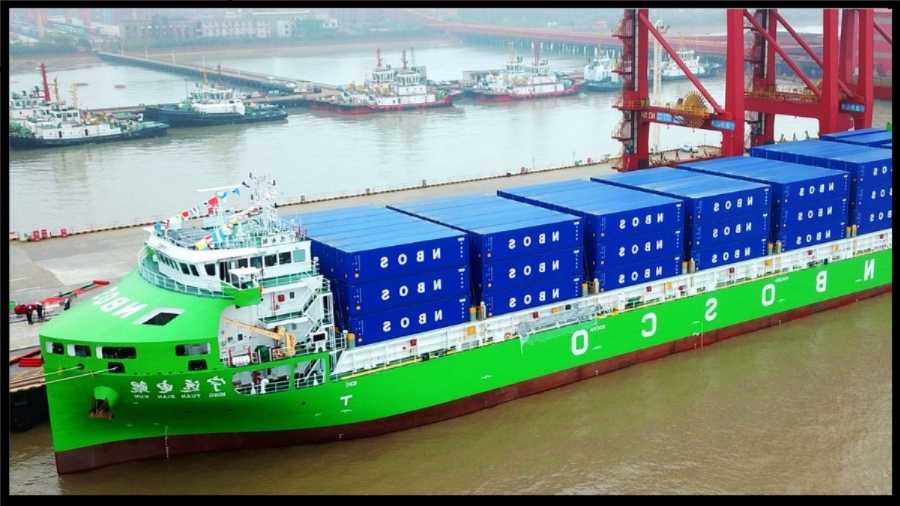
China has now put the Ning Yuan Dian Kun into commercial service, marking the start of operations for what Chinese official and state-linked sources describe as the world’s largest all-electric intelligent container ship. The vessel began service on April 15 on the coastal route between Ningbo-Zhoushan Port and Jiaxing/Zhapu in Zhejiang province, with reported capacity of 740 to 742 TEU, length of 127.8 meters, beam of 21.6 meters, and battery storage of roughly 19,600 to 20,000 kWh spread across 10 containerized battery units. Reporting around the launch also says the ship is expected to cut annual carbon dioxide emissions by roughly 1,400 to 1,462 tonnes, operate with zero direct voyage emissions, and use a combined charging approach that includes high-voltage shore power and battery-container swapping. The project has been framed as more than a one-off delivery because the operator, Ningbo Ocean Shipping, says a sister ship is also scheduled to join service, creating a scaled coastal electric-shipping operation rather than a single demonstration vessel.
This is not an immediate freight-rate shock. It is a route-specific technology milestone in short-sea container service rather than a broad market-capacity event.
The main insurance and risk questions center on battery systems, charging, thermal management and operational learning rather than conventional fuel or war-risk exposure.
The strongest direct signal is on fuel displacement. A fully electric vessel removes conventional marine-fuel consumption from its service loop and turns energy supply into a shore-power and battery-logistics question.
Electric short-sea service needs route discipline, charging access and terminal coordination, so the route effect is meaningful even if it remains confined to selected coastal corridors.
The immediate asset effect is selective, but this raises the strategic value of battery-ready designs, shore-power integration and short-haul coastal routes suited to electrification.
| Development lane | Current marker | Immediate operating read | Importance | Commercial consequence | Next checkpoint |
|---|---|---|---|---|---|
| Commercial entry | The Ning Yuan Dian Kun launched commercial operations on April 15 on the Ningbo-Zhoushan to Jiaxing/Zhapu route in Zhejiang. Real service, not concept only | This is already an operating route deployment rather than a distant pilot proposal. | That matters because battery-electric shipping becomes more credible when it enters repeatable freight service instead of remaining a ceremonial launch. | Operators and ports can now watch a live short-sea use case rather than guessing how the model performs in practice. | Watch service reliability, turnaround performance and whether route frequency expands after initial months. |
| Battery architecture | The ship carries ten containerized battery packs totaling about 19,600 to 20,000 kWh. Energy system is modular | The energy system is being treated as modular cargo-like infrastructure rather than as a hidden internal power pack only. | This matters because modular battery containers may simplify maintenance, charging logistics and replacement strategy on fixed routes. | Ports and operators may see battery-container handling as part of the commercial model, not just vessel engineering. | Watch whether the modular battery approach becomes a template for additional coastal vessels. |
| Charging model | Xinhua said the ship uses a dual-mode replenishment system combining high-voltage shore power with rapid battery-container swapping. Port energy logistics are central | The ship’s viability depends as much on terminal-side power handling as on onboard engineering. | That matters because electric ship adoption will scale fastest where ports can support quick energy turnaround without damaging schedule efficiency. | Shore-power readiness and battery-exchange capability could become competitive advantages on selected coastal corridors. | Watch whether supporting infrastructure at both ends of the route expands as the service matures. |
| Operating fit | Analysts quoted in Chinese coverage said the ship is best suited to inland and short-haul coastal trades because battery range remains the main constraint. Best fit is still short-sea | The vessel is not evidence that deepsea container shipping is about to go fully electric. | This matters because it places the milestone in the right commercial lane: regional service, short rotations and controlled charging windows. | Near-term adoption is more likely in feeder, river-sea and coastal loops than in long-haul intercontinental trades. | Watch for similar deployments on other short-sea and river-connected container corridors. |
| Intelligent systems | Official reporting says the vessel includes smart navigation, engine-room systems, autonomous collision-avoidance functions and integrated ship-shore-cloud control. Electrification and automation are being paired | The vessel is being positioned as both an electric ship and an intelligent-navigation platform. | That matters because commercial value may come not only from lower emissions, but also from efficiency, crew environment and navigation support. | Owners may increasingly evaluate electrification together with automation, data integration and route optimization. | Watch whether performance reporting emphasizes energy savings alone or also highlights labor, safety and scheduling benefits. |
| Scale-up path | The operator’s sister ship, Ning Yuan Dian Peng, is expected to join service after trials and delivery, enabling scaled green service on fixed routes. Second unit makes the story stronger | A second vessel would move this from symbolic leadership into a small operating fleet. | That matters because repeat builds are usually the real proof that owners and infrastructure partners see a bankable operating model. | The market will likely take the concept more seriously if the two-ship pattern holds and route deployment scales as planned. | Watch the sister ship’s delivery and whether additional orders follow beyond the initial pair. |
We welcome your feedback, suggestions, corrections, and ideas for enhancements. Please click here to get in touch.