HomeKorean Shipyards Move Closer to U.S. Navy Newbuild Work
Korean Shipyards Move Closer to U.S. Navy Newbuild Work
July 9, 2026
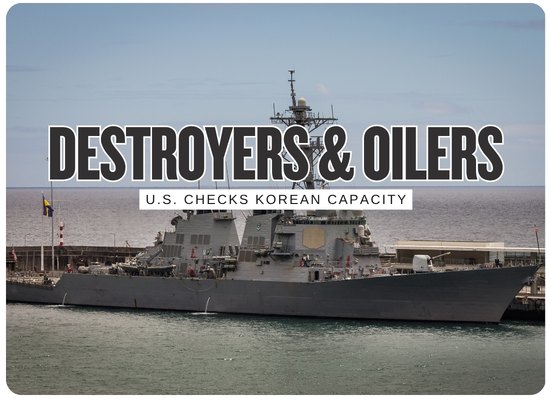
The U.S. Navy and Defense Department have moved the South Korea shipbuilding discussion into a more concrete stage by sending requests for information to major Korean yards covering destroyers and oilers. Reporting out of Korea says HD Hyundai Heavy Industries and Hanwha Ocean responded on the destroyer side, while Samsung Heavy Industries joined those two yards on the oiler side. The requests reportedly sought design capability, production capacity, pricing, and delivery information. This lines up with the Navy’s current shipbuilding plan, which asks Congress for authority to build up to two auxiliary ships overseas and to allow some large, non-sensitive combatant modules to be fabricated in allied facilities while keeping final assembly, integration of classified systems, testing, and activation under tighter U.S. control. Hanwha’s position also stands out because its Philly shipyard is already working on a U.S. Navy subcontract tied to the Next Generation Logistics Ship, or light replenishment oiler program.
This news sits at the intersection of naval acquisition, industrial capacity, foreign partnership structure, and long-cycle sustainment. The immediate signal is not that Korean yards have won U.S. Navy newbuild contracts. The immediate signal is that the U.S. side has started formal market sounding on real ship classes, which makes the conversation more concrete for yards, suppliers, shipbuilders, repair players, and defense-industrial stakeholders.
High
U.S. Yard Competition
Domestic builders and their suppliers now face a sharper comparison on capacity, delivery speed, and production discipline even if the final structure still keeps major work inside the United States.
Watch
Destroyer Path
Combatants remain the harder lane because design control, integration boundaries, classified systems, and legal constraints are all tighter here than on support-ship work.
Medium
Oiler Opportunity
Auxiliary and replenishment work looks more commercially reachable as a partnership lane because it fits the Navy’s current logic around lower-risk foreign participation better than full combatant outsourcing.
Watch
Supplier Repositioning
Component vendors, design houses, steel fabricators, and integration firms may need to think earlier about mixed production models that combine allied fabrication with U.S.-based final work.
Low
Immediate Contract Certainty
This is still a market-research stage. The near-term change is strategic positioning, not a guaranteed flood of signed destroyer and oiler construction awards.
U.S. Navy Korea RFI Readout
Topic
Current Read
News Coverage
Importance
Who Feels It First
Closest Next Signal
Destroyer RFIs
The combatant side is now in formal market-sounding territory.
High Interest
Two major Korean builders were reportedly asked to submit capability information tied to proposed destroyer work, pushing the conversation beyond general diplomacy.
Combatants are the hardest class to internationalize because design sovereignty, classified integration, and domestic political sensitivity are all heavier here.
Prime contractors, naval combat-system suppliers, U.S. yards, and Korean defense yards.
Any sign of legislative movement or a clearer workshare model for surface combatants.
Oiler RFIs
Support-ship cooperation looks more immediately plausible.
Active Lane
Three Korean yards reportedly responded on medium-sized oiler work, which fits the Navy’s broader overseas auxiliary-ship logic more naturally.
Auxiliaries are generally easier to place inside mixed build models because the technical and political barriers are lower than on destroyers.
Auxiliary-ship builders, replenishment-ship suppliers, logistics planners, and repair yards.
Whether the oiler lane turns into concept design, teaming, or pilot production work faster than destroyers do.
Legal structure
The main constraint is still not capacity alone.
Watch
Current law and congressional posture still limit direct foreign construction of U.S. Navy combat ships, even as the Navy asks for more flexibility on auxiliaries and overseas module fabrication.
That means the final model may matter more than the headline interest itself.
Congress, Navy acquisition planners, domestic yards, and foreign partners shaping entry strategy.
Whether the outcome leans toward direct overseas work, U.S.-based foreign-owned production, or overseas module support only.
Hanwha position
One player already has a stronger U.S. foothold.
Meaningful
Hanwha’s Philly yard and its subcontract role on the Navy’s light replenishment oiler effort give it a more immediate U.S.-industrial-base angle than a pure offshore entrant would have.
That could matter if Washington prefers foreign partnership structures that still deepen U.S.-based production and workforce capacity.
Hanwha, U.S. labor markets, Philly suppliers, and competitors pursuing similar footholds.
Whether concept work and yard upgrades turn into broader Navy production credibility.
HD Hyundai and Samsung angle
Partnerships may matter as much as direct yard capability.
Building
Existing ties with Huntington Ingalls and General Dynamics NASSCO suggest that U.S. alignment may be structured through teamwork and production sharing rather than simple replacement.
That lowers the chance that this becomes a clean foreign-versus-domestic story.
U.S. primes, alliance supply chains, planners, and naval subcontractors.
Whether these relationships stay strategic or become tied to specific hull programs.
Industrial message
The Navy is signaling urgency on capacity and timing.
High
The formal RFI step suggests Washington wants more than a political headline. It wants structured market data on who can design, build, price, and deliver faster.
This raises pressure on every relevant yard to show not only patriotism or capability, but throughput and schedule realism.
Domestic shipbuilders, allied yards, naval suppliers, and investors following defense industrial policy.
Any move from information-gathering into formal teaming, concept awards, or procurement reshaping.
The cleanest current read is that auxiliaries appear to be the easier first lane, destroyers remain the more politically and technically loaded lane, and the real contest may be over production structure rather than nationality alone.
U.S. Navy Korea Build Path Estimator
Use this tool to estimate which lane looks most likely to shape the next phase of this story for your operation or market view.
Use a higher value if you think Washington is likely to loosen current foreign-build barriers.
Raise this if you think oilers and support ships are the cleanest early cooperation lane.
Use a lower value if you think destroyers stay too politically or technically restricted.
Raise this if you expect policy to favor U.S.-based final assembly and industrial-base growth.
This covers existing U.S. yards, teaming, subcontracting, and industrial relationships.
Raise this if you think schedule pressure will drive more creative production structures.
Most Likely Near Term Lane
Auxiliary Path
The current mix suggests support ships and replenishment work remain the cleanest early cooperation lane.
Heat Score
71 / 100
This looks like a live strategic story with real industrial implications, but still not a straight contract award phase.
Most Fragile Variable
Legal Path
The structure of any deal still depends heavily on how much foreign-build flexibility Washington is prepared to accept.
Momentum Gauge
Active
The story has moved beyond political signaling and into serious industrial positioning.
This estimator is editorial and illustrative. It does not predict legislation, procurement outcome, combatant licensing, or actual ship award timing.
Feedback Welcome
We welcome your feedback, suggestions, corrections, and ideas for enhancements.