Hormuz Escort Doubts Put Gulf Shipping Decisions on Hold
🔔 Subscribe to ShipUniverse Weekly →
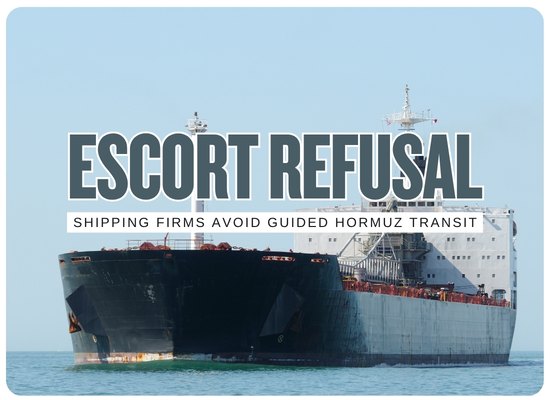
Some shipping companies are avoiding U.S.-military guided transit through the Strait of Hormuz after recent attacks on commercial vessels raised concerns that escorted movement may still leave ships, crews, and cargo exposed. The development comes as the waterway remains one of the most sensitive maritime corridors in the world, carrying a major share of oil and LNG flows while also sitting inside an active conflict environment. For operators, the issue is no longer simply whether a naval route is available. The decision now includes crew risk, insurer approval, charterparty obligations, war-risk premiums, cargo urgency, vessel type, flag exposure, route instructions, and whether a guided transit could itself create a more visible target profile.
Guided Transit Is Not Removing Gulf Risk
Some operators are still holding back from Hormuz passages despite a U.S.-military guided transit option.
Crew Safety Concern
Recent attacks have made crew exposure a central decision point, even when military coordination is available for a transit.
Insurance Approval Risk
War-risk cover, exclusions, voyage declarations, and underwriter instructions can determine whether a shipowner accepts or delays the passage.
Transit Volume Pressure
Traffic remains below normal levels, keeping schedules, Gulf cargo flows, and refinery supply plans exposed to slower movement.
Charterparty Friction
Owners and charterers may clash over safe-port language, deviation rights, waiting costs, cancellation windows, and crew instructions.
Energy Cargo Timing
Crude, LNG, LPG, refined products, chemicals, and dry cargo tied to Gulf ports may face fresh timing and cost uncertainty.
Operator Readout
The practical signal is that a guided transit option does not equal commercial confidence. Owners are still weighing vessel profile, flag, cargo, crew, insurer approval, attack pattern, and charter terms before committing to Hormuz movement.
Hormuz Transit Confidence Watch
Some operators are declining guided passage as attack risk, insurance terms, and crew exposure outweigh schedule pressure.
The latest Hormuz update shows a gap between military availability and commercial acceptance. A guided transit option may reduce some route uncertainty, but it does not remove the operational questions that shipowners and charterers must answer before committing a vessel into a high-risk corridor.
Approximate 2024 oil flow through the Strait of Hormuz, equal to about one-fifth of global petroleum liquids consumption.
Recent average daily transit level reported before the latest refusal story, still far below pre-conflict norms.
Approximate pre-conflict daily sailing range cited in recent traffic reporting.
Guided Transit Decision Table
| Decision Factor | Latest Readout | Maritime Meaning | Stakeholders Affected | Watch Level |
|---|---|---|---|---|
| Operator refusals | Some companies are avoiding U.S.-guided Hormuz transit | Military guidance is not enough for all owners to accept the route. | Owners, charterers, cargo interests, insurers | High |
| Crew risk | Recent attacks keep safety concerns elevated | Masters, crew managers, unions, and flag states may influence voyage approval. | Seafarers, ship managers, P&I clubs, flags | High |
| War-risk cover | Premiums and insurer instructions remain sensitive | Voyage approval may depend on specific underwriter terms and declared route conditions. | Underwriters, brokers, owners, lenders | Watch |
| Traffic weakness | Recent Hormuz volumes remain well below normal | Lower throughput can affect Gulf energy flows, port calls, cargo timing, and freight pricing. | Energy traders, refiners, ports, LNG buyers | Medium |
| Charterparty exposure | Transit refusal can trigger cost and responsibility disputes | Safe-port clauses, deviation rights, off-hire terms, and delay costs need close review. | Charterers, owners, lawyers, brokers | Watch |
| Energy cargo continuity | Hormuz remains central for crude, LNG, LPG, and products | Refiners and buyers may face schedule uncertainty if more ships wait outside the corridor. | Cargo owners, terminals, refiners, utilities | High |
Planning note: The key commercial issue is confidence. If owners view a guided transit as still too risky, cargo can remain delayed even when a military-backed passage plan exists.
Hormuz Transit Decision Estimator
Compare guided-transit exposure against delay, reroute, war-risk, and cargo urgency costs.
Estimated war-risk exposure adjusted by the selected confidence profile.
Estimated holding cost if the vessel pauses before transit.
Estimated commercial exposure tied to cargo urgency.
Estimated delay, cargo timing, and reroute exposure.
The modeled case shows similar exposure between transit and refusal.
Escalate reviewThis tool is for editorial and commercial sensitivity only. It does not replace naval instructions, security advisories, insurance quotes, P&I guidance, flag-state advice, crew-management requirements, charterparty review, sanctions screening, or professional voyage planning.
We welcome your feedback, suggestions, corrections, and ideas for enhancements.
Please click here to get in touch