India’s Frigate Supply Chain Surge
🔔 Subscribe to ShipUniverse Weekly →
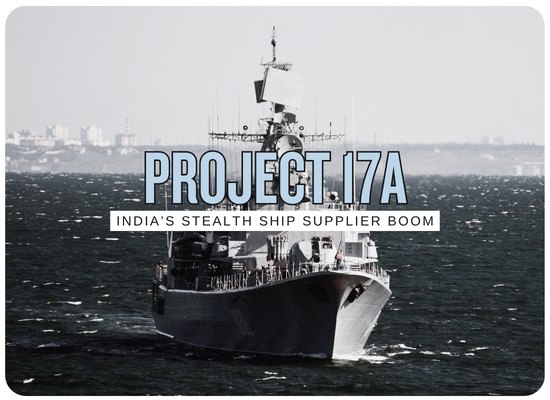
India’s Project 17A stealth frigates are a warship story, but they are also a supplier story. Behind every new frigate is a growing industrial chain for steel, stealth design, propulsion, platform automation, sensors, missiles, electronic warfare, anti-submarine systems, and lifecycle support.
The indigenous push behind the frigate program
Project 17A is important because it shows India moving beyond basic ship assembly into higher-value naval integration. The program brings together in-house warship design, major public shipyards, Indian equipment makers, specialist MSMEs, modular construction, integrated platform controls, advanced weapons, and blue-water combat requirements.
The supplier opportunity is broader than one ship class. A stealth frigate requires industrial competence across the full surface-combatant stack: hull form, acoustic control, power, survivability, radars, launch systems, combat management, data networks, propulsion, sensors, aviation support, spares, and maintenance. Once those capabilities mature domestically, they can support destroyers, corvettes, patrol vessels, unmanned motherships, amphibious ships, export candidates, and future refit work.
Supply chain signal board
Weapons and sensors
Missiles, radars, electronic warfare, anti-submarine systems, torpedoes, launchers, and fire-control integration create the highest-value supplier lanes.
Platform automation
Integrated Platform Management Systems, machinery controls, power monitoring, and fault diagnostics help reduce crew burden and improve ship survivability.
Combat integration
The frigate’s combat value depends on how well sensors, weapons, communications, electronic warfare, and command systems work as one fighting system.
Local supplier depth
High indigenous content is valuable only if suppliers can maintain quality, delivery timing, documentation, and lifecycle support across multiple ships.
The frigate supply chain is becoming a naval ecosystem
A stealth frigate is not a single manufacturing project. It is a system-of-systems build, with hundreds of supplier inputs moving through design, fabrication, installation, testing, harbor trials, sea trials, delivery, and fleet sustainment. That creates opportunities for companies that can remove friction from the chain.
9 supplier niches behind Project 17A’s indigenous push
These are the supplier lanes worth watching as India’s stealth frigate program advances and the wider naval industrial base gains confidence.
- ❶ Shipbuilding base Modular blocks, outfitting, and naval steel Project 17A highlights the importance of shipyards that can build complex combatants with modular methods. The supplier opportunity includes block fabrication, precision welding, outfitting, naval-grade steel, cable trays, piping, brackets, insulation, foundations, and shipyard production systems. This is not glamorous work, but it decides build speed, cost discipline, and repeatability.
- ❷ Stealth package Signature management and survivability materials A modern frigate needs reduced radar, acoustic, infrared, and electromagnetic signatures. Supplier niches include radar-cross-section shaping support, special coatings, acoustic mounts, vibration isolation, exhaust treatment, cooling management, low-observable deck fittings, and materials that reduce detectability without complicating maintenance.
- ❸ Propulsion train CODOG machinery, gearboxes, shafts, and controls Combined Diesel or Gas propulsion gives frigates flexibility between endurance and speed. Behind that are diesel engines, gas turbines, gearboxes, shafting, propellers, control systems, lubrication, vibration monitoring, and machinery diagnostics. The supplier upside grows when local firms can support maintenance, overhaul, spares, and upgrade work across ship classes.
- ❹ Platform brain Integrated Platform Management Systems IPMS is one of the quietest but most important supplier lanes. It connects machinery monitoring, alarms, power distribution, auxiliaries, damage-control functions, and automation into a common operating picture. This niche rewards companies that understand naval-grade software, redundancy, cybersecurity, shock tolerance, maintainability, and crew-friendly interfaces.
- ❺ Sensor layer Radars, electro-optics, EW, and surveillance systems Frigates need to see, classify, track, and survive in crowded air, surface, and electronic environments. Supplier niches include surveillance radars, fire-control sensors, electro-optical systems, electronic support measures, jammers, decoy launchers, signal processors, antenna systems, and combat-system interfaces. This is one of the highest-value parts of the indigenous push.
- ❻ Missile economy Strike and air-defense integration BrahMos and Barak-8 style capability turns the frigate into a serious surface combatant, but the supplier market reaches beyond the missile itself. Launch systems, canisters, power supplies, cooling, test equipment, fire-control links, safety interlocks, software integration, maintenance kits, and missile-handling support all matter.
- ❼ Undersea fight Sonar, torpedoes, ASW rockets, and acoustic processing Anti-submarine warfare is a core frigate mission. The supplier lane includes hull-mounted sonar, towed or variable-depth sensor options, torpedo launch systems, ASW rocket launchers, decoy systems, acoustic processors, underwater communication, vibration control, and operator training. This niche is likely to remain strategically important as submarine activity rises across the Indian Ocean.
- ❽ Combat software Combat management and data fusion A frigate’s value depends on how quickly it can turn sensor information into decisions. Combat-management software connects radars, sonars, weapons, communications, electronic warfare, identification systems, and operator displays. Indian suppliers with secure software, human-machine interface design, sensor fusion, cybersecurity, and open integration skills can become increasingly important.
- ❾ Lifecycle support Spares, testing, upgrades, and obsolescence management The most durable supplier market begins after delivery. Frigates need calibration, spare parts, software patches, sensor upgrades, propulsion support, missile-system maintenance, coating refreshes, EW updates, IPMS support, and depot-level repair. A supplier that can keep systems ready across the ship’s service life may become more valuable than one that only delivers first-fit equipment.
Supplier heat map
The supplier market is not evenly attractive. Some niches are high-value because they involve classified performance, scarce engineering talent, or recurring support. Others are lower-margin but essential to shipyard throughput.
| Supplier niche | Demand strength | Best positioned firms | Main execution risk |
|---|---|---|---|
| Modular shipbuilding and naval steel | High | Fabricators, steel suppliers, outfitting firms, shipyard automation providers | Schedule discipline, welding quality, documentation, rework control |
| Signature management | High | Coatings, acoustic mounts, vibration specialists, exhaust and thermal-control firms | Performance must survive real maintenance conditions |
| Propulsion and machinery controls | High | Engine support firms, gearbox specialists, control-system providers, diagnostic companies | Imported dependencies, spares lead time, overhaul capacity |
| Integrated platform management | Very high | Naval automation, control software, cyber-hardened monitoring, power-management firms | Cybersecurity, redundancy, shipboard reliability, configuration control |
| Radar, EW, and surveillance systems | Very high | Defense electronics, antenna, signal-processing, jammer, and decoy suppliers | Rapid threat evolution and integration complexity |
| Missile and launcher integration | Very high | Launcher, canister, test equipment, power, cooling, software, and safety-system firms | Qualification burden and system-level acceptance testing |
| Anti-submarine systems | High | Sonar, acoustic processing, torpedo, ASW rocket, decoy, and underwater communications firms | Classified performance and hard-to-replicate sea conditions |
| Combat management software | Rising fast | Sensor fusion, command software, cybersecurity, data-link, and interface specialists | Legacy integration, cyber accreditation, operator trust |
| Lifecycle support and upgrades | Rising | Spares, testing, calibration, depot support, upgrade, and obsolescence-management providers | Margins depend on contract structure and installed base |
Indigenous opportunity gauge
The biggest opportunities are in supplier categories that repeat across many ships, require deep technical capability, and remain relevant after commissioning.
Strategic lanes for suppliers and investors
The high-value electronics lane
This lane includes radars, EW, combat-management software, data links, fire-control systems, signal processing, cyber protection, and mission displays.
- Strong fit for defense electronics firms and software-led suppliers.
- Recurring upside through upgrades, patches, calibration, and threat-library refreshes.
- Higher barriers due to security, integration, and qualification requirements.
The shipyard productivity lane
This lane includes modular construction support, digital shipyard tools, automated fabrication, pipe and cable traceability, outfitting kits, and production-quality systems.
- Useful across frigates, destroyers, corvettes, and support ships.
- Less flashy than weapons, but directly tied to delivery speed.
- Best companies reduce rework, schedule slippage, and inspection delays.
The lifecycle readiness lane
This lane covers spares, depot repair, software sustainment, missile-system support, sonar calibration, EW updates, propulsion overhaul, coatings, and obsolescence management.
- Potentially durable as the installed base grows.
- Can create repeat work long after first delivery.
- Requires strong documentation, technical data, and fleet-support discipline.
Red flags inside supplier claims
A strong indigenous story should still be tested carefully. Naval supply chains can look impressive on paper while struggling with quality, timing, certification, documentation, or support depth.
| Red flag | Problem underneath | Diligence question |
|---|---|---|
| High local content but weak technical ownership | Assembly may be local while critical know-how remains external | Does the supplier control design, software, test data, and upgrade rights? |
| Prototype success with limited production discipline | One unit can work while repeat delivery fails | Can the company deliver on schedule across multiple hulls? |
| Thin lifecycle support plan | Fleet readiness can suffer after commissioning | Are spares, repairs, calibration, and software support already structured? |
| Manual documentation and configuration tracking | Integration errors can multiply during refits and upgrades | Is configuration control digital, auditable, and ship-specific? |
| Imported bottlenecks hidden inside domestic systems | Foreign subcomponents can create lead-time and sanctions exposure | Which parts remain import-dependent or single-source? |
| Combat integration handled late | Systems may work alone but not as part of the fighting ship | Are interface requirements, test procedures, and operator workflows mature? |
| No clear path beyond one ship class | The supplier may be tied to a narrow program window | Can the product repeat across future Indian naval programs? |
Supplier scorecard for Project 17A style opportunities
- ❶ Repeatability One frigate is not enough The best suppliers can repeat across multiple hulls, shipyards, refits, and future ship classes. A single installation is useful. A repeatable naval product line is more valuable.
- ❷ Technical control Design rights shape long-term value Suppliers with control over software, interface data, diagnostics, test procedures, and upgrade roadmaps are better positioned than firms limited to fabrication or assembly.
- ❸ Integration proof Shipboard acceptance beats brochure claims Naval customers need systems that survive installation, shock, vibration, electromagnetic interference, cyber review, sea trials, and operator use.
- ❹ Service depth Support turns equipment into readiness A strong supplier can provide spares, repair, calibration, documentation, training, updates, and obsolescence support across the ship’s operating life.
- ❺ Export fit Domestic success can become regional leverage If Indian suppliers prove reliability at home, some may become attractive for friendly navies looking for cost-competitive frigate systems, upgrade packages, or support services.
Project 17A Supplier Opportunity Heat Check
Use this quick tool to score whether a supplier niche has strong potential inside India’s stealth-frigate supply chain and future naval programs.
This tool is a practical screening aid, not investment advice. Real diligence should include contracts, qualification status, shipyard references, import exposure, delivery history, technical data rights, margins, spares, and support obligations.
Bottom line for suppliers
Project 17A shows that India’s frigate strategy is not only about adding hulls. It is about building a deeper naval industrial base around stealth design, combat systems, automation, weapons, ASW, electronics, modular shipbuilding, and lifecycle support.
The most attractive supplier niches are the ones that can repeat. A company that helps one frigate sail is useful. A company that can support multiple ship classes, upgrades, refits, and future indigenous programs becomes part of India’s long-term naval readiness story.
We welcome your feedback, suggestions, corrections, and ideas for enhancements.
Please click here to get in touch