Cruise Lifeboat Maintenance Is Now a Passenger Trust Issue
🔔 Subscribe to ShipUniverse Weekly →
The lifeboat program has become a full-system reliability test
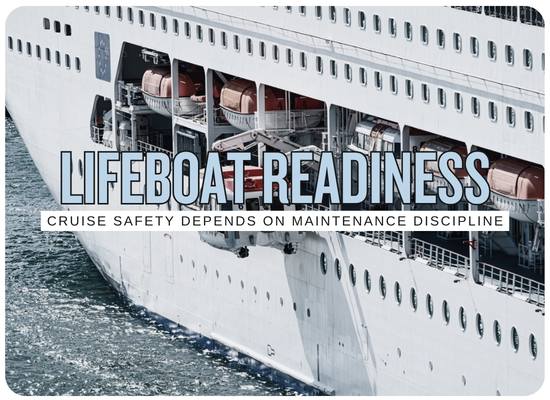
Cruise ships carry thousands of people, which means lifeboat readiness has to be treated like a live operating system. The hull, engine, release gear, davit, winch, falls, batteries, communications, supplies, crew drills, and inspection records all need to tell the same story: this equipment will work when called.
The maintenance lens has changed
Cruise operators can no longer judge lifeboat readiness only by a clean-looking craft and a completed drill. The practical risk is usually buried deeper: a release hook with poor history, a davit limit switch that has not been properly challenged, expired service documentation, weak battery performance, corroded wire falls, an engine that starts only under perfect conditions, or a crew that knows the drill script but not the fault scenario.
Annual and five-year service cycles need records that inspectors, class, flag, and operators can follow without confusion.
Cruise ships carry large, mixed passenger populations, so launch readiness must account for older guests, children, accessibility needs, and crowd flow.
Lifeboat accidents have historically made drills and maintenance a focus area, especially around release gear and launching appliances.
A small defect can become a detainable item if maintenance records, service authorization, or operational testing cannot support readiness.
10 lifeboat maintenance traps cruise operators should watch closely
The most expensive lifeboat problems are often predictable. They start as small gaps in servicing, records, crew familiarity, or equipment aging, then show up during a drill, port inspection, class attendance, or real emergency.
Release gear treated as a routine fitting
Release gear is one of the most sensitive parts of the lifeboat system. Poor adjustment, undocumented servicing, corrosion, worn components, incorrect reset, or maintenance under unsafe conditions can turn a safety device into a serious hazard. Operators should treat hooks, interlocks, hydrostatic systems, and reset indicators as critical controls, not ordinary deck hardware.
Confirm service-provider authorization, manufacturer procedures, crew familiarity, reset verification, and records for every on-load or off-load release system.
Davit and winch testing left too close to the deadline
A cruise ship schedule leaves limited room for surprise failures. Davits, winches, brakes, limit switches, sheaves, foundations, hydraulic lines, and control stations need planned attention before the inspection window gets tight. Current IMO servicing requirements include annual thorough examination and operational testing, plus deeper five-year examination, overhaul, and overload operational testing for relevant equipment.
Build a forward calendar around class attendance, drydock windows, port availability, load-test logistics, and parts lead times.
Wire falls aging quietly in a harsh environment
Wire falls are exposed to salt, weather, bending fatigue, lubrication issues, sheave wear, and uneven handling. They can look acceptable from a distance while hiding broken wires, corrosion pockets, diameter loss, or end-termination concerns. On a cruise ship, multiple boat stations can multiply the risk if inspections become too visual and not technical enough.
Track wire fall condition by station, date, running hours, lubrication, diameter checks, renewal history, and defects found during drills.
Engines that start during checks but fail the stress test
A lifeboat engine should not only start on a calm inspection day. It has to be ready after vibration, humidity, battery drain, fuel aging, cooling restrictions, and long idle periods. Fuel quality, filters, coolant, belts, batteries, charge systems, starter motors, ventilation, exhaust arrangements, and seawater circuits all deserve more attention than a quick start-and-stop.
Record cold-start behavior, battery voltage, charging performance, fuel condition, cooling checks, steering response, and running duration.
Batteries and chargers checked only at surface level
Lifeboat batteries are easy to underestimate. A green light on a charger does not always prove useful capacity under load. Cruise operators should monitor charger function, terminals, corrosion, battery age, cable condition, load performance, emergency lighting, radio power, and any system that depends on stored energy during a real evacuation.
Use load-based checks where applicable and keep battery replacement dates, charger alarms, and station-level defect trends visible to the safety team.
Sprinkler and air-support systems overlooked on enclosed boats
Fully enclosed lifeboats can include systems that are not tested as naturally as engines or steering. Sprinkler lines, pumps, nozzles, valves, air cylinders, pressure gauges, seals, hatches, ventilation controls, and closing arrangements need special discipline. A lifeboat can look ready while still carrying weaknesses in survival-support systems.
Verify system-specific test steps, pressure readings, valve positions, nozzle condition, closing arrangements, and spare parts for enclosed craft.
Inventory and survival equipment drift
Lifeboat equipment lockers can suffer from expired supplies, missing items, moisture damage, loose stowage, damaged packaging, weak labeling, or inconsistent counts between boats. On cruise ships, high passenger capacity makes standardization especially important. Every boat station should be easy for crew to audit and easy for inspectors to verify.
Track water, rations, first-aid items, signaling equipment, seasickness supplies, tools, bailers, plugs, thermal protection, and documentation by boat number.
Crew drills that avoid realistic faults
A scripted drill may satisfy a schedule but still leave gaps in readiness. Cruise crews need practice with abnormal conditions: failed engine start, partial communications, passenger mobility limits, blocked access, night operations, weather exposure, delayed launch, injured passenger, missing muster group, or a release-system fault that requires escalation.
Rotate drill scenarios by station and include deck, hotel, medical, security, and guest services roles where passenger movement is involved.
Service-provider paperwork that does not survive inspection
Under the current IMO framework, work on lifeboats, rescue boats, launching appliances, and release gear depends heavily on qualified, authorized service providers and documented standards. A ship can have the right maintenance performed and still face trouble if certificates, authorization, technician scope, equipment serial numbers, or checklists are unclear.
Match every service report to the boat, davit, winch, release gear, manufacturer, technician authorization, test performed, parts used, and next due date.
Passenger evacuation planning separated from equipment maintenance
Lifeboat readiness is not complete if it only proves that equipment can move. Cruise ships need the human side to match: muster routing, accessible embarkation, crowd control, public address clarity, crew assignments, passenger counting, children and older guests, language support, medical cases, and communication between the bridge and boat stations.
Connect lifeboat maintenance records with evacuation drills, muster observations, passenger-flow reviews, and lessons from tabletop exercises.
Maintenance matrix for cruise lifeboat systems
A useful lifeboat program separates the asset into maintainable systems. This keeps the safety team from treating the boat as one object and helps management see which part of the chain is creating risk.
| System Area | Common Weak Point | Inspection Signal | Operator Response |
|---|---|---|---|
| Release gear | Misadjustment, worn components, poor reset, weak documentation | Unclear service report, crew uncertainty, inconsistent indicators | Verify authorized servicing, manufacturer procedure, reset checks, and crew briefing |
| Davit and winch | Brake wear, hydraulic leaks, sheave wear, limit switch faults | Noisy operation, uneven lowering, slow response, overdue testing | Plan annual and five-year tasks early, with parts and load-test logistics secured |
| Wire falls | Corrosion, broken wires, lubrication gaps, fatigue, poor end condition | Diameter loss, rust staining, rough movement, station-level variation | Track condition by boat station and renew before defects become inspection findings |
| Boat engine | Weak battery, fuel contamination, cooling restriction, starter issues | Slow start, smoke, poor charging, short run checks only | Record cold starts, running duration, fuel condition, coolant, belts, and charge status |
| Electrical systems | Battery age, charger fault, corroded terminals, emergency light failure | Charger alarm, voltage drop, loose cables, weak radio power | Use load checks and replacement tracking, not only visual charger confirmation |
| Hull and closures | Cracks, seal damage, hatch issues, seating damage, water ingress | Moisture, delamination, loose fittings, damaged gaskets | Inspect structurally and functionally, especially on heavily exposed stations |
| Survival equipment | Expired items, missing inventory, moisture damage, inconsistent stowage | Different locker layouts, damaged packs, poor labeling | Standardize boat-by-boat inventory sheets and seal checks |
| Records and certificates | Incomplete scope, missing serial numbers, unclear technician authorization | Inspector cannot trace work to equipment or due date | Build a single LSA evidence pack with certificates, reports, checklists, and defect closure |
Supplier opportunities inside cruise lifeboat maintenance
Cruise operators need more than a yearly service visit. They need partners that reduce downtime, improve evidence, train crew safely, and help plan work around itineraries.
Annual and five-year examination support
Strong opportunity for providers that can cover multiple equipment brands, produce clean documentation, and coordinate load testing without disrupting itineraries.
Critical spares before the inspection window
Hooks, seals, wire falls, batteries, gauges, hoses, filters, belts, and manufacturer-specific parts can become schedule risks if ordered too late.
Boat-by-boat compliance evidence
Fleet managers need dashboards that show due dates, defects, certificates, technician scope, serial numbers, and closed corrective actions across many vessels.
Scenario-based drill support
Vendors can help operators move beyond routine drills with fault scenarios, safe release-gear training, passenger-flow coordination, and post-drill findings.
From calendar maintenance to defect prediction
Sensors, inspection apps, photo records, trend logs, and asset histories can help operators detect recurring problems before they become detainable deficiencies.
Cruise Lifeboat Maintenance Risk Score
Use this quick tool to estimate whether a cruise ship’s lifeboat maintenance program is in a strong position or approaching a risk zone. It is not a statutory survey, but it can help safety, technical, and operations teams prioritize follow-up.
Readiness level
Recordkeeping checklist for cruise operators
Lifeboat paperwork should be built for fast review. A strong evidence pack can reduce inspection friction and help shore management see risk before the ship does.
| Record Item | Useful Detail | Common Gap |
|---|---|---|
| Boat identification | Boat number, maker, model, serial number, capacity, station location | Reports that do not clearly match the boat or station |
| Davit and winch identification | Maker, model, serial number, brake data, test date, next due date | Equipment listed generically as port or starboard only |
| Release gear service | Technician authorization, parts used, reset check, operational test result | Unclear scope or no link to the specific release system |
| Defect closure | Finding, risk level, corrective action, part number, retest, closeout date | Open defects carried forward without clear ownership |
| Wire fall history | Installation date, inspection notes, lubrication, renewal, condition trend | No station-level trend or unclear renewal evidence |
| Drill findings | Scenario, crew roles, timing, abnormal events, lessons, corrective actions | Drill completed but no operational learning captured |
| Survival inventory | Expiry dates, locker condition, missing items, seals, moisture condition | Inventory checked but not standardized across boats |
Execution notes for cruise technical teams
The strongest lifeboat programs are predictable. They do not depend on one inspection visit, one expert crew member, or one folder of certificates. They create repeatable discipline at every boat station.
The best lifeboat program is boring on inspection day
Cruise lifeboat maintenance should not become dramatic during surveys, drills, or port inspections. The goal is a calm, traceable, well-practiced system where equipment condition, service records, crew training, and passenger evacuation planning all line up. For cruise operators, that kind of readiness protects passengers, protects crew, and protects the brand.
We welcome your feedback, suggestions, corrections, and ideas for enhancements.
Please click here to get in touch