The Routes Rewriting Shipping
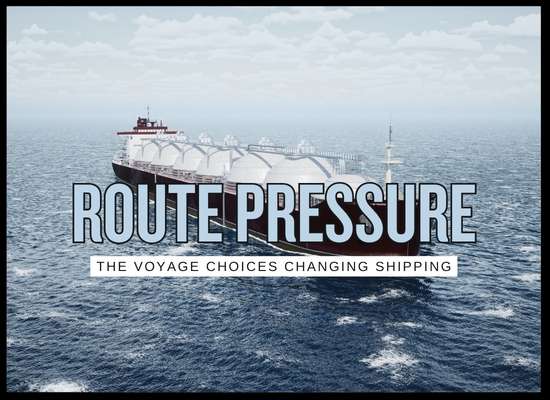
Shipping is being reshaped right now not just by freight demand or ship supply, but by a series of route choices that operators have been forced to make under pressure. Some are crisis-driven, like staying away from the Red Sea or treating Hormuz exposure more cautiously. Others are economic, like planning arrivals to avoid waiting time, using canal slots more strategically, or making route and fuel decisions with carbon cost in mind. UNCTAD’s 2025 Review of Maritime Transport says rerouting away from the Red Sea and around the Cape of Good Hope added roughly 30% to some Asia-Europe voyage lengths and sharply increased distance-adjusted demand, while current UNCTAD Hormuz work shows how quickly another chokepoint can spill into freight, fuel, and insurance cost. At the same time, the European Commission’s ETS and FuelEU rules are making some routing decisions more commercially visible than they were even a year ago, and the Panama Canal’s 2026 slot allocation framework is reinforcing the idea that route planning is increasingly a reservation and certainty problem, not just a geography problem.
| # | Routing decision | Changing | Happening now | Operator Actions | Teams should watch | Impact tags |
|---|---|---|---|---|---|---|
| 1 |
Staying off the Red Sea and routing around the Cape of Good Hope
Still the most visible route reset in global liner and many tanker and bulk patterns.
|
The Red Sea detour has turned from temporary disruption into a structural routing choice on many trades. UNCTAD said the diversion around the Cape added about 30% to some Asia-Europe voyage lengths and sharply boosted distance-adjusted demand, which changed vessel deployment, schedule design, and freight economics well beyond the affected corridor. | The security picture has remained unstable enough that many operators still see the Cape route as commercially cleaner than returning to a shorter but more exposed passage. | Stronger operators are no longer treating the Cape as a pure contingency. They are redesigning service loops, vessel strings, bunker planning, and schedule promises around it as a working base case. | Voyage-length inflation, schedule recovery cost, extra bunker burn, TEU-mile growth, and how much fleet capacity is being absorbed by longer loops. | Red Sea Cape route Distance shock |
| 2 |
Treating Hormuz exposure as a routing and waiting decision, not just a transit question
Operators are increasingly deciding not only whether to pass, but when to hold, approach, or defer.
|
The current Gulf disruption has widened routing logic beyond simple passage through the Strait. The real decision now often includes timing, hold-off behavior, risk tolerance by cargo, and whether the ship should remain outside the most exposed operating pattern until the next instruction is commercially clearer. | UNCTAD’s March 2026 Hormuz analysis shows how quickly transits and market conditions changed, while freight rates, war-risk premiums, and fuel costs reacted almost immediately. | Stronger operators are putting routing, insurance, crew exposure, and charterparty fit into one live decision loop instead of treating passage as a standalone navigational question. | Hold-off time, changed approach instructions, premium timing, laycan pressure, and the gap between navigational feasibility and commercial executability. | Hormuz Holding patterns Risk timing |
| 3 |
Using just-in-time arrival instead of sail fast then wait
One of the quietest route shifts is also one of the most commercially important.
|
More fleets are adjusting voyage speed and approach timing so the ship reaches port closer to when the berth, terminal, or cargo system is actually ready. This changes routing in a practical sense because the vessel is no longer optimizing only for shortest transit time but for lower total waste across the voyage and port call. | IMO continues to emphasize that many ships still spend hours or days waiting outside ports, and major industry work on port-call optimization keeps targeting the same old pattern of burning fuel to arrive early only to sit idle. | Stronger operators are combining weather, berth readiness, and commercial timing into one arrival plan so route execution and port execution stop fighting each other. | Anchorage hours, speed-to-wait ratio, avoided fuel burn, berth-readiness accuracy, and how often early arrival actually creates value. | JIT arrival Waiting reduction Operational savings |
| 4 |
Choosing Panama transit certainty over ad hoc canal access
Panama routing is increasingly becoming a booking and slot strategy, not just an all-water geography choice.
|
The Panama Canal’s updated reservation and long-term slot allocation framework is reinforcing a more deliberate routing mindset. For some operators, the real route decision is no longer just Panama versus alternative paths, but whether to pay up for certainty, commit earlier, or redesign the network around more predictable canal access. | The canal has moved further toward structured slot allocation, with LoTSA 2.0 and booking-system changes intended to support planning certainty and more cost-effective operations for customers. | Stronger operators are treating canal access as part of network design and cost control rather than assuming capacity can always be purchased at the last workable moment. | Slot security, auction and booking cost, transit timing certainty, and the cost difference between planned access and reactive access. | Panama Slot strategy Planning certainty |
| 5 |
Making carbon-aware route choices on EU-linked trades
Route economics are increasingly being re-priced by emissions exposure, not only bunker cost and transit time.
|
The route now matters more commercially on EU-linked trades because emissions carry more explicit financial consequence under EU ETS and fuel strategy is more tightly connected to voyage design under FuelEU Maritime. This does not mean vessels are “detouring for carbon” in a simplistic way, but it does mean route, speed, waiting time, and fuel choice are more connected than before. | The European Commission’s shipping ETS framework and FuelEU rules have made voyage execution on covered trades more financially visible and harder to treat as purely operational. | Stronger operators are bringing carbon cost into routing, speed, and fuel decisions earlier instead of leaving it as a compliance calculation after the voyage is already fixed. | EU-linked emissions exposure, time in port, fuel-strategy impact, ETS cost by leg, and whether route options are being compared on total cost rather than bunker bill alone. | EU ETS FuelEU Carbon-aware routing |
| 6 |
Rebalancing transshipment through Mediterranean and other relay hubs
When mainline paths change, hub strategy changes with them.
|
One of the quieter routing shifts has been the growing importance of how carriers rebalance transshipment through relay hubs when traditional corridor logic is under pressure. Longer Cape routings, Red Sea avoidance, and schedule instability have all changed how some services sequence calls and where cargo is most efficiently transferred. | Longer voyage loops, weaker schedule reliability, and pressure to recover network stability make it harder to keep legacy hub patterns untouched. Operators have had to rethink where they consolidate, split, and relay cargo so that disruption in one corridor does not damage the whole network equally. | Stronger operators are treating hub selection and relay design as a live network-control question instead of assuming the old hub map still works efficiently under longer and less reliable route structures. | Missed connections, relay dwell time, transshipment congestion, feeder dependency, and whether hub changes are improving or worsening end-to-end reliability. | Transshipment Hub strategy Network redesign |
| 7 |
Choosing route certainty over nominal distance
The shortest route is losing ground to the most executable one.
|
A major routing shift now underway is the willingness to accept a longer voyage if it produces better execution certainty, cleaner insurance treatment, stronger schedule credibility, or fewer operational surprises. In other words, some operators are paying more distance to buy less uncertainty. | Corridor disruptions, canal booking uncertainty, and security-linked rerouting have made nominally shorter routes less attractive when they carry a higher probability of disruption, delay, or mid-voyage commercial reset. | Stronger operators are comparing routes on total execution value rather than nautical miles alone. That includes reliability, insurability, congestion risk, and the chance that the route still works commercially if conditions worsen. | On-time performance, cost of disruption avoided, schedule promises kept, and the premium being paid for route certainty over route length. | Certainty Risk tradeoff Execution value |
| 8 |
Routing around fuel and bunkering optionality
Fuel planning is becoming part of route design rather than a downstream purchasing step.
|
More voyage plans are now being shaped by where the ship can bunker economically, reliably, and in a way that fits both compliance exposure and the next leg of the route. That means route choice is increasingly tied to bunker flexibility rather than only to distance and port sequence. | Fuel cost volatility, FuelEU exposure on some trades, and wider concern about execution certainty have all pushed operators to think about routing and bunkering as one combined decision. | Stronger operators are comparing route options with bunker strategy built in from the start, including price, availability, fuel type, compliance implications, and the operational cost of where and when the vessel will actually take supply. | Delivered bunker cost, bunker-stop efficiency, fuel availability risk, compliance impact by route, and cost difference between flexible and forced fueling strategies. | Bunkering Fuel strategy Voyage design |
| 9 |
Routing with cargo sensitivity in mind instead of treating all voyages the same
Some cargoes can absorb uncertainty. Others cannot.
|
More operators are differentiating routes according to cargo sensitivity. Energy flows, time-critical containers, refrigerated cargo, and supply-linked industrial inputs do not all tolerate the same delay profile or risk posture, so routing is becoming more cargo-specific than it used to be. | Security shocks, weather risk, schedule fragility, and cost-chain spillover have made it harder to justify one routing template across all cargo classes when the commercial damage from delay varies so widely. | Stronger operators are matching route choice to cargo value, timing sensitivity, downstream penalty risk, and the real commercial cost of uncertainty rather than optimizing only around vessel movement. | Cargo-delay cost, sensitivity by commodity, claims exposure, customer service failure, and whether route choice is being aligned with the cargo’s real tolerance for disruption. | Cargo fit Timing sensitivity Commercial alignment |
| 10 |
Building route playbooks around corridor-specific risk rather than global averages
Routing is becoming more corridor-specific, rule-based, and operationally codified.
|
Another quiet but important shift is that operators are writing route playbooks tied to specific corridors rather than relying on general network habits. The bridge, the operations desk, chartering, compliance, and insurance teams increasingly need corridor-specific triggers for when to slow down, hold off, divert, book earlier, or change the commercial posture. | Repeated disruption in the same corridors has shown that generic operating logic is too blunt. What works for the North Atlantic or a normal Asia-Europe passage may be badly mismatched to Red Sea, Hormuz, Panama, or EU-covered voyage conditions. | Stronger operators are codifying hotspot-specific route playbooks so decision-making becomes faster, more repeatable, and less dependent on improvisation every time the same corridor destabilizes again. | Corridor-specific escalation triggers, response speed, repeatability of routing choices, and whether lessons learned are actually changing default route behavior. | Playbooks Corridor risk Decision rules |
The strongest route is no longer simply the shortest one. It is the one that holds together best across security, timing, fuel, carbon, canal certainty, and cargo sensitivity. This tool is meant to show where the route is quietly leaking value before the next visible disruption makes the choice look obviously wrong.