
🔔 Subscribe to ShipUniverse Weekly →
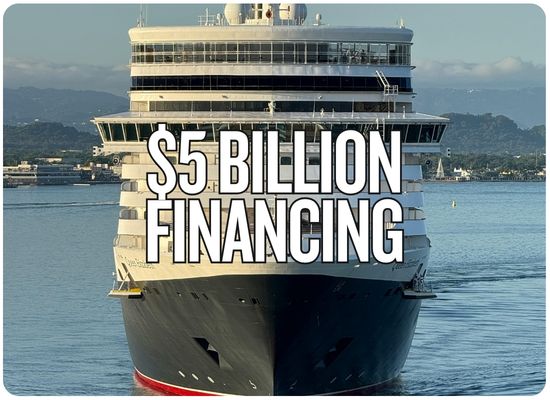
Norwegian Cruise Line Holdings has secured credit facilities totaling up to approximately $5 billion to finance two 227,000-gross-ton cruise ships under construction arrangements with Italy's Fincantieri, with deliveries scheduled for 2034 and 2036. Each vessel is designed for approximately 5,000 lower berths, adding a combined 10,000 berths to Norwegian Cruise Line's planned fleet. The financing agreements were signed October 27, disclosed in an SEC filing October 30 and reported by cruise-industry media on November 3, 2026. Crédit Agricole Corporate and Investment Bank serves as facility agent, alongside other lenders, with Italian export credit agency SACE providing conditional insurance coverage. The facilities can finance 80% of qualifying ship delivery payments and mature 12 years after each vessel's delivery.
Two Ships. Two Credit Facilities. A $5 Billion Ceiling.
Italian export-credit support underpins long-term vessel financing for Norwegian's largest planned ship class.
454,000 GT combined gross tonnage
2034 + 2036 scheduled deliveries
Fincantieri shipbuilder
The Two Financed Vessels
Both are existing planned newbuilds within Norwegian's larger five-ship next-generation program.
NCL NextGen Class III Ltd. is the borrowing entity.
NCL NextGen Class IV Ltd. is the borrowing entity.
How the Financing Is Structured
Norwegian's Five-Ship Mega-Class Through 2037
Two existing vessel orders move into the financed category, within a much larger three-brand fleet renewal program.
Five Planned Ships, Five Delivery Years
Cumulative new-class lower berths, assuming delivery as scheduled and without deducting other fleet changes.
Construction and Financing Status
| Target Year | New-Class Vessel | Gross Tonnage | Lower Berths | Financing Status | Commercial / Contract Milestone |
|---|---|---|---|---|---|
| 2030 | New Class 1 | ~227,000 GT | ~5,000 | Previously financed | First planned delivery of the larger Norwegian Cruise Line newbuild class. |
| 2032 | New Class 2 | ~227,000 GT | ~5,000 | Previously financed | Second planned vessel adds another 5,000 lower berths to the class. |
| 2034 | New Class 3 | ~227,000 GT | ~5,000 | Oct. 2026 agreement | NCL NextGen Class III credit facility, up to approximately $2.5B. Maturity expected in 2046. |
| 2036 | New Class 4 | ~227,000 GT | ~5,000 | Oct. 2026 agreement | NCL NextGen Class IV credit facility, up to approximately $2.5B. Maturity expected in 2048. |
| 2037 | New Class 5 | ~227,000 GT | ~5,000 | Conditional | Additional planned vessel announced in February 2026; financing and contract effectiveness remain subject to conditions. |
Total prospective lower-berth capacity by 2037, including the conditional fifth vessel. This is gross newbuilding capacity, not net fleet growth.
The two ships represent approximately 23% of the 43,000 berths in NCLH's full announced newbuilding pipeline across all three brands.
Can 10,000 New Berths Support the Debt?
Model Norwegian's 2034 and 2036 delivery milestones using the actual repayment structure, then test passenger-night capacity, operating cash contribution and floating interest-rate exposure.
Change the Assumptions
The financing ceiling and vessel capacities are sourced. All future occupancy, interest-rate and operating-cash inputs are illustrative.
Occupied guest-nights for the ships assumed in service by the selected year. This is a full-year equivalent, not a forecast of actual bookings or first-year operations.
Capacity and Debt-Service Comparison
Berth growth is scheduled in two stages. The debt-service bars reflect the model's interest and repayment calculation for the selected year.
Debt service divided by modeled occupied passenger-nights, not total operating cost.
Assumed utilization of each applicable $2.5B maximum facility, including financed premiums.
Each vessel has 5,000 preliminary lower berths and a facility ceiling of approximately $2.5B. The selected utilization is applied equally to both facilities. This represents a hypothetical amount borrowed, not the shipbuilding purchase price or a verified drawdown. The ceiling includes eligible SACE premiums.
The loans are modeled with 24 equal principal installments at six-month intervals following delivery, as specified in the October 30 SEC filing. Interest is estimated semiannually on opening principal at (selected SOFR + 0.90%) ÷ 2. The rate is assumed constant over the model year, without capitalization, fees, hedging or changing reset dates. For the 2034 and 2036 deliveries, each calendar year is treated as a complete operating and loan year starting at the delivery anniversary. Actual calendar-year results will depend on delivery dates and payment timing.
Annual passenger cruise days = ships × 5,000 lower berths × selected operating days × lower-berth occupancy. Occupancy above 100% is permitted because extra passengers may share cabins. Equivalent passenger voyages = passenger cruise days ÷ selected cruise duration. These are theoretical embarkation equivalents, not unique customers or confirmed ticket sales.
Operating cash contribution is a user-supplied hypothetical amount per occupied guest-night after assumed direct operating expenses and before modeled financing payments. Cash remaining after debt service is not corporate free cash flow, earnings or profit. The model excludes taxes, corporate overhead, further capital spending, maintenance reserves, working capital, other fleet debt, foreign-exchange effects, SACE premium costs not reflected in assumed draws and principal refinancing. The two newbuilds' operation and debt service are modeled separately from the rest of Norwegian Cruise Line Holdings.
We welcome your feedback, suggestions, corrections, and ideas for enhancements.
Please click here to get in touch