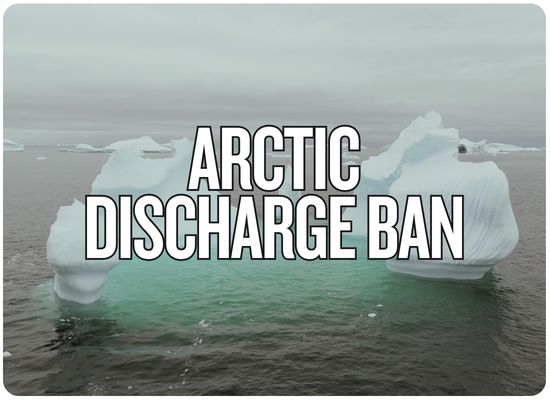
Greenland's parliament has unanimously approved a plan to phase out wastewater discharges from ship exhaust-gas cleaning systems in its ports, internal waters and territorial sea. Under the government-backed timetable, open-loop scrubber discharges would be prohibited from July 1, 2027, with the restriction extending to closed-loop and hybrid systems from July 1, 2029. The proposal passed by 21 votes, with no opposition or abstentions. It would require affected ship operators to reassess fuel selection, wastewater retention, scrubber operating procedures and the economics of Greenland voyages.
ShipUniverse | Arctic Shipping Regulation | November 2026
Greenland's Scrubber Discharge Deadline Is Now on the Calendar
A unanimous parliamentary decision sets a two-stage plan to stop wastewater from ship exhaust-gas scrubbers entering Greenlandic coastal waters.
Parliamentary Vote21–0
Passed October 8, 2026, with no abstentions
First Deadline2027
Open-loop discharge phaseout
Second Deadline2029
All scrubber discharge modes
Territorial Reach12 NM
Territorial-sea limit, plus internal waters and ports
Two Deadlines. Different Technical Consequences.
The dates are the adopted implementation targets. Detailed enforceable provisions must still be introduced.
Ships using open-loop scrubbers would need to stop discharge before entering restricted waters. Options could include switching to compliant fuel or using approved closed-loop operation where installed.
Closed-loop and hybrid scrubber discharge would also be prohibited. Zero-discharge operation with adequate onboard retention, or compliant-fuel operation, becomes the practical comparison.
Why the System Type Matters
A scrubber reduces sulfur emissions to air, but different designs manage the resulting contaminated washwater differently.
Open-Loop
Uses seawater once and usually releases treated exhaust washwater overboard. It cannot simply become a recirculating system without appropriate equipment.
Discharge targeted from 2027
Closed-Loop
Recirculates cleaning water but typically produces a bleed-off stream requiring proper management. Closed-loop does not automatically mean zero discharge.
Bleed-off targeted from 2029
Hybrid
Can change between open and closed modes. After 2027, closed mode may provide flexibility; after 2029, wastewater retention or compliant fuel becomes more important.
Both discharge modes covered by 2029
Where Greenland Plans to Apply the Restrictions
The proposed reach is broader than port-only controls.
Port AreasBerths, harbor operations and designated port waters
Internal WatersWaters landward of the relevant territorial baseline
Territorial SeaSeaward zone extending generally to 12 nautical miles
The key distinction: This is a planned restriction on discharge into the water, not a general prohibition on ships carrying scrubber equipment. Final operating, documentation, retention and enforcement requirements remain subject to implementing rules.
ShipUniverse | Arctic Regulatory Intelligence
Three Scrubber Designs. Two Deadlines. Multiple Jurisdictions.
What changes for open-loop, closed-loop and hybrid vessels, and how the Greenland plan fits into the growing regional restrictions on scrubber wastewater.
Greenland: Proposed Operating Requirements
Planned requirements, subject to implementing legislation. Operational choices are illustrative and require vessel-specific approval.
Ship Equipment
From July 2027
From July 2029
Potential Operating Response
Primary Cost Driver
Open-Loop ScrubberSeawater through-flow
Discharge prohibited
Direct washwater overboard would not be allowed.
Discharge prohibited
No relief from the second-stage rule.
Switch to compliant fuel and cease discharge. A conversion to hybrid technology would require equipment investment.
Fuel premium, changeover logistics and operational planning.
Closed-Loop ScrubberRecirculation with bleed-off
Closed-loop discharge not yet in phased ban
Other applicable controls may still apply.
Bleed-off prohibited
Closed-loop does not mean zero wastewater release.
Retain wastewater using a verified zero-discharge configuration, arrange approved disposal or use compliant fuel.
Holding tank capacity, discharge reception, operating cost or fuel premium.
Hybrid ScrubberSwitchable open/closed modes
Closed-mode option
Open-mode discharge would be prohibited.
No scrubber discharge
Closed-mode bleed-off is covered too.
Use closed mode when allowed, then zero-discharge storage or compliant fuel as the second phase begins.
Equipment capabilities, wastewater retention and fuel spread.
No ScrubberCompliant-fuel vessel
No scrubber water
Scrubber-discharge restriction does not apply.
No scrubber water
Other fuel and emissions rules still apply.
Continue using fuel or propulsion that meets applicable environmental requirements.
Marine fuel supply and price, not scrubber wastewater management.
Three Different Regulations to Check
Compliance with one does not automatically satisfy the others.
01 / MARPOL ANNEX VI
Sulfur in Exhaust
The global fuel sulfur cap is generally 0.50%, with 0.10% fuel limits in designated sulfur ECAs, subject to approved equivalent compliance methods.
02 / GREENLAND PLAN
Scrubber Discharge to Water
The new proposal targets wastewater discharge regardless of whether exhaust emissions comply with the sulfur rules.
03 / MARPOL ANNEX I
Arctic Heavy Fuel Oil
Specific heavy fuel oils are subject to a separate Arctic use-and-carriage prohibition, with remaining transitional provisions expiring in 2029.
How Nearby Rules Compare
Effective national rules versus Greenland's planned implementation. OSPAR's timetable covers a different minimum geographic area.
Jurisdiction
Open-Loop Discharge
Closed-Loop Discharge
Geographic / Legal Distinction
Greenland
July 1, 2027 planned
July 1, 2029 planned
Ports, internal waters and territorial sea; parliamentary direction approved, implementing rules pending.
Denmark
Prohibited since July 1, 2025
Prohibited from July 1, 2029
Applies in Danish territorial waters under national regulations.
Sweden
Prohibited since July 1, 2025
Zero-discharge requirements from January 2029
National territorial-water requirements, with additional port conditions possible.
Finland
Prohibited since July 1, 2025
Prohibited from January 1, 2029
Territorial-water controls under enacted national law.
OSPAR 2025/01
National measures by July 1, 2027
National measures by July 1, 2029
Ports and internal waters; implementation provisions allow notified postponement, and territorial expansion is under review.
Sweden's precise closed-loop operational requirements should be checked against the applicable national regulations. Greenland is not automatically governed by every Danish territorial-water implementing rule.
The Shipowner's Six-Point Compliance Review
01 / ROUTEPlot Territorial Entry
Identify where the vessel enters port, internal or territorial waters subject to restrictions.
02 / EQUIPMENTVerify EGCS Mode
Record whether the scrubber can operate open, closed or genuinely without discharge.
03 / FUELConfirm Approved Fuel
Check sulfur requirements and separate Arctic HFO restrictions for each voyage segment.
04 / WATERMeasure Holding Capacity
Calculate bleed-off volume and actual usable retention, including contingency margin.
05 / DISPOSALCheck Reception Facilities
Arrange suitable waste reception where available; do not assume every Arctic port can accept scrubber residues.
06 / EVIDENCEDocument the Changeover
Prepare records of fuel use, discharge controls, tank status and other applicable compliance evidence.
What Is Already Established
The parliamentary decision, phase-in targets, affected discharge types and proposed Greenlandic geographic reach.
What Still Needs Final Rules
Precise inspection methods, enforcement provisions, equipment exceptions if any, documentation and locally available waste-handling arrangements.
Compare compliant-fuel switching against zero-discharge wastewater retention. Check storage feasibility, costs per Greenland visit and the annual effect on a vessel or fleet.
Planning model: Proposed Greenland phases, not current enforceable restrictions. Fuel eligibility under the IMO Arctic HFO rules and other national requirements must be assessed separately. All default financial figures are hypothetical.
1. Select the Regulatory Phase and Fuel Profile
Fuel consumption represents only the days inside the relevant controlled waters. The price difference is a user assumption, not a live bunker quotation.
Coastal approach, fjord passage and port time combined.
Model the annual operating schedule.
Average consumption over the selected restricted hours.
For fleet scaling only; vessel characteristics may vary.
Hypothetical reference fuel; not proof it is permitted.
Select a fuel appropriate to the vessel and applicable rules.
2. Calculate Zero-Discharge Storage and Disposal
For a closed-loop or hybrid scrubber capable of retaining bleed-off, test whether actual usable tank capacity covers the operating window, including a safety margin.
Illustrative equipment-specific wastewater rate.
Available free capacity, not total nameplate volume.
Additional design allowance for operating variability.
Assumed price at a suitable receiving facility.
Waste handling and collection arrangement.
Incremental operating expense compared with reference use.
Hypothetical one-time modifications if required.
Simple straight-line cost allocation, without financing.
Wastewater Holding Capacity TestStorage feasible
Required storage compared with usable capacity.
3. Compare the Two Compliance Cost Paths
Both figures represent incremental expense compared with the entered high-sulfur fuel reference. The model separately considers whether the proposed phase allows continued closed-loop discharge.
Option A | Switch to Compliant Fuel
$21,200
Extra fuel cost per visit, compared with the reference fuel.
Option B | Retain and Dispose
$10,879
Waste collection, operating expense and allocated modification cost per visit, if feasible.
Fuel Used in Controlled Waters80.0 t
Per vessel, per Greenland visit
Wastewater Generated36.0 m³
Before the storage safety margin
Storage Required With Margin41.4 m³
Compared with available usable tanks
Fuel-Switching Premium / Year$148,400
Illustrative annual incremental fuel cost
Zero-Discharge Cost / Year$76,150
Includes allocated modification expenditure
Lowest Modeled Annual Response Cost$76,150
Subject to fuel legality and equipment feasibility
Annual Difference vs Fuel Switch$72,250
Positive means the selected alternative costs less
Retention Break-Even Fuel Spread$135.98/t
Indicative spread needed to cover retention costs
Fleet Annual Response Cost$76,150
Applies uniform operating assumptions to all vessels
Wastewater retention is less expensive in this scenario
The selection uses the lowest modeled feasible response, subject to technical and legal suitability.
Calculation method: Fuel consumption per visit equals daily consumption multiplied by restricted hours divided by 24. Switching premium equals fuel consumed multiplied by the difference between compliant fuel and reference fuel prices.
Wastewater volume equals bleed-off rate multiplied by restricted hours. Required holding capacity equals that volume multiplied by one plus the safety margin. Retention is viable only when closed-loop-capable equipment is selected and sufficient usable tank capacity is available.
The zero-discharge cost includes wastewater volume multiplied by disposal cost, a fixed collection charge, incremental daily running expenses and simple annualized modification investment allocated across the selected yearly visits.
From the modeled 2027 phase, ordinary closed-loop discharge is treated as not yet prohibited by this specific Greenland phase-in, subject to other restrictions. From the modeled 2029 phase, the least-cost feasible response is selected between compliant fuel and zero-discharge retention.
Important: This is not legal confirmation that the reference high-sulfur fuel can be carried or burned in any specific Arctic location. Compliance with MARPOL Annex I Regulation 43A, sulfur emission requirements and the forthcoming Greenland rules must be established independently. The tool assumes suitable waste reception is available outside the restricted area; this is not guaranteed. Modification capital cost is allocated rather than discounted, and the model excludes downtime, fuel changeover expenses, variable processing performance, tank cleaning, financing, carbon pricing and charterparty allocation of benefits.
Feedback Welcome
We welcome your feedback, suggestions, corrections, and ideas for enhancements.