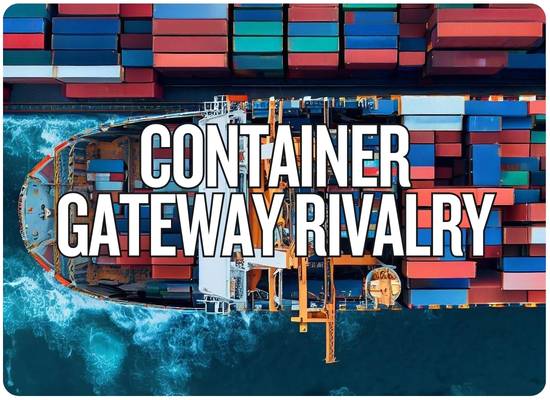
Poland launched a procurement process on November 3, 2026, for approximately PLN 2.5 billion ($637 million) of marine construction at Cape Pomerania, a new deepwater port development at Świnoujście on the Baltic Sea. The design-and-build contract covers land reclamation, protective breakwaters, dredging, navigational infrastructure and a 1,300-meter container pier. The wider development is designed to create 186 hectares of new land and accommodate a container terminal with eventual capacity of two million TEU annually. Contractor selection is scheduled for the third quarter of 2027. The procurement has been launched, but no main construction contract has yet been awarded.
ShipUniverse | Baltic Infrastructure | November 4, 2026
Poland Is Building an Entirely New Outer Port
Cape Pomerania would transform reclaimed seabed
into a deepwater container gateway, with
new protective structures, marine access
and a terminal designed for direct ocean calls.
Marine Works Tender
PLN 2.5B
Approximately US$637M; estimated procurement value
Future Container Capacity
2M TEU
Annual design target, not booked traffic
New Reclaimed Land
186 ha
Entire planned outer-port footprint
Container Pier
1,300 m
Approximately 530 meters wide
The Marine Engineering Footprint
Simplified arrangement of the published design.
Dimensions describe different components and
must not be added together as container berth length.
BALTIC SEA | POMERANIAN BAY
MAIN PROTECTIVE BREAKWATER
3,350 m
Integrated with dredged-material
reclamation areas T3 and T4.
EASTERN PROTECTION
1,580 m
Shields the container pier
and port basin.
TERMINAL PIER / T1–T2
1,300 × 530 m
Main container pier with
associated infrastructure.
WIDER OUTER PORT
~3 km
Planned total quay infrastructure,
beyond the initial container pier alone.
MARINE ACCESS
17 m
Planned port basin depth,
with dredged access and turning area.
RECLAMATION
186 hectares
New land for terminal facilities
and future outer-port development.
Conceptual engineering layout only; not to scale.
A further 120-meter auxiliary quay is
included in the announced works.
PUBLIC AUTHORITY 02
Szczecin–Świnoujście Port Authority
Container pier, port basin and associated
marine and landside connections.
One selected contractor will deliver
the jointly procured works.
The Procurement Clock
Official announced and tender-notice milestones.
NOVEMBER 3, 2026
Launch
Government announces the marine works procurement.
NOVEMBER 4, 2026
EU Publication
TED notice 766318-2026 is published.
DECEMBER 2, 2026
Qualification Deadline
Requests to participate due at 10:30 CET.
Q3 2027
Contractor Selection
Target date for choosing the main contractor.
What PLN 2.5 billion actually buys:
This is the estimated value of the marine
design-and-build package. It is not a final
awarded price, a complete accounting of
terminal equipment and all related investments,
or proof that two million TEUs have been
committed by shipping lines.
ShipUniverse | European Container Gateway Analysis
The Baltic Has More Capacity Coming Than Just Świnoujście
Cape Pomerania enters a market with established
deepsea calls, strong rail systems and competing
expansion plans. Winning cargo will depend on
carrier networks and all-in inland logistics costs,
not quay length alone.
Six Established Gateways Under the Microscope
Actual 2025 TEU throughput unless stated otherwise.
Potential competition is an analytical scenario,
not a forecast of traffic losses.
Gateway
2025 TEU
Infrastructure Position
Possible Competitive Overlap
Established Strength
Evidence Type
GdańskPoland
2.77M
Baltic Hub designed for 4.4M TEU annually.
Polish imports, central-European transit and Baltic transshipment.
Existing direct intercontinental calls, carrier connections and deepwater infrastructure.
Existing Hub
GdyniaPoland
>1.0M
Separate Outer Port aims for at least 2.5M additional TEU capacity.
Polish hinterland and competition for new ocean services.
Established container operators, rail links and current liner connections.
Expanding
HamburgGermany
8.30M
Major North Sea deepsea gateway.
Selected western Polish and central-European rail or truck cargo.
Large liner-service network, established hinterland rail system and terminal scale.
Existing Hub
BremerhavenGermany
5.21M
About 4.93 km of container quays.
Deepsea-to-Baltic feeder and selected central-European logistics flows.
Established vessel services, cargo volumes and rail connections.
Existing Hub
KlaipėdaLithuania
1.31M
Record 2025 container throughput.
Selected Baltic transshipment and connecting liner services.
Existing regional cargo relationships and eastern Baltic position.
Regional Gateway
Szczecin–ŚwinoujścieExisting Polish port group
109K
Current port-group container throughput before Cape Pomerania.
Transition from current smaller container activity toward direct deepsea operations.
Existing maritime and regional infrastructure; new gateway has not yet opened.
Project Home
Gdańsk's 2025 volume refers to Baltic Hub.
Gdynia's 2.5M future capacity is a separate,
uncompleted project. The 109K figure is for
the combined existing Szczecin–Świnoujście
port group, not the new Cape Pomerania terminal.
Figures do not represent directly interchangeable cargo.
Three Numbers That Change the Market Discussion
Świnoujście Planned
2.0M TEU
New terminal design capacity,
if completed and fully equipped.
Gdynia Outer Port Planned
2.5M+ TEU
Separate expansion seeking
a private development partner.
Gdańsk Baltic Hub Designed
4.4M TEU
Existing annual design capacity,
compared with 2.77M handled in 2025.
Capacity is infrastructure potential, not
guaranteed demand. Adding future project
capacities does not show how many TEUs
shipping lines will actually move.
The Tender's Hidden Contractor Filter
EU publication 766318-2026 establishes
demanding financial and construction
experience requirements. Qualifying consortia
are permitted subject to specific rules.
Annual Net Revenue
PLN 1B
Required in each of the preceding three fiscal years.
Financial Resources / Credit
PLN 350M
Minimum available finance or borrowing capacity.
Liability Insurance
PLN 75M
Minimum qualifying civil-liability coverage.
Specialist experience: The tender requires
qualifying marine structures projects including
one with at least PLN 500M and another with at least
PLN 250M in hydrotechnical works, plus at least
10 million m³ of dredging completed within a
consecutive three-year period. Specific rules
govern how consortium members may satisfy
the requirements.
01 / DEMAND
Ocean Service Commitments
Can carriers sustain scheduled direct calls?
02 / LAND
Rail and Road Capacity
Can inland access support the terminal's volumes?
03 / COST
Delivered TEU Economics
Can total transport charges compete with incumbents?
04 / DELIVERY
Construction and Permits
Can the marine works and operating infrastructure align?
Contractor selection and cargo capture are separate markets.
Dredging and breakwater firms are competing
for construction work now. Container terminals,
inland logistics providers and shipping lines
will compete for traffic only when the new
facility becomes operational.
ShipUniverse Interactive Port Market Tool
Which Ports Could Lose Cargo to Cape Pomerania?
Model annual container capture, shipping-line call
capacity, inland transport limits and potential
cost differences versus existing gateways.
Scenario model, not a forecast.
Cape Pomerania is not yet an operating container
terminal. No liner-service contracts, diverted
TEU volumes or customer freight quotes are
assumed to have been announced.
1. Estimate the Addressable Container Market
The addressable pool is cargo that could
realistically consider switching gateways.
It is not total Baltic throughput.
Hypothetical contestable inland and feeder cargo
Portion of the pool switching from other gateways
Additional business not diverted from existing ports
2. Check the Three Capacity Constraints
A planned two-million-TEU terminal does not
guarantee two million TEUs of scheduled ship
calls or inland transport capacity.
Average weekly vessel calls, across services
Loaded and discharged TEU movements per call
Assumed practical inland and feeder network limit
Terminal Design Ceiling
2,000,000
Announced eventual annual TEU capacity
Scheduled Liner Handling
390,000
Weekly calls × TEUs per call × 52
Inland / Feeder Limit
600,000
User-selected annual transport capacity
Estimated Terminal Utilization19.5%
Utilization is calculated against the eventual
2M TEU design ceiling, not a phased opening
capacity or financial break-even threshold.
3. Allocate Possible Cargo Diversions
Set the relative share of switched cargo
that could come from each incumbent gateway.
Inputs are automatically normalized to 100%.
These values are assumptions, not measured losses.
Scenario weight
Scenario weight
Scenario weight
Scenario weight
Scenario weight
Hamburg
117,000 TEU
Bremerhaven
43,875 TEU
Gdańsk
73,125 TEU
Gdynia
43,875 TEU
Klaipėda
14,625 TEU
Only cargo shifted from incumbent gateways
appears in this allocation. Newly generated
cargo is counted separately.
If all port weights are zero, allocation
remains unassigned.
4. Compare All-In Logistics Costs
Enter delivered cost per TEU for the
incumbent gateway and the proposed
Świnoujście route, including relevant
ocean, terminal, rail, road and feeder costs.
These are illustrative quotes in EUR.
Illustrative average existing route cost
Illustrative all-in new gateway cost
Requested New Gateway Volume
400,000
Target diverted traffic plus new cargo
Modeled Annual Throughput
390,000
Limited by demand and capacity constraints
Shifted From Existing Ports
292,500
Hypothetical incumbent TEUs reallocated
New / Incremental Cargo Handled
97,500
Traffic not assumed to come from other ports
Requested Volume Above Capacity
10,000
Remains at other gateways or needs additional capacity
Required Whole Vessel Calls / Week
4
At selected average TEU moves per call
All-In Cost Difference
€25/TEU
Positive means Świnoujście is cheaper
Annual Shipper Savings Potential
€7.31M
Only on cargo hypothetically switched from incumbent routes
Primary Constraint
Liner Calls
Limiting factor at selected demand and capacity
More Scheduled Calls Are Needed to Meet the Target
The selected assumptions produce less
scheduled call capacity than targeted cargo demand.
Model methodology:
Targeted diverted cargo equals addressable annual
TEU multiplied by capture percentage.
Requested new gateway volume equals targeted
diverted cargo plus incremental new cargo.
Annual liner-call capacity equals scheduled
calls per week multiplied by average TEU
movements per call and 52 weeks.
Actual modeled throughput is the smallest of
requested volume, 2,000,000 annual TEU design
capacity, scheduled call capacity and entered
inland/feeder capacity.
When capacity is insufficient, both diverted
and incremental cargo are allocated
proportionally. The remainder is not treated
as lost cargo: it stays at other gateways
or requires a different service arrangement.
Port-specific diversion figures equal
modeled switched TEUs multiplied by each
normalized scenario weight.
Delivered-cost advantage equals incumbent
€/TEU less Świnoujście €/TEU.
Annual shipper savings potential equals
that difference multiplied by modeled
cargo switched from incumbent ports.
A negative result represents an
incremental cost, not a saving.
Required whole weekly vessel calls equal
the ceiling of requested annual TEUs
divided by 52 and the assumed average
TEUs handled per call.
Important limitations:
The 2M TEU figure is Poland's future terminal
design capacity. This tool assumes the
terminal is complete and fully available,
solely for scenario analysis.
All cargo capture, shipping-line service,
inland capacity, port-share and cost
assumptions are hypothetical. No
construction-cost recovery or terminal
profitability is inferred from shipper
savings. Actual port fees, liner networks,
vessel draft restrictions, transit times,
empty-container repositioning, transshipment
double counting, land transport contracts
and berth productivity may differ.
Total annual TEU handling is not the
same as unique import/export containers.
Port diversion figures are not predictions
of losses at named competing ports.
Feedback Welcome
We welcome your feedback, suggestions, corrections, and ideas for enhancements.