
SHIPUNIVERSE
Maritime Intelligence, Tools & Live Industry Radars

One place for live maritime intelligence, practical decision tools, industry events and focused reporting.

15Live Radars 263Maritime Tools
24/7Intelligence Focus
GlobalIndustry Coverage
NEW RADARS

Explore our latest intelligence radars

RADARS
TOOLS
All Tools
Latest 20
Open to load latest items…
NEWS
All News
Latest 20
Open to load latest items…
REPORTS
All Reports
Latest 20
Open to load latest items…
TECH
All Tech
Latest 20
Open to load latest items…
CRUISE
All Cruise
Latest 20
Open to load latest items…
NAVAL
All Naval
Latest 20
Open to load latest items…
SHIPUNIVERSE REPORTING

Reports, news and industry coverage

Full analysis in the ShipUniverse intelligence layout.

← Back to latest posts ShipUniverse / CRUISE

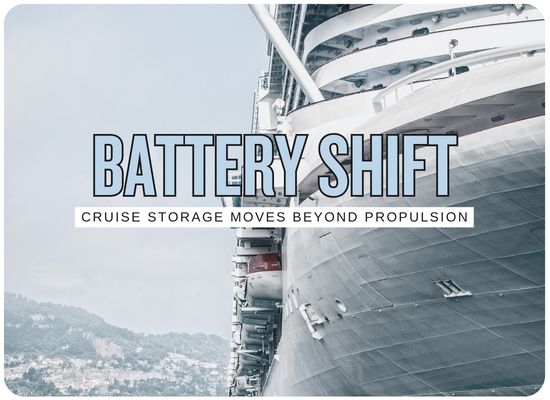
The Key Ways Energy Storage Is Moving Into Cruise Fleets

🔔 Subscribe to ShipUniverse Weekly →

Cruise Energy Storage

Cruise ship batteries are moving beyond propulsion. The real money is in the ship’s electrical behavior.

A battery does not need to push a 180,000-ton cruise ship across the Atlantic to earn its place onboard. The better near-term case is quieter and more practical: shave the hotel-load peaks, keep one less generator online, cover spinning reserve, smooth shore-power limits, carry emergency loads and let smaller river ships run cleaner around ports, locks and city centers.

15new river cruise vessels in the latest EST-Floattech contract
650 kWhbattery capacity planned for each vessel
9.7 MWhcombined capacity across the river-cruise order
2030EU berth-power rules sharpen the port-energy case

The operator takeaway

For large ocean cruise ships, batteries are still mostly a hybrid-power tool, not a full-propulsion answer. For river ships, expedition vessels, ferries and port-heavy cruise profiles, the case is already much clearer. The battery becomes a buffer between uneven electrical demand and machinery that likes steady, efficient loading.

Less engine stress Batteries absorb peaks so generators can run in cleaner operating bands.
Cleaner port stays Storage helps bridge hotel loads, shore-power gaps and low-noise operating windows.
Better redundancy Stored energy can support reserve functions and selected emergency loads.
Capital signal: the best battery projects start with the load profile, not the battery catalog. The first question is not “how many MWh can we install?” It is “which peaks, ports, engines and emergency loads are we trying to control?”

7 ways batteries are moving into cruise fleets

1. Peak shaving

Flatten the hotel-load spikes

Batteries can cover short demand surges from thrusters, elevators, galleys, HVAC ramps and hotel systems so another generator does not start just for a peak.

Fuel savingsHotel loadTransient power
2. Spinning reserve

Keep reserve without idling extra engines

A battery can provide instant reserve power, letting the vessel operate with fewer generators online while still protecting against sudden load changes or generator loss.

ReserveRedundancyEngine hours
3. Silent port operation

Run hotel loads with less noise and exhaust

Storage can support limited zero-emission or low-noise hotel operation in sensitive berths, city centers, fjords and river ports where local emissions are becoming harder to defend.

Port stayNoiseLocal emissions
4. Generator optimization

Let engines run where they are efficient

Diesel-electric ships often waste fuel when generators run lightly for long periods. Batteries help load-level the plant and reduce start-stop cycles.

GensetsLoad levelingMaintenance
5. Shore-power buffering

Bridge ship demand and weak grid capacity

Batteries can help smooth charging and load changes when shore power is available, and port-side storage can protect local grids from large cruise-load peaks.

OPSGrid bufferCharging
6. Emergency loads

Back up selected systems cleanly

Battery systems can support backup power roles for selected hotel, control, safety, communications or auxiliary loads, especially where a cleaner alternative to small emergency engines is practical.

BackupControlsSafety margin
7. River cruising

The best early cruise use case

River vessels have shorter duty cycles, frequent port calls, city-center berths and lower total energy demand than ocean megaships. That makes 500 to 700 kWh systems commercially meaningful.

River shipsLocksCity berths

Battery use-case matrix

Use Case Best Vessel Fit Battery Job Value Created Procurement Watch
Peak shaving Large ocean ships, expedition ships, river ships Cover short power spikes Fewer generator starts, lower fuel, smoother plant operation Power rating matters as much as kWh capacity
Spinning reserve Diesel-electric and hybrid plants Instant backup for generator loss or sudden load Fewer engines online, lower running hours, stronger redundancy Class, control logic and reserve state-of-charge rules
Silent port operation River ships, expedition vessels, smaller cruise ships Carry hotel load for limited periods Lower noise, less exhaust, better sensitive-port profile Hotel load can drain capacity faster than expected
Generator optimization Ships with variable hotel and propulsion demand Load-level the electrical plant Better specific fuel consumption and reduced maintenance Needs a real energy-management system, not just batteries
Shore-power buffering Port-heavy cruise routes and constrained terminals Soften load swings and charging demand Better OPS usability, less grid stress, more flexible port calls Ship-side and port-side responsibilities must be clear
Emergency backup River ships, ferries, selected retrofit packages Support selected critical or auxiliary loads Cleaner backup and faster response for defined loads Do not blur comfort backup with statutory emergency power
Partial electric sailing River, fjord, harbor and short sensitive-zone profiles Move or maneuver on stored energy for limited windows Low-noise, low-emission operation where it matters most Route profile, charging access and reserve margin decide viability

Where batteries earn first

River-cruise hotel load, backup and partial-electric operationPriority 97
Peak shaving on variable hotel and thruster loadsPriority 94
Spinning reserve and fewer online generatorsPriority 91
Generator optimization with energy-management softwarePriority 86
Silent port operation and sensitive-area maneuveringPriority 82
Shore-power buffering and charging managementPriority 77
Full ocean-cruise propulsion replacementPriority 38
Buyer filter: batteries are strongest when they solve a repeated operating problem. Occasional “green moments” are harder to finance than daily peak shaving, nightly hotel support or predictable city-berth restrictions.

Supplier opportunity map

Supplier Lane Buyer Problem Best Pitch Proof Buyers Need Red Flag
Battery system OEMs Need safe, class-approved marine storage Modular, scalable, serviceable battery systems for hybrid use Type approvals, lifecycle model, thermal-runaway design, service network Automotive claims with weak maritime integration proof
System integrators Battery must work with generators, switchboards and EMS One electrical architecture, not loose equipment packages Single-line diagrams, fault studies, commissioning record, crew training Battery room designed before control philosophy is settled
Energy-management software Battery value disappears if control logic is poor Peak shaving, reserve control and generator loading in one platform Fuel baseline, state-of-charge rules, alarm logic, shore-power behavior Dashboard looks good but does not control the plant
Shore-power and charging vendors Ports and ships need cleaner berth energy Charge, connect, buffer and meter without shocking the grid Compatibility, load profile, cable handling, interlocks, metering Installed OPS with too little usable berth capacity
Fire safety and battery rooms Battery safety is a ship-design issue Ventilation, gas exhaust, detection, suppression and safe access Hazard study, class notation, escape routes, isolation, emergency response Battery selected before location and ventilation are approved
Retrofit yards Space, weight, cable routes and downtime constrain upgrades Battery installation that fits the drydock window Weight study, schedule, hot-work plan, crane access, class coordination Great equipment with no practical installation path

Cruise Battery Use-Case Sizing Tool

Estimate usable battery time, peak-shaving value and the best first operating case.

0 hrs

Battery screen

Usable capacity0 kWh
Annual value per ship$0
Fleet installed capacity0 MWh

    By the ShipUniverse Editorial Team — About Us | Contact


    ← Browse more ShipUniverse posts
    MARITIME DECISION TOOLS

    Practical tools for real vessel and commercial decisions

    Browse the latest 24 tools or instantly search every published ShipUniverse maritime tool.

    24 latest toolsView all 263 →
    TOOL

    Crew Change, Relief Logistics, Port Coordination & Cost Tool

    🔔 Subscribe to ShipUniverse Weekly → Fleet Crewing • Seafarer Repatriation…

    Open →
    TOOL

    Marine Insurance Hull, P&I, Deductible & Claim Reserve Tool

    🔔 Subscribe to ShipUniverse Weekly → Marine Claims • Hull &…

    Open →
    TOOL

    Shipbuilding Milestone, Change Order, Yard Delay & Payment Exposure Tool

    🔔 Subscribe to ShipUniverse Weekly → Newbuilding Contract Control • Yard…

    Open →
    TOOL

    Project Cargo Sea Fastening, Deck Load & Transport Planning Tool

    🔔 Subscribe to ShipUniverse Weekly → Project Cargo • Deck Strength…

    Open →
    TOOL

    Maritime Emissions Data Verification, MRV & FuelEU Audit Readiness Tool

    🔔 Subscribe to ShipUniverse Weekly → Emissions Assurance • Fuel Traceability…

    Open →
    TOOL

    Tanker Terminal Acceptance, Berth Compatibility & Pre-Arrival Readiness Tool

    🔔 Subscribe to ShipUniverse Weekly → Tankers • Marine Terminals •…

    Open →
    TOOL

    Cruise Itinerary Disruption, Port Substitution & Revenue Impact Tool

    🔔 Subscribe to ShipUniverse Weekly → Cruise Operations • Port Diversions…

    Open →
    TOOL

    Port Dredging Production, Sediment Disposal & Project Cost Tool

    🔔 Subscribe to ShipUniverse Weekly → Ports / Dredging / Material…

    Open →
    TOOL

    Offshore ROV/AUV Survey Productivity, Weather Window & Spread Cost Tool

    🔔 Subscribe to ShipUniverse Weekly → Offshore Survey · ROV/AUV Operations…

    Open →
    TOOL

    Freight Contract, Surcharge & Shipping Invoice Verification Tool

    🔔 Subscribe to ShipUniverse Weekly → Freight Procurement • Carrier Contracts…

    Open →
    TOOL

    Marine Cargo Damage, Shortage, Survey & Claims Recovery Tool

    🔔 Subscribe to ShipUniverse Weekly → Marine Cargo • Shortage Reconciliation…

    Open →
    TOOL

    Container Terminal Yard Capacity, Dwell Time & Truck Gate Congestion Tool

    🔔 Subscribe to ShipUniverse Weekly → Port Logistics • Yard Density…

    Open →
    TOOL

    Fleet Class Survey, Statutory Certificate & Expiry Planning Tool

    🔔 Subscribe to ShipUniverse Weekly → Fleet Compliance • Class /…

    Open →
    TOOL

    Drydock Project Critical Path, Work Package & Schedule Overrun Tool

    🔔 Subscribe to ShipUniverse Weekly → Drydock • Work Packages •…

    Open →
    TOOL

    Container Demurrage, Detention, Free Time & Storage Cost Tool

    🔔 Subscribe to ShipUniverse Weekly → Container Logistics • Free Time…

    Open →
    TOOL

    Naval Fleet Replenishment, Fuel Endurance & Sustainment Planning Tool

    🔔 Subscribe to ShipUniverse Weekly → Naval Logistics • Fuel /…

    Open →
    TOOL

    Cruise Tender Operations, Passenger Throughput & Excursion Revenue Tool

    🔔 Subscribe to ShipUniverse Weekly → Cruise Port Calls • Tender…

    Open →
    TOOL

    Ship Recycling IHM, Survey & Yard Readiness Tool

    🔔 Subscribe to ShipUniverse Weekly → Ship Recycling • IHM Part…

    Open →
    TOOL

    Port Berth Productivity, Crane Deployment & Vessel Turnaround Tool

    🔔 Subscribe to ShipUniverse Weekly → Container Terminals • Berth Occupation…

    Open →
    TOOL

    Offshore DP Capability, Thruster Failure & Station-Keeping Margin Tool

    🔔 Subscribe to ShipUniverse Weekly → Offshore DP Operations • Directional…

    Open →
    TOOL

    Ship-to-Ship Transfer Fender, Mooring, Hose & Transfer Planning Tool

    🔔 Subscribe to ShipUniverse Weekly → Marine Operations • Fender Energy…

    Open →
    TOOL

    Vessel Sanctions, AIS Anomaly & Counterparty Due Diligence Tool

    🔔 Subscribe to ShipUniverse Weekly → Sanctions • AIS Integrity •…

    Open →
    TOOL

    Marine Biofuel Compatibility, Fuel Changeover & Engine Readiness Tool

    🔔 Subscribe to ShipUniverse Weekly → Biofuel Grades • FAME /…

    Open →
    TOOL

    Charterparty Speed, Consumption, Weather & Performance Claim Tool

    🔔 Subscribe to ShipUniverse Weekly → Time Charter • Speed Warranty…

    Open →