
🔔 Subscribe to ShipUniverse Weekly →
AI cannot run a voyage if the ship still speaks in nine different languages
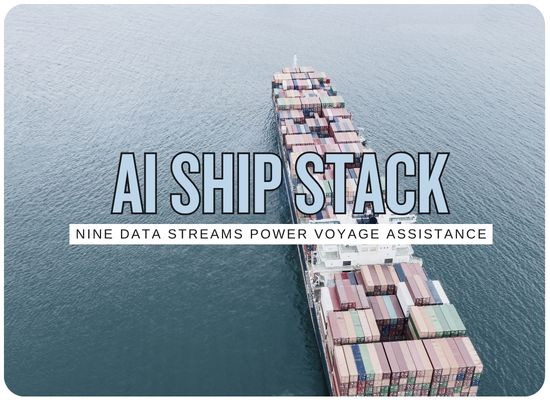
The hard part is not getting an AI model to suggest a route. The hard part is making the bridge, ECDIS, weather feed, engine room, cargo desk, fuel plan, maintenance file, communications stack and shore operations all tell the same truth at the same time. Until that happens, AI is just another screen the crew has to babysit.
The voyage AI stack needs clean inputs before it earns trust
AI-assisted voyage execution needs more than weather routing. It needs bridge reality, chart constraints, machinery limits, fuel economics, cargo restrictions, maintenance status, communications reliability and shore approval rules. A weak feed in any one area can turn a good recommendation into a bad operating decision.
The data streams that need to talk before AI can run the voyage
Bridge systems
Radar, AIS, GNSS, heading, speed, alarms and watchkeeper context create the live operating picture.
ECDIS and route plan
The AI needs charted hazards, route geometry, safety contours, waypoints, TSS rules and approved limits.
Weather and ocean data
Wind, waves, current, swell, tropical risk, ice, visibility and forecast confidence drive route and speed choices.
Engine and propulsion
Speed recommendations are useless without engine load, SFOC, shaft power, RPM, limits and machinery condition.
Cargo constraints
The best route on paper may be wrong for reefer load, cargo temperature, tank limits, stability or motion sensitivity.
Fuel and bunker plan
AI voyage decisions need ROB, fuel grade, consumption curve, next bunker port, price exposure and reserve margin.
Maintenance status
A smart plan must know degraded equipment, overdue work, sensor faults, class restrictions and available spares.
Communications stack
AI assistance depends on reliable ship-shore links, bandwidth rules, offline mode, cyber controls and message audit trails.
Shore operations
Operators, charterers, technical managers, ports and performance teams need one approval chain, not five versions of truth.
Each system answers a different part of the voyage decision
| System | Data AI needs | Decision it improves | Failure if disconnected | Minimum proof | Integration priority |
|---|---|---|---|---|---|
| Bridge | Position, speed, heading, traffic, alarms, sensor confidence | Collision risk, deviation alerts, situational awareness | AI gives advice detached from bridge reality | Live sensor feed, timestamps, bridge approval record | Very high |
| ECDIS | Approved route, chart constraints, waypoints, safety settings | Route execution and safe deviation checks | AI recommends a route the bridge cannot safely approve | Route import/export, version control, approval log | Very high |
| Weather | Forecast, current, waves, visibility, confidence and update timing | Weather routing, speed, ETA and fuel burn | AI optimizes against stale or incomplete weather | Provider SLA, forecast timestamp, uncertainty handling | Very high |
| Engine | Power, RPM, SFOC, load limits, alarms and performance model | Speed selection and fuel efficiency | AI saves fuel on paper but stresses machinery in practice | Validated engine model and sensor calibration | Very high |
| Cargo | Stability, motion limits, tank or reefer constraints, cargo priority | Safe route and speed within cargo limits | Voyage plan ignores commercial cargo risk | Cargo constraint file and manual override rule | High |
| Fuel | ROB, grades, consumption curve, bunkering options and reserves | Bunker timing, reserve margin and cost exposure | Route looks efficient but creates fuel-risk exposure | ROB validation and fuel-consumption reconciliation | Very high |
| Maintenance | Open faults, degraded equipment, inspections, spares and service limits | Feasible speed, route and remote support decisions | AI assumes equipment is healthy when it is not | CMMS integration and exception list | High |
| Communications | Bandwidth, latency, outages, cyber rules and offline procedure | Ship-shore coordination and remote support | AI depends on a link that disappears mid-voyage | Connectivity SLA, failover policy, offline workflow | High |
| Shore operations | Charter terms, port updates, owner limits, approval workflow | Commercially useful voyage execution | AI optimizes the voyage but not the business outcome | Named approval chain and audit trail | Very high |
The serious projects will build a shipboard data spine first
The foundation is not the AI model. It is the vessel data layer: standardized names, clean timestamps, validated sources, clear ownership, cyber zoning and a way to move selected data safely between ship and shore.
Do not ask whether the software has AI. Ask which nine systems it reads, which ones it can write to, how it handles bad data, and who approves the voyage change.
Questions that separate useful AI from another dashboard
| Buyer demand | Weak answer | Strong answer | Document to request | Priority |
|---|---|---|---|---|
| System map | Integrates with vessel systems | Bridge, ECDIS, weather, engine, cargo, fuel, maintenance, comms and shore flows shown | Integration architecture | Very high |
| Data quality rules | Uses real-time data | Missing, stale, conflicting and outlier data are flagged before recommendations | Data validation method | Very high |
| ECDIS boundary | Supports route planning | Clear route import, export, approval and bridge-workflow limits | ECDIS interface note | Very high |
| Engine model | Optimizes fuel consumption | Uses validated vessel performance curve, engine data and correction method | Performance model file | High |
| Approval workflow | Keeps operator in the loop | Named approver, approval window, override, escalation and log | Authority matrix | Very high |
| Cyber controls | Secure cloud connection | Segmentation, access control, logging, remote-support limits and fallback plan | Cyber and OT access file | High |
| Verification method | Customer results show savings | Baseline, correction factors, fuel data, weather data and third-party review path | Measurement protocol | Very high |
AI-Assisted Voyage Readiness Scorecard
Use this quick screen to judge whether a vessel is ready for AI-assisted voyage execution or only basic advisory tools.
Planning tool only. Final deployment should reflect vessel class, route profile, bridge procedures, ECDIS approval path, engine model quality, cargo constraints, cyber architecture, crew training, flag and class requirements.