
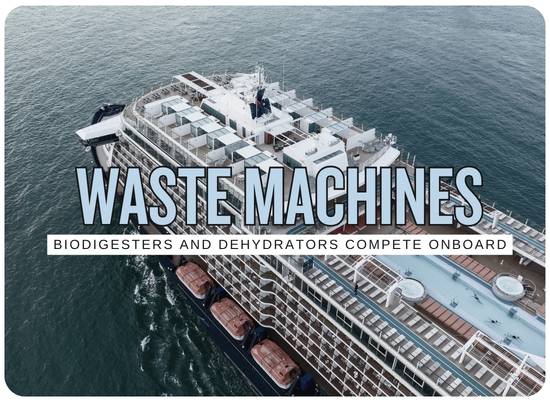
Cruise Food Waste Machines Are Becoming a Shipboard ROI Battle

The winning food-waste system is not one machine. It is a sorted pathway.
I see Star Princess operating 26 food-waste machines as a useful signal because cruise waste is no longer a back-of-house disposal chore. It is becoming a machinery, workflow, service-contract and port-cost decision. Biodigesters, dehydrators, grinders, pumps, incinerators and waste-storage systems each win a different part of the stream. The operator that sorts correctly can reduce offload volume, improve galley flow, cut odor risk, lower landing costs and keep the ship more flexible across sensitive itineraries.
The Star Princess hook is really a system-design story
The headline number is striking, but the smarter takeaway is that one large cruise ship may need a distributed food-waste network, not a single giant room full of equipment. Food waste starts in galleys, dining rooms, buffet lines, crew messes, bars, prep areas and garbage rooms. The fastest path is often to process food waste close to where it is generated, then move liquid effluent, dry solids or residuals through the right shipboard route.
Plate scrapings, prep waste and softer organic material can often be processed continuously near galleys and waste rooms.
Bones, fruit rinds, fats, skins and hard-to-digest material often make more sense as dried, reduced-volume residue.
Incineration can reduce volume, but it brings emissions, ash, fuel, maintenance, crew handling and operating restrictions into the equation.
Biodigester vs dehydrator vs incinerator
Best base-load machine
A biodigester is the best default winner when the ship has constant wet organic waste, enough water and drainage integration, good crew separation, and a downstream wastewater path that can handle the effluent. Its strength is continuous daily reduction with lower storage pressure.
Best volume reducer
A dehydrator wins when the ship needs to shrink difficult solids before storage, offload or further processing. It uses heat and electricity, but it can turn messy, wet residuals into a drier material that is easier to store, weigh, land ashore or potentially send to another use.
Best controlled fallback
Incineration wins only when residuals are suitable, operating conditions allow it, emissions and ash are managed, and port offload or storage constraints justify burning. It is powerful, but it is rarely the cleanest first-dollar answer for wet food waste.
8 buying questions before choosing the winner
The first decision is wet, hard, contaminated or residual
Cruise food waste is not one stream. Soft prep waste, plate scrapings, buffet leftovers, bones, fruit rinds, seafood shells, cooking fats, packaging-contaminated food and crew mess waste behave differently. A biodigester can be excellent for wet organic waste, while a dehydrator may be better for hard material, and an incinerator may only make sense for selected dry residuals.
Distance from galley to machine can decide labor cost
A large food-waste machine in the wrong location can look efficient on paper and still lose in daily operations. Cruise ships need short routes from galley, buffet, prep and waste-handling areas to the machine. The more crew must push bins across decks, the more the system depends on labor discipline and elevator availability.
Continuous processing wins only if the input stays clean
Biodigesters are attractive because they can work continuously and reduce the need to store or land wet food waste. The catch is feed discipline. Hard objects, excessive fats, packaging, utensils, shells or unsuitable material can reduce performance. The ship needs training, signage, sorting, grinder support where appropriate, and service backup.
Dehydrators turn a wet storage problem into a dry residue problem
Dehydrators can be very strong when the ship needs to reduce volume before landing material ashore. They are especially useful for harder items that do not digest easily. But they use heat, electricity, space and maintenance. The ROI improves when port offload is expensive, storage is tight, itinerary restrictions are strict, or the residual material can be handled more cheaply.
Incineration is a residual strategy, not a food-waste strategy
Incineration can reduce volume dramatically, but wet food waste is often a poor feed unless it is dried or mixed properly. The buyer has to price burner fuel, refractory wear, ash handling, emissions, odor, crew time, safety interlocks, maintenance and port or local restrictions. Incineration can be a useful part of the system, but it should not be the default answer to avoid sorting.
The support equipment may decide uptime
Grinders, macerators, bin tippers, conveyors, pumps, effluent systems, valves, strainers, sensors and tank routing are not accessories. They are the system. A food-waste machine that frequently clogs, floods, backs up or requires manual intervention can lose the ROI case even if the main equipment is well chosen.
The best machine changes by route
A Caribbean ship with easy legal discharge windows, a Baltic or Alaska-intensive ship, and an expedition ship with strict destination expectations may need different food-waste strategies. Storage days, port reception availability, local restrictions, guest messaging and garbage-room volume can all shift the winner.
Food-waste machines are now aftermarket assets
Cruise operators should price the long tail: pumps, seals, motors, heaters, sensors, grinder parts, biological media, cloud reporting, crew training, troubleshooting, remote support, planned maintenance and port attendance. A cheaper machine can become expensive if the service network is weak or if shipboard crews lack practical support.
System comparison matrix
The best answer depends on the waste stream. A cruise ship should not force all food waste through the same machine.
| System | Best Waste Stream | Primary Value | Weak Point | Winner Scenario |
|---|---|---|---|---|
| Biodigester | Wet organic food waste, prep waste, plate waste, soft leftovers | Continuous volume reduction near generation points | Requires sorting discipline, drainage route, pump reliability and biological stability | Large ships with steady galley flow and many distributed processing points |
| Dehydrator | Bones, fruit rinds, skins, fats, harder leftovers and difficult solids | Major weight and volume reduction before storage or offload | Uses heat or electricity and still leaves a residue that must be handled | Ships with expensive port offload, tight garbage-room volume or hard-to-digest residuals |
| Grinder or macerator | Food waste that must be reduced in particle size before discharge or further treatment | Improves pumpability and regulatory discharge compatibility | Can clog, wear, consume water and hide sorting problems | Ships needing fast preparation of food waste for downstream treatment or legal discharge windows |
| Effluent pump system | Biodigester liquid output and food-waste slurry | Moves processed waste to wastewater treatment or discharge route | Pump failure can shut down an otherwise good system | Distributed biodigester layouts with multiple galley and garbage-room locations |
| Waste storage | Dry residue, sorted organics, contaminated food waste, ash, offload material | Preserves route flexibility when discharge or processing is not available | Consumes volume, creates odor risk and needs handling discipline | Ships operating sensitive routes or ports with variable reception capability |
| Incinerator | Selected dry residuals, compatible waste, some sludge or residue interfaces | Volume reduction and reduced port offload dependency | Fuel, emissions, ash, refractory, maintenance and operating restrictions | Ships with strong sorting, dry feed, trained crew and clear emissions compliance path |
| Waste-to-energy gasification | Dry organic and mixed residual streams after preparation | Creates usable onboard energy and reduces landfill dependence | Higher complexity, fewer fleet installations and tougher integration | Newbuilds or major retrofits where energy recovery is part of the design |
| Service contract | All machinery, pumps, controls, sensors, grinders and support equipment | Protects uptime and crew adoption | Can be under-scoped if it only covers the main machine | Mixed-machine fleets with many galleys, changing crews and high itinerary exposure |
Which system wins by waste type?
Cruise Food-Waste Machine ROI Selector
Use this screening tool to compare biodigesters, dehydrators and incineration based on onboard population, food-waste rate, offload cost, energy cost and service cost.
System result
Supplier opportunity map
The high-value spend is bigger than the visible machine. Cruise buyers need a complete food-waste system that works every day under galley pressure.
| Supplier Lane | Buyer Problem | Commercial Pitch | Proof Buyers Should Request |
|---|---|---|---|
| Biodigester OEMs | High wet organic waste volume across many galleys | Continuous processing close to waste generation | Daily capacity, contamination tolerance, service history, pump compatibility, downtime rate |
| Dehydrator suppliers | Hard-to-digest solids and expensive offload volume | Up to major volume reduction and cleaner residual storage | Energy use, batch time, residue weight, odor control, cleaning access, service intervals |
| Grinder and macerator suppliers | Food waste needs sizing before downstream processing | Improve pumpability, digestion performance and discharge compatibility | Screen size, wear parts, jam rate, water use, noise, maintenance access |
| Effluent pump and piping integrators | Processed waste must move reliably through the ship | Protect machine uptime by solving the routing problem | Flow rate, redundancy, clog resistance, pipe routing, tank interface, cleaning procedure |
| Incinerator service providers | Residuals still need volume reduction or compliant disposal | Use incineration selectively for compatible dry residuals | Fuel use, ash rate, burner life, refractory condition, emissions records, port restrictions |
| Waste-storage and bin-handling firms | Sorting fails when bins, carts and rooms are poorly designed | Reduce labor, odor and contamination before machinery | Cart routes, bin washdown, color coding, crew workflow, space model, odor management |
| Service-contract providers | Machines need uptime across itineraries and crew changes | Turn food-waste equipment into a managed operating system | Response time, spare parts, remote support, onboard training, scheduled maintenance, reporting |
| Waste analytics platforms | Operators cannot improve what they do not measure | Track waste by venue, meal period, itinerary and machine pathway | Scale accuracy, dashboard, crew adoption, menu feedback, integration with provisioning |
Procurement rules before buying more machines
A machine that shrinks waste is not the same as a system that legally and cheaply disposes of it. Price the full path to discharge, treatment, storage, incineration or shore offload.
Measure waste by buffet, dining room, galley, crew mess, specialty restaurant, bar and prep area before selecting equipment sizes.
Sorting, cart movement, loading, cleaning, jam clearing, bin washing and reporting are part of the machine economics.
Budget grinders, pumps, pipe routing, effluent connections, bins, tippers, storage, sensors, scales, controls and service support with the headline machine.
Use incinerators for suitable residual streams after sorting and pre-processing. Do not use them as a substitute for better galley waste discipline.
The system that wins is the one that protects the voyage
Star Princess shows where cruise food-waste management is headed: distributed machines, not one back-of-house shortcut. Biodigesters are likely the core winner for wet daily food waste because they can operate close to where food is handled. Dehydrators win where the ship needs to shrink hard residuals and reduce shore offload. Incinerators remain useful, but mainly as a controlled residual tool with emissions, ash, fuel and maintenance priced honestly. The smartest operators will not ask which machine is best in isolation. They will build a sorted waste pathway that keeps galleys moving, reduces storage pressure, avoids unnecessary landing costs and gives the environmental officer reliable records every voyage.
We welcome your feedback, suggestions, corrections, and ideas for enhancements.
Please click here to get in touch