
🔔 Subscribe to ShipUniverse Weekly →
The blower load is where air lubrication savings become real, or disappear
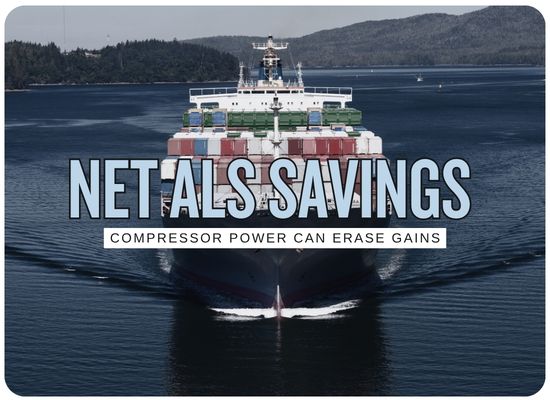
A ship can have a beautiful bubble carpet and still deliver a disappointing payback. The number that matters is not the headline drag reduction. It is the net fuel saved after the air package has spent its own kilowatts through turbo blowers, screw compressors, controls, valves, cooling and maintenance.
This is a lifecycle power decision, not a brochure contest
Turbo blowers usually look strongest when the vessel needs large, steady, low-pressure air volume for long sea hours. Screw compressors or screw blowers usually look strongest when the ship’s air demand changes frequently and the package needs flexible turndown, familiar service and tight VSD control.
Two technologies, two different ways to lose money if sized badly
Best case: efficient base-load air
A turbo blower, also sold as a centrifugal blower or turbo compressor, can be attractive when the ALS needs large continuous airflow and the vessel spends many hours near a stable operating point.
Best case: flexible air on variable duty
A screw compressor or screw blower can be attractive when the system needs dependable output across changing speed, draft, air demand and operating modes.
Every ALS bid should separate gross propulsion saving, air-system electrical load, maintenance cost and verified net saving. If those numbers are blended together, the buyer cannot see the real payback.
Where turbo, screw or a staged package fits best
| Decision area | Turbo blower advantage | Screw compressor advantage | Owner risk | Question to ask | Likely answer |
|---|---|---|---|---|---|
| Power draw | Can be very efficient near the design point | Can follow variable air demand with VSD control | Air-system kW eats the headline ALS saving | Show kW at 40%, 60%, 80% and 100% expected flow | Profile decides |
| Turndown | Strong if staged or designed for a wide stable range | Often attractive where flow changes often | Oversupply wastes fuel, undersupply loses bubble coverage | What is the minimum stable flow and specific power? | Often screw |
| Steady sea hours | Strong for ships with long legs and repeatable draft/speed | Less dominant if demand rarely changes | CAPEX premium must be earned every sailing day | How many annual hours are near the design point? | Often turbo |
| Variable operation | Can work, but needs good control and staging | Strong where the duty curve keeps moving | The wrong machine may run off its efficient island | Map airflow by speed, draft, trim and sea state | Often staged |
| Maintenance | Potentially low routine service with proper support | Familiar machinery-room service model | ALS downtime can erase expected annual savings | Give five-year service intervals, spares and overhaul cost | Support decides |
| Footprint and noise | Can be compact, but high-speed equipment needs review | Packaged units may be easier to arrange in retrofits | Skid size hides piping, silencers, access and ventilation | Show installed footprint, dB(A), clearances and removal path | Ship-specific |
| CAPEX versus OPEX | Higher purchase cost can win through lower energy use | Lower or familiar package cost can win on retrofit simplicity | Lowest bid may become highest fuel penalty | Compare five-year lifecycle cost, not equipment price | TCO required |
A 200 kW air-power gap can be a six-figure annual decision
Planning example: 20,000 kW propulsion baseline, 8% gross ALS power reduction, 5,000 ALS hours per year, $600/mt fuel, 170 g/kWh main-engine SFOC and 190 g/kWh auxiliary-generator SFOC.
Estimated net annual value after subtracting auxiliary fuel used to create air.
Still positive, but roughly $114,000 less value per year in this scenario.
The ALS may still work technically while the investment case nearly disappears.
The supplier should prove useful air, not just airflow
| Buyer demand | Weak answer | Strong answer | Document to request | Priority |
|---|---|---|---|---|
| Duty-point power map | Rated motor size listed | kW shown at real flow and pressure points | Compressor performance map | Very high |
| Air demand curve | One design condition | Demand by speed, draft, trim and sea state | ALS airflow model | Very high |
| Net savings model | Gross fuel-saving claim | Gross saving, air power, maintenance and net value separated | Net energy balance | Very high |
| Electrical integration | Existing auxiliaries can handle it | Generator loading, startup current, switchboard and redundancy reviewed | Electrical load study | High |
| Noise and vibration | Normal marine limits | dB(A), foundation, enclosure and crew-space impact defined | Noise and vibration note | High |
| Service plan | Low maintenance | Intervals, onboard tasks, spares, overhaul and downtime priced | Five-year OPEX schedule | High |
| Verification method | Trial will confirm savings | Baseline, correction factors, metering and acceptance test agreed | Performance verification protocol | Very high |
Turbo Blower vs Screw Compressor Net Savings Screen
Compare two air-package options using gross ALS savings, annual operating hours, fuel price and auxiliary power penalty.
Planning tool only. Final ALS economics should use measured power curves, real air demand, vessel speed and draft profile, hull condition, auxiliary-generator loading, installation cost, maintenance cost, availability and sea-trial verification.
We welcome your feedback, suggestions, corrections, and ideas for enhancements.
Please click here to get in touch