AI Hull Inspection Could Drastically Cut Survey Costs Before the Next Drydock
🔔 Subscribe to ShipUniverse Weekly →
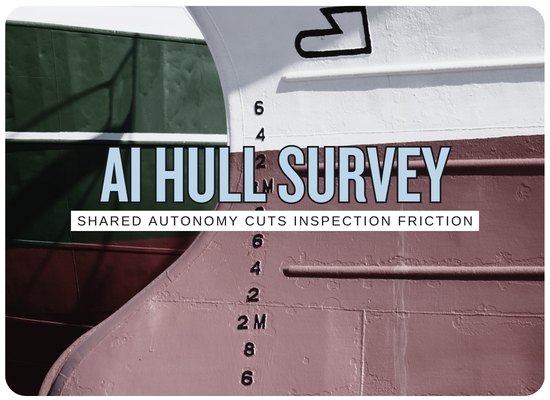
Shared autonomy could make hull inspection faster without removing the surveyor
The most practical future for AI hull inspection is not a robot making every decision alone. It is shared autonomy: human planning and review, robotic underwater capture, AI-assisted defect detection, and class-ready evidence packaging. That model can reduce wasted survey time, improve consistency, and help owners plan drydock work with fewer underwater surprises.
The savings case is visibility before the vessel reaches the yard
Drydock time becomes expensive when underwater findings appear late. A hull coating issue, propeller damage, sea chest blockage, rudder problem, worn anode, or structural concern can change the repair scope after the vessel is already in the yard. AI-assisted hull inspection gives operators a better chance to see the underwater condition earlier and arrive with a cleaner plan.
Shared autonomy makes the model more realistic. The robot does not need to replace the surveyor. It needs to help the surveyor and technical team capture repeatable footage, follow planned inspection routes, flag anomalies, label areas of concern, compare past inspections, and package evidence for owner, class, insurer, and yard review.
Operators with repeated underwater survey needs, high drydock cost, fouling sensitivity, older hulls, expensive off-hire exposure, or port calls where in-water inspection is practical.
The inspection must produce evidence that class, technical management, insurers, and repair teams can actually use.
The strongest case is not only cheaper inspection. It is fewer late surprises, better drydock scope, safer underwater work, and faster decisions.
AI hull inspection should be judged by decision quality. If it helps the owner decide earlier, document better, and reduce underwater uncertainty, it can be more than another inspection gadget.
Seven operating pieces turn underwater footage into a usable survey record
A strong AI hull inspection program is not only the ROV or crawler. It is the full workflow around planning, capture, analysis, review, and action.
Survey plan and inspection grid
The inspection should begin with a structured route: hull zones, appendages, sea chests, propeller, rudder, thrusters, anodes, coating zones, weld areas, and known historic defects.
Human-supervised robotic capture
A pilot, surveyor, or trained operator can guide the ROV or crawler while AI supports station keeping, route following, target reacquisition, and image-quality prompts.
AI-assisted anomaly detection
Computer vision can flag coating breakdown, fouling, corrosion patterns, cracks, dents, missing anodes, propeller damage, blocked openings, and areas that need closer human review.
Location context and evidence tagging
Footage is more useful when tied to a hull zone, timestamp, vessel side, frame area, component, defect category, confidence level, and inspection pass.
Surveyor and superintendent review
Human review remains essential. The technical team confirms whether a finding is cosmetic, operationally important, class-relevant, repair-worthy, or worth monitoring.
Class-ready reporting package
A useful report includes inspection conditions, equipment used, coverage map, image quality, findings, locations, supporting footage, operator notes, and unresolved areas.
Drydock and maintenance action list
The final output should feed the yard specification, coating plan, anode replacement plan, hull cleaning decision, propeller work, sea chest inspection, and future monitoring schedule.
AI inspection creates value when it shortens the path from suspicion to decision
The biggest savings often come from faster triage and better planning. A robotic inspection may not replace every diver or drydock survey, but it can reduce unnecessary mobilization, support in-water survey planning, and help the owner prepare repair scope earlier.
| Inspection route | Best use | Strength | Limitation | Cost-saving path | Operator fit |
|---|---|---|---|---|---|
| Drydock inspection | Full access, repairs, coating work, statutory survey, heavy maintenance | Best physical access and repair capability | Expensive, schedule-constrained, off-hire exposure | AI inspection helps arrive with a cleaner scope | Essential |
| Diver inspection | Close tactile review, class-approved underwater checks, complex areas | Human judgment underwater and physical verification | Safety exposure, scheduling, weather, visibility, cost | AI triage can reduce unnecessary diver callouts | Still valuable |
| ROV inspection | Visual survey, propeller check, damage review, hull condition capture | Fast deployment and reduced diver exposure | Visibility, current, navigation, image quality, class acceptance | Faster first look and better evidence capture | Strong |
| Hull crawler inspection | Repeatable hull path, coating assessment, biofouling review, close contact | Stable imaging and repeatable coverage on hull surface | Coating protection, surface condition, hull geometry, attachment limits | Trend data between dockings | Growing |
| Shared autonomy inspection | Human-supervised route with AI detection, tagging, and reporting | Combines human judgment with faster evidence processing | Needs data quality, trained operators, validation, and workflow discipline | Lower review time and better drydock planning | High potential |
| Fully autonomous inspection | Repeatable inspection routes with minimal human steering | Scalable coverage if environment is controlled | Harder in ports, poor visibility, complex geometry, uncertain conditions | Lower routine inspection cost over repeated use | Selective |
The strongest return may come before the docking date
Hull inspection is often treated as a survey task, but for operators it is also a planning task. Earlier underwater evidence can improve yard negotiation, spare planning, coating decisions, propeller work, anode ordering, and repair sequencing.
| Finding category | AI inspection contribution | Drydock planning value | Risk if missed | Human review needed | Priority |
|---|---|---|---|---|---|
| Coating breakdown | Flags affected areas and compares repeat imagery | Better coating scope, paint planning, and surface preparation budget | Late repair expansion and extra yard days | Coating specialist and superintendent | High |
| Biofouling | Classifies fouling severity by hull zone | Cleaning timing, fuel analysis, emissions planning | Higher fuel burn and charterer disputes | Performance team and hull specialist | High |
| Propeller damage | Captures blade condition, dents, edge damage, rope, cavitation signs | Propeller repair, polishing, balancing, or specialist booking | Vibration, speed loss, off-hire, emergency repair | Technical superintendent and propeller specialist | Very high |
| Anode wear | Identifies missing or depleted anodes and location patterns | Ordering, replacement scope, corrosion management | Accelerated corrosion and unplanned steel work | Hull superintendent and class if needed | Medium high |
| Sea chest and intake issues | Shows blockage, fouling, damage, or unusual condition | Cleaning plan, cooling system review, operational risk control | Cooling restrictions or machinery alarms | Chief engineer and technical manager | Very high |
| Dents and hull marks | Captures visual evidence and approximate location | Repair prioritization and claim file support | Structural uncertainty or delayed claims evidence | Surveyor and structural specialist | High |
| Inspection coverage gaps | Maps areas inspected and areas missed | More complete survey record and targeted follow-up | False confidence from incomplete footage | Surveyor and operator | Very high |
Owners should start with inspection assist before full autonomy
A staged rollout makes more sense than buying a fully autonomous promise. The fleet should prove image quality, class usefulness, operator workflow, and cost reduction before scaling.
ROV video capture with structured reporting
Begin with a controlled underwater inspection that creates clean footage, location notes, component labels, and a standard report format.
AI tagging and defect triage
Add AI to flag fouling, coating damage, propeller issues, missing anodes, hull marks, and low-quality footage that needs a second pass.
Shared autonomy route support
Use human-supervised route planning, assisted station keeping, mission prompts, and coverage mapping to make inspections more repeatable.
Class and yard workflow integration
Format reports so findings support class conversations, yard planning, coating decisions, claims files, and maintenance history.
Fleetwide inspection rhythm
Scale only after the operator can compare hull condition across sister vessels, routes, coatings, cleaning intervals, and drydock outcomes.
AI Hull Inspection Savings Estimator
Use this tool to estimate whether shared-autonomy hull inspection could justify a pilot by reducing survey cost, drydock uncertainty, or diver mobilization.
This calculator is a planning aid. Real savings depend on class acceptance, inspection conditions, vessel type, port rules, diver availability, off-hire economics, evidence quality, and whether findings actually change drydock planning.
The technology must prove coverage, quality, and acceptance
AI hull inspection can create faster evidence, but owners should not treat every underwater video as survey-grade. The system has to prove that it inspected the right areas, captured useful footage, and separated AI suggestions from confirmed findings.
| Control point | Needed safeguard | Business reason | Failure mode | Owner question | Priority |
|---|---|---|---|---|---|
| Coverage map | Record which hull zones were inspected and which were missed | Prevents false confidence from partial footage | Operator assumes complete inspection when gaps remain | Can we prove coverage by hull zone | Very high |
| Image quality threshold | Define lighting, distance, resolution, stability, and visibility standards | Findings depend on usable evidence | Low-quality footage creates weak decisions | Would class or a yard trust this image | Very high |
| AI confidence labels | Separate AI-suggested findings from human-confirmed findings | Prevents overreliance on automated detection | False positives or missed defects drive bad actions | Which findings were confirmed by a qualified reviewer | High |
| Class and survey acceptance | Engage class early on report format and inspection method | Not all robotic inspection output replaces accepted survey methods | Duplicate diver or drydock inspection still required | Can this output support the intended survey purpose | Very high |
| Operator training | Train pilots and reviewers on vessel-specific inspection areas | Poor capture can erase the benefit of good AI | Wrong areas inspected or defects missed | Who is qualified to fly and interpret | High |
| Data ownership | Define ownership of video, AI labels, reports, and trend history | Inspection data has claims, class, and commercial value | Vendor lock-in or unclear records after contract end | Can we export the complete inspection history | Medium high |
| Action workflow | Route confirmed findings into PMS, drydock scope, claims, or repair plan | Inspection value comes from action, not footage | Reports sit unused in a folder | Which process changes after the inspection | High |
The best first pilot is a pre-drydock evidence sprint
Owners looking at AI hull inspection should start before a planned drydock or major in-water survey. Pick a small vessel group, inspect key underwater zones, compare AI flags with human review, and use the findings to improve drydock scope. That gives the fleet a clear test: did the system reduce uncertainty before money was spent?
Use AI-assisted ROV or crawler inspection before drydock to identify coating, fouling, propeller, anode, sea chest, and hull damage issues earlier.
Require coverage maps, source footage, confidence labels, exportable reports, human confirmation, and class-aware documentation.
Track inspection cost, diver mobilizations avoided, drydock scope changes, late findings reduced, off-hire days affected, and repair planning accuracy.
Shared autonomy can make hull inspection more useful by combining robot access, AI triage, and human judgment. The strongest savings come when the inspection changes drydock planning before the vessel enters the yard.
We welcome your feedback, suggestions, corrections, and ideas for enhancements.
Please click here to get in touch