12 Cost Explosions Shipowners Could Face If the Gulf War Keeps Escalating
🔔 Subscribe to ShipUniverse Weekly →
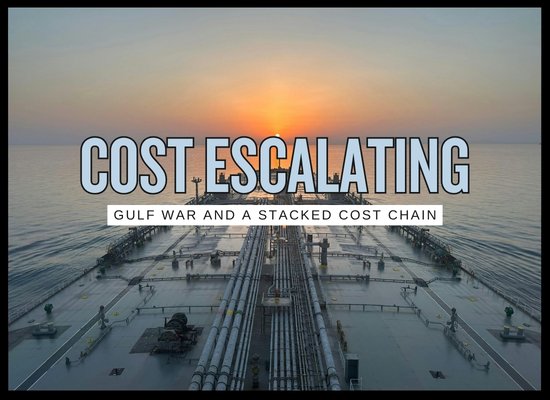
If the Gulf war keeps escalating, the damage to shipowners is unlikely to arrive as one single bill. It is more likely to spread through a stacked cost chain: war-risk pricing, disrupted navigation, longer idle time, diversion and bunker burn, crew strain, higher port friction, charterparty disputes, cargo claims, and a bigger working-capital burden on every exposed voyage. Current official and market evidence already points in that direction. UNCTAD says ship transits through Hormuz came close to a halt in early March 2026 and that the Strait carries about one quarter of global seaborne oil trade plus significant LNG and fertilizer volumes. IMO says around 20,000 seafarers remain impacted in the region, while UKMTO and JMIC continue to warn about severe GNSS interference, AIS anomalies, and broader disruption to safe passage. EIA says VLCC rates from the Middle East to Asia reached their highest level since at least 2005 in March 2026.
The owner bill can widen long before the route fully closes
In a deeper Gulf escalation, the practical danger is not only one very large invoice. It is the way insurance, delay, diversion, bunker, crew, port, charter, cargo, and financing pressure can start landing together on the same ship, turning one risky voyage into a much heavier commercial event than the original fixture ever assumed.
12 cost explosions owners could actually face
This version goes deeper into how each cost grows, where it usually spreads next, and what makes it commercially dangerous to shipowners.
| # | Cost explosion | Pressure first appears | Beyond the obvious line item | Owner Paying | Where the second wave usually lands | Owner-side control points |
|---|---|---|---|---|---|---|
| 1️⃣ |
War-risk premiums and cover restructuring
The first visible bill is often not the biggest final one.
AWRP
Buy-backs
Cover timing
|
The pressure starts when insurers cancel, narrow, or reprice war cover and the owner has to secure fresh terms or buy-back protection under much worse conditions. | Once cover becomes conditional, the owner is not only paying premium. The owner is paying for timing risk, uncertainty around fixture performance, internal claims and legal review, and sometimes the cost of holding a ship in limbo while insurance is finalized. | Additional war-risk premium, broker and placement friction, possible security-related endorsements, and the cost of reworking a voyage that was priced under a very different insurance assumption. | Charterparty recovery fights, delayed NOR strategy, cargo hesitation, and sometimes financing-side stress if multiple voyages suddenly require much larger upfront cash commitment. | Quote timing, charter wording on premium pass-through, written evidence of routing rationale, and whether the owner can pivot quickly into a safer or commercially cleaner voyage choice. |
| 2️⃣ |
Delay and idle-time loss while routes stay technically open but commercially impaired
This is where many owners underprice the damage.
Idle time
Hold-off
Suppressed transit
|
Pressure begins when ships are instructed to wait, drift, or hold off while route risk, convoy logic, insurance, port readiness, or underwriter comfort is reassessed. | Delay grows because every extra day starts to hit more than time-charter value. It can affect berth windows, onward schedule integrity, cargo readiness, crew welfare, and later bunker and routing choices. | Daily earnings erosion, idle-time cost, schedule recovery burn later in the voyage, and a weaker ability to turn the ship efficiently after the exposed leg is finished. | Demurrage exposure, off-hire arguments, missed loading sequence, late-arrival claims, and extra support cost at substitute service points. | Daily delay ledger, hold-vs-divert decision timing, berth-window realism, and how quickly delay is translated into a commercial decision instead of being allowed to drift. |
| 3️⃣ |
Diversion and extra-voyage-distance shock
The reroute bill is rarely just extra miles.
Diversion
Route change
Longer voyage
|
The pressure appears when the original Gulf-linked route no longer looks commercially executable and the owner has to move to a materially longer fallback path. | The bill widens because distance does not only mean fuel. It means more days tied up, later re-entry into the market, more emissions exposure on some trades, and more fragility around every dependent cargo promise. | Extra sea days, larger bunker bill, more port-planning complexity, weaker fleet utilization, and reduced ability to capitalize on strong spot opportunities elsewhere. | Cargo substitution, replacement-supply freight, weaker laycan fit, and more difficult coordination with terminals and charterers at the destination end. | Full-route cost comparison, contract liberty to divert, re-priced voyage economics with real fuel assumptions, and whether the backup route still preserves earnings quality. |
| 4️⃣ |
Bunker spikes and disrupted refuelling logic
A fuel hub shock can make every later decision worse.
Fujairah
Fuel timing
Supply disruption
|
Pressure starts when bunker hubs in or near the risk zone become disrupted, price up sharply, or no longer feel operationally clean enough to rely on. | The cost widens because the owner is not only paying a higher price per ton. The owner may also buy in the wrong place, with the wrong quantity, under weaker timing, and under more constrained route flexibility. | Higher bunker invoice, more expensive contingency stems, reduced flexibility on speed and timing, and a bigger chance of carrying the wrong fuel strategy into a longer route. | Emissions cost on regulated legs, worse optimization opportunity, more expensive substitute hubs, and stronger pressure on cash because fuel has to be bought earlier or at higher premia. | Real-time bunker comparison, stem timing, substitute-hub readiness, and integration of fuel planning with route, compliance, and charterparty recovery logic. |
| 5️⃣ |
GNSS interference and degraded navigation reliability
A route can stay open and still become much more expensive to navigate.
GNSS
Spoofing
AIS anomalies
|
The first pressure appears when positional trust weakens and ships face spoofing, false tracks, signal degradation, or abnormal congestion-related operating patterns. | The bill widens because degraded navigation reliability forces more cautious operating behavior, more bridge workload, more conservative speed and approach logic, and sometimes additional tug, pilot, or security support. | Slower and less efficient transits, higher bridge-management burden, more incident avoidance cost, and a larger tail-risk if a navigational event occurs. | Port-entry disruption, marine-service overrun, collision or grounding severity, and stronger insurer scrutiny if an incident happens in a known interference zone. | Navigation redundancy, bridge protocols, interference logging, pre-arrival service planning, and whether operating assumptions are being adapted to degraded positional trust. |
| 6️⃣ |
Crew strain, relief failure, and retention shock
The human bill can become a commercial bill faster than owners expect.
Seafarers
Relief
Retention
|
Pressure starts once crews face longer exposure windows, uncertain safe passage, delayed relief, and growing family stress linked to the operating environment. | This widens because crew strain does not stay in the welfare lane. It feeds into execution quality, error risk, morale, willingness to trade exposed routes, and eventually into crewing cost and retention difficulty. | Welfare spending, relief rearrangements, overtime or bonus pressure, slower operational response onboard, and longer-term retention damage if crews feel management left them in a deteriorating risk zone too long. | Higher crewing cost, weaker safe execution, reputational harm, and more resistance from unions, managers, or chartering partners if the exposure looks unmanaged. | Relief days overdue, crew-feedback escalation, fatigue signs, family-communication support, and the speed at which welfare concerns are pulled into formal risk decisions. |
| 7️⃣ |
Alternate-port and service-cluster substitution cost
The substitute answer can still be a very expensive answer.
Port substitution
Salalah
Service clusters
|
Pressure begins when the owner shifts away from one Gulf-linked port or service cluster into another location that is safer, more available, or commercially more acceptable. | The bill widens because substitute ports often come with less ideal cargo sequencing, extra inland moves, more waiting, more husbandry cost, and new local inefficiencies just as the owner is trying to stabilize the voyage. | Higher agency and husbandry cost, extra launch and transport spending, storage or re-handling bills, weaker berth productivity, and poorer schedule integrity. | Inland transport premium, terminal mismatch, slower discharge or loading, and the chance that the substitute location also suffers security or congestion stress. | Alternate-port productivity, real security posture, local service capacity, re-handling math, and whether the substitute cluster truly reduces total cost rather than only the visible route risk. |
| 8️⃣ |
Charterparty fights over premium, delay, liberty, and off-hire
Commercial logic can still fail if the contract does not follow it.
War clauses
Off-hire
Notice
|
Pressure appears when an owner makes a defensible safety decision but the charter chain does not clearly support the cost allocation or timing consequences of that decision. | The bill grows because the owner may lose not only time and premium recovery, but also certainty around hire, demurrage, NOR validity, substitute-port logic, and later settlement value. | Legal spend, cash-flow uncertainty, delayed recovery of extra cost, hire disputes, and the need to reserve against a voyage that is no longer commercially simple. | Broader counterparty strain, claim settlement drag, and a weaker ability to close the voyage financially even after the ship has completed the trade. | Notice compliance, written approvals, war-clause scope, supporting evidence for routing decisions, and a live record of every additional cost line intended for recovery. |
| 9️⃣ |
Cargo claims and commercial stress from missed timing
The cargo side can amplify owner pain long after the security event itself.
Cargo claims
Delay
Inventory stress
|
Pressure starts once delay, diversion, or substitute-port logic begins affecting cargo condition, timing, replacement buying, or contractual delivery expectations. | It widens because cargo problems frequently create commercial arguments beyond the freight bill, especially where the buyer has to replace supply, delay a plant, or accept a worse delivery outcome. | Claims reserve, reefer or cargo-monitoring cost, dispute management time, replacement-pressure from counterparties, and weaker customer confidence in future voyage commitments. | More aggressive cargo owners, claims-handler involvement, greater documentary burden, and wider knock-on effect where cargo sensitivity is high. | Cargo-type sensitivity, dwell-time exposure, claims evidence quality, notice under the trade contract, and whether the cost of preserving cargo integrity is being treated as part of live voyage management. |
| 🔟 |
Compliance drag on longer or more inefficient EU-linked voyages
Poor war-time execution can become more expensive under peacetime regulation too.
EU ETS
FuelEU
Emissions
|
Pressure appears when longer or less efficient voyage execution raises emissions on legs linked to EU rules and therefore raises compliance cost as well as fuel cost. | It widens because the owner is now paying through multiple regulatory channels for wasted time and distance. Delay is no longer just delay, and diversion is no longer just fuel. | Higher ETS allowance cost, weaker FuelEU position, more expensive route comparison on EU-linked business, and a narrower margin for accepting operational waste. | Harder commercial decisions on replacement routes, more expensive schedule recovery, and stronger internal tension between operational safety and regulatory cost. | EU-linked emissions exposure, delay-driven fuel burn, route-comparison models that include carbon, and whether compliance is being priced into contingency planning early enough. |
| 1️⃣1️⃣ |
Freight shock from replacement-supply routing and rate volatility
The market can become expensive even when the original cargo path is no longer used.
VLCCs
Replacement supply
Spot rates
|
Pressure starts when Gulf-linked cargo is replaced by longer-haul supply or when market participants bid aggressively for limited clean routing options and tonnage positioning. | The bill widens because replacement trade often means longer distances, tighter vessel availability, and a freight market that can stay elevated longer than owners first expect once disruption changes sourcing patterns. | Higher freight cover cost, more expensive spot exposure, weaker economics on replacement fixtures, and more volatile voyage returns across the owner’s wider trading book. | Stronger ballast-position value, more expensive cargo coverage, and a wider gap between nominal freight opportunity and true voyage profitability after risk cost is added. | Substitute-origin freight math, asset positioning, replacement-haul duration, and whether the owner is pricing the full voyage risk instead of chasing the headline rate. |
| 1️⃣2️⃣ |
Working-capital and financing strain from a few very expensive voyages
The balance sheet often feels the shock after operations do.
Liquidity
Working capital
Cash cycle
|
Pressure begins when premiums, bunker purchases, longer voyage duration, larger advances, and slower collections all start tying up more cash in fewer exposed ships. | It widens because the owner may still be waiting on premium recovery, claim settlement, or freight collection while paying more cash upfront than the voyage originally required. | Larger liquidity buffers trapped in exposed voyages, weaker fleet-wide flexibility, covenant strain, and higher dependence on revolving lines or refinancing room. | Reduced ability to seize opportunity elsewhere, more fragile treasury planning, and a tighter balance-sheet posture right when the market becomes less predictable. | Advance-funding needs, cash tied up per voyage, slower collection cycles, covenant headroom, and the true treasury effect of running several stressed Gulf-linked voyages at once. |
The first invoice is usually not the final problem
War-risk premium gets attention first, but owners often feel the bigger damage when time, fuel, port friction, and contract arguments stack on top of it.
An open route can still be commercially broken
Severe interference, selective transit, port incidents, and timing uncertainty can make the corridor behave like a partial closure even without a formal legal shutdown.
The strongest owners build a cost stack early
The edge is not predicting the next headline. It is translating one deterioration in the Gulf into the full owner-side bill before the voyage drifts into a much worse position.
What the cost increases can actually look like for owners
These are owner-side modeling examples, not live market quotes. They are here to show how the cost stack can widen in practical voyage terms when several stressed assumptions land together.
Example A Medium tanker voyage under heavy stress
| Cost line | Illustrative range | How it gets there |
|---|---|---|
| Delay and idle-time loss | $175k to $420k | 5 to 7 days at roughly $35k to $60k of daily earnings or schedule value. |
| Additional war-risk and security cost | $700k to $1.8M | Owner-side premium, buy-back, and placement friction on a stressed exposed voyage. |
| Extra fuel and route cost | $650k to $1.1M | Diversion or heavier fuel use under disrupted routing and more expensive bunkering. |
| Port and service overrun | $120k to $220k | Alternate-port handling, husbandry, marine services, and local inefficiency. |
| Legal, charter, and claims reserve | $250k to $450k | Off-hire, premium recovery, late-delivery arguments, and claims-handling reserve. |
Example B LNG or high-value timing-sensitive cargo
| Cost line | Illustrative range | How it gets there |
|---|---|---|
| Delay value and schedule slippage | $300k to $900k | 4 to 8 days at a higher daily economic value because slot timing matters more. |
| War-risk and voyage cover | $900k to $2.2M | Premium and cover friction on a very high-value exposed voyage. |
| Fallback routing or timing damage | $700k to $1.4M | Extra sea days, alternate routing, missed slot logic, and higher fuel burn. |
| Commercial and cargo-side claims reserve | $300k to $700k | Replacement-value stress, customer claims pressure, and wider settlement reserve. |
Example C Container or liner leg with network knock-on
| Cost line | Illustrative range | How it gets there |
|---|---|---|
| Delay and loop recovery | $250k to $700k | Lost schedule integrity, later speed-up burn, and cost of network recovery. |
| Premium and security cost | $400k to $1.2M | Insurance and exposure cost on the affected leg or set of calls. |
| Alternate-port and cargo handling | $250k to $600k | Substitute port, rolled cargo, re-handling, and local service inflation. |
| Customer and claims reserve | $300k to $600k | Late-delivery service issues, rolled-cargo disputes, and inventory knock-on. |
Example D Multi-voyage cash strain at fleet level
| Cash-pressure line | Illustrative range | How it accumulates |
|---|---|---|
| Three to four voyages with large premium outlays | $2.5M to $6.5M | Large security or premium payments landing within a short time window. |
| Additional bunkers and routing cash need | $1.2M to $3.0M | More expensive stems, earlier bunker purchases, and longer voyages tying up cash. |
| Slower collections and dispute reserve | $300k to $1.2M | Charterparty friction, claims handling, and delayed commercial closure. |
| Welfare, relief, and support spending | $150k to $500k | Extra crew and support cost spread across several exposed ships. |
Once Gulf escalation moves beyond a short insurance event and starts affecting route choice, bunkering, crew, and port execution, it becomes much easier for a single exposed voyage to move into a seven-figure owner-side cost event. A small cluster of those voyages can become a genuine treasury and strategy issue even for otherwise healthy operators.
We welcome your feedback, suggestions, corrections, and ideas for enhancements. Please click here to get in touch.