Signals the Next Shipping Bottleneck Is Already Building
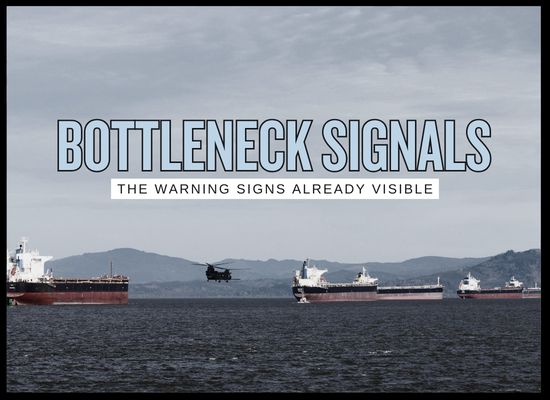
The next shipping bottleneck does not usually announce itself with a single dramatic closure. It builds through smaller signs that start appearing across the system at the same time: more rerouting, more waiting, tighter slot certainty, costlier emissions exposure, crew strain, and a growing gap between the route on paper and the voyage that can actually be executed. Current official and major-industry sources already point in that direction. UNCTAD says the Strait of Hormuz shock sent transits close to a halt in early March 2026, while its recent maritime reviews show how earlier Red Sea and Panama disruptions lengthened voyages, raised ton-miles, and strained supply chains. The Panama Canal’s 2026 slot framework is reinforcing planning certainty as a competitive advantage, and EU shipping rules are making inefficient voyage execution more financially visible on covered trades.
The bottleneck before the bottleneck
Signals the next squeeze is already forming
A bottleneck is not only a blocked canal or a closed strait. It is a system reaching the point where cost, capacity, timing, and confidence start tightening together.
1️⃣ Longer routes are still soaking up vessel time
One of the strongest early warnings is persistent distance inflation. When ships that once moved through shorter corridors are still sailing longer patterns, effective capacity is reduced even if nominal fleet size looks comfortable. That is exactly how the Red Sea diversions amplified ton-miles and distorted schedule recovery.
2️⃣ Corridor risk is spreading from one chokepoint into the next planning cycle
Hormuz is a direct example, but the larger signal is that operators are being forced to price corridor uncertainty into route planning more often and more seriously. Once that becomes normal, more voyages start carrying hesitation, holds, and fallback logic before the ship even approaches the risk area.
3️⃣ Port waiting is still being priced too lightly
Many bottlenecks begin as an execution problem rather than a closure problem. If vessels are still accelerating into uncertain berths and then sitting at anchor, the network is quietly carrying avoidable congestion, fuel waste, and schedule damage that can amplify under the next disturbance.
4️⃣ Slot certainty is becoming more valuable than nominal route choice
Panama is the clearest example right now. When access, reservations, and long-term slot planning become a strategic differentiator, the shipping system is telling you that predictability is tightening. Once certainty itself carries a premium, congestion risk is not far behind.
5️⃣ Carbon and compliance costs now punish inefficient routing faster
On covered trades, longer routes, more waiting, and poorer timing are no longer just fuel problems. They also widen emissions exposure and compliance drag. That means the next bottleneck can become financially painful earlier because inefficient execution now shows up in more than one bill.
6️⃣ Crew strain is becoming part of network fragility
The current Gulf situation shows how quickly seafarer welfare turns from a humanitarian issue into an operational one. When crews are stranded, relief plans slip, and mental strain rises, the system is not just slower. It is more brittle.
7️⃣ Delivered-cost pressure is spreading beyond freight lines
When disruptions affect energy, LNG, fertilizers, and time-sensitive cargoes, the bottleneck is no longer just about ships waiting. It is about how quickly the higher route bill starts spreading into commodity timing, inventory stress, and downstream pricing.
8️⃣ The route on paper is diverging from the voyage that can actually be executed
The last quiet signal is one of the most important. A network gets fragile when the planned voyage depends on too many assumptions holding at once: secure transit, timely berth access, manageable premiums, rested crews, and no contract friction. Once operators stop trusting the paper route, the next bottleneck is usually closer than it appears.
How the signals usually show up before the headline does
The next bottleneck often appears first as a cluster of quieter pressures rather than one visible blockage.
| Early signal | Importance | Before the crunch | Alternative Actions |
|---|---|---|---|
| Longer route baselines persist | Effective supply is tighter than the fleet count implies | Less slack means a smaller new disruption can trigger a larger queue | Track usable capacity in time and miles, not just vessel count |
| Waiting becomes normalized | The system is already carrying avoidable friction | Congestion compounds faster when idle time is already embedded | Push harder on just-in-time arrivals and berth-readiness realism |
| Slot certainty gets priced up | Predictability is getting scarce | Scarce certainty is often an upstream sign of emerging bottlenecks | Plan reservations and fallback options earlier |
| Route risk needs active management | Execution depends on more live judgment than before | Decision-heavy networks slow down under stress | Write corridor-specific route playbooks and escalation rules |
| Carbon cost grows with poor execution | Inefficiency is now charged through more than one line item | The cost chain widens sooner | Price fuel, time, and carbon together in route choices |
| Crew stress persists | The human operating system is under strain | A brittle crew environment reduces resilience before cargo visibly stalls | Treat relief and welfare as operational controls |
The warning rarely arrives alone
A real bottleneck is usually preceded by distance inflation, waiting, uncertainty, and rising delivered cost appearing together.
Certainty is becoming a billable commodity
When reliable passage, slots, or timing need to be bought more aggressively, the system is already telling you that friction is tightening.
The queue forms in the planning layer first
By the time ships are visibly stacked up, the commercial and operational warning signs have usually been flashing for a while.
Bottleneck buildup screener
This tool helps translate soft warning signs into a directional view of whether a shipping system is still absorbable or already getting tight.
The next bottleneck is easiest to miss when teams wait for a visible queue. The better approach is to price the warning signs before they harden into one.
The next bottleneck is usually visible first in route length, waiting, planning certainty, crew stability, and the way the cost chain starts widening before the network openly jams. The operators who notice that early do not stop disruption, but they often make it a lot smaller.
We welcome your feedback, suggestions, corrections, and ideas for enhancements. Please click here to get in touch.