Cruise Industry Segments Most Exposed to Fuel Spikes
🔔 Subscribe to ShipUniverse Weekly →
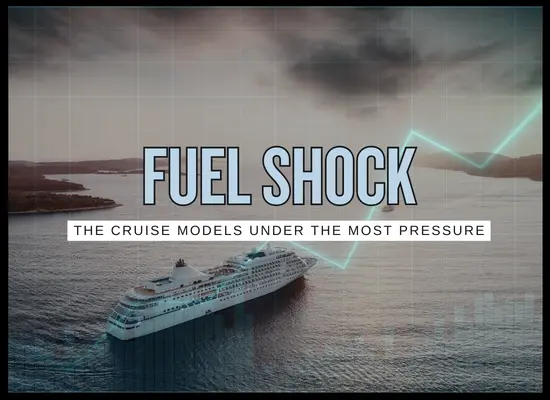
Fuel pressure is back in the cruise conversation because the oil shock is no longer theoretical. Reuters reported on March 16 that Brent had crossed $100 a barrel during the latest Middle East disruption, while refined-fuel markets were tightening even faster in Asia. For cruise operators, that matters because ships buy marine fuels, fuel is a meaningful operating cost, and the industry’s own filings show that exposure is shaped not just by oil prices but by the operating model underneath each product. Segments built around smaller ships, remote routing, higher hotel loads, and longer or more complex itineraries generally have less room to hide from a sudden fuel move than dense, high-capacity products that can spread cost more efficiently.
Fuel spike exposure is uneven across cruise
This report ranks cruise segments by how exposed they look when fuel jumps quickly. The focus is not just on raw fuel burn, but on the full commercial picture: ship size, route length, remote operations, pricing flexibility, and how much room each segment has to absorb or pass through a sudden bunker-cost shock.
Current market read
The key point is simple. Fuel spikes do not hit every cruise product the same way. Small ships on remote or expedition-style routing can face high fuel intensity per guest and weaker procurement flexibility, while dense mainstream ships can spread fuel cost across many more berths. Some premium products can defend pricing better, but not all of them can do it fast enough if fuel jumps sharply during selling season.
Exposure ladder by segment
This is a strategic ranking, not a stock call. The ladder reflects how exposed each segment generally looks under a sudden fuel-price move.
| # | Segment | Exposure read | Why the pressure builds fast | Natural offsets | Current strategic takeaway |
|---|---|---|---|---|---|
1 |
Expedition and exploration cruises
Polar, remote, and specialist sailings with smaller ships and harder operating environments.
|
Highest exposure Remote routing Small ship economics | Expedition products can become fuel-sensitive very quickly because they combine lower berth density with long repositioning legs, weather variability, remote logistics, and energy-hungry hotel functions relative to guest count. Even if the ticket price is high, the operating model leaves less room to disappear a sharp fuel move quietly. | Premium pricing helps. So does a clientele that is less price-sensitive than the mass market. But those cushions do not erase the fact that a small ship covering long or remote distances can carry a lot of fuel burden per passenger. | This is the segment most likely to feel fuel spikes first in margin planning. It also happens to be one of the growth areas drawing more attention, which makes execution discipline even more important when fuel markets turn unstable. |
2 |
Small-ship luxury and yacht-style ocean cruises
Ultra-luxury vessels that sell space, service, and destination feel more than sheer onboard scale.
|
Very high exposure Low berth density Pricing power | These products usually run with fewer guests per ship and a high-service, high-comfort operating profile. That can mean a lot of energy use and limited economies of scale versus larger ships. If itineraries are destination-rich or include longer crossings, the fuel burden becomes more noticeable. | The big offset is revenue quality. Luxury guests can absorb higher pricing better than the contemporary mass market, and inclusive pricing can help mask some cost pass-through. Still, smaller-ship math usually keeps this segment relatively exposed. | Luxury is not automatically protected from fuel shocks. It often has stronger pricing leverage than mainstream cruise, but its ship economics can still leave it vulnerable on a per-guest basis. |
3 |
Premium ocean cruising and destination-heavy long-haul products
Longer voyages, richer itineraries, and products that lean heavily on destination depth and itinerary variety.
|
High exposure Longer sailings Moderate pricing cushion | The issue here is less about tiny ships and more about itinerary shape. Longer voyages, broader geographic spread, and tighter destination schedules can create more fuel sensitivity, especially if the product relies on staying on a demanding timetable or preserving a rich port mix. | This segment often has better pricing power and a somewhat less promotional guest base than the contemporary market. Operators may also have more room to adjust speed, revise routing, or fine-tune deployment without breaking the brand promise. | Premium products sit in the middle of the exposure ladder. They are not usually as fragile as expedition or small-ship luxury, but they can feel a sustained fuel spike faster than dense short-haul mass-market products. |
4 |
Contemporary and family-focused mass-market ocean cruises
Large-ship mainstream cruising built on high occupancy, dense berth count, and broad vacation appeal.
|
Mixed exposure Big absolute fuel bill Scale cushion | This segment can have the largest absolute fuel bills simply because the fleets are big and the ships are large. But the cost is spread across many more berths, which softens the per-passenger hit. The real pressure point is not just fuel burn. It is whether the segment can defend price if both fuel and consumer caution rise together. | Scale is the major defense. Large ships can distribute fuel cost broadly, and operators often have more levers around scheduling, sourcing, itinerary planning, efficiency technology, and yield management. | Mass market is not the most structurally exposed segment, but it can become the most commercially uncomfortable if fuel rises at the same time that value-sensitive demand weakens. |
5 |
River cruising
Smaller ships, calmer operating profiles, and shorter sailing distances tied closely to destination touring.
|
Lower relative exposure Shorter sailing profile Still cost-sensitive | River cruise is not immune to energy inflation, but the sailing profile is usually less punishing than long-haul ocean operations. Distances are shorter, routing is more contained, and the product economics are less dependent on open-ocean fuel burn. | Strong pricing, destination-driven value, and a generally different operating profile lower the direct fuel-spike risk relative to ocean segments. Labor, port, and hotel-style service costs can still matter a lot, but fuel is usually less dominant than in harder-running ocean categories. | On a relative basis, river cruise usually looks like the least exposed segment in a pure fuel-spike comparison, even though broader travel inflation can still create margin pressure. |
The pressure points behind the ranking
Fuel exposure is rarely about one variable. It usually comes from a stack of operating choices that either amplify or soften the shock.
Ship size per paying guest
A segment can run a beautiful premium product and still be fuel-sensitive if it spreads propulsion and hotel energy across too few berths. That is why small-ship categories often look more exposed on a per-guest basis even when the clientele is affluent.
Route shape and schedule intensity
Longer itineraries, remote calls, tougher weather, and more operational complexity all make fuel harder to hide. A fuel spike hurts more when the product promise depends on covering distance, maintaining timing, and reaching places with limited flexibility.
Pricing power versus timing
Luxury and premium cruise can often pass through more cost than the value end of the market. But that does not always happen immediately. If fuel jumps during key selling windows, even strong brands can feel a margin squeeze before pricing catches up.
Efficiency and procurement discipline
Better itinerary planning, slower steaming when possible, newer hardware, and hedging or purchasing discipline can materially soften the blow. Segments with more operational levers are better positioned than those that rely mostly on brand prestige to absorb the hit.
Cruise fuel spike pressure tool
Adjust the sliders to test how exposed a cruise product looks under different operating conditions. This is designed for segment analysis, not for valuing any single company.
Higher values mean longer sailings, wider routing, and more distance to cover.
Higher values mean tougher weather windows, remote calls, and more operational friction.
Lower values mean fewer berths and less ability to spread fuel cost broadly.
Higher values mean more energy-intensive comfort, service, or onboard demand.
Higher values mean better room to absorb or pass through higher fuel cost.
Higher values mean stronger itinerary optimization, hedging, or fuel-management defenses.
We welcome your feedback, suggestions, corrections, and ideas for enhancements. Please click here to get in touch.