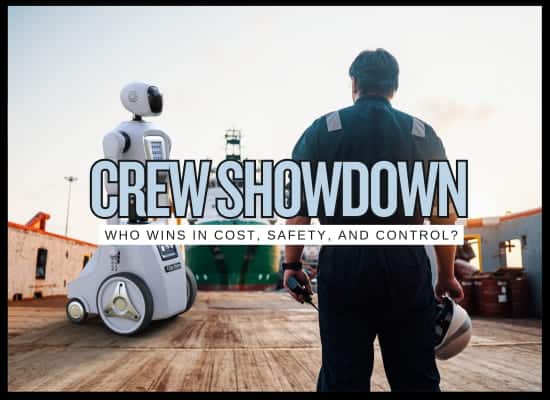
Let's talk robots on ships. Can robots really take over tasks that require human hands, not just a GPS signal? This isn’t about autopilot systems or remote navigation. We’re talking about engine room maintenance, cargo inspections, emergency response, and the gritty, unpredictable work that real crew members handle daily. Humans are in fact, incredibly energy efficient and can work an entire day on a single meal.
So, do robots actually make financial and operational sense for commercial vessels? Or are experienced seafarers still the smarter choice and could they always be the smarter choice? This report takes a hard look at the potential of “robot crew” solutions, the real costs of replacing human dexterity, and whether ship owners are truly ready to trade people for programmable parts.
For all the advancements in maritime automation, there remains no substitute for the flexibility, instincts, and physical dexterity of human crew. On commercial ships, humans adapt to unexpected failures, operate in complex conditions, and perform critical onboard work that robotics still struggle to replicate.
From emergency response to routine maintenance in tight or dangerous spaces, the human element provides irreplaceable value. Below is a breakdown of where human crew continue to shine and why many shipowners see them as not just necessary, but critical.
Human Pros
Function
Why Humans Excel
Robot Limitations
Example Scenario
Emergency Response
Fast, intuitive action in fires, flooding, or man-overboard scenarios
Delayed reaction, limited sensory input, lacks judgment under stress
Crew rerouted power and manually sealed bulkhead after electrical fire in engine room
Maintenance & Repairs
Skilled diagnosis, tool use in confined, unpredictable environments
Robots lack fine-motor control and tactile feedback
Engineer climbed into ballast tank to patch a leak mid-transit
Decision-Making
Combines experience, instinct, and situational awareness
AI lacks contextual judgment and improvisation
Chief mate adjusted cargo plan due to sudden weather shift
Problem Solving
Creative solutions under pressure with limited resources
Pre-programmed responses can’t adapt beyond scope
Crew bypassed faulty pump by rigging temporary manual system
Communication
Verbal, non-verbal, cross-cultural teamwork and coordination
Limited natural language processing; poor in emergencies
Bridge team coordinated multilingual crew during docking in dense fog
Note: Human crew remain central to the flexible, safe, and adaptive operation of commercial ships in unpredictable real-world conditions.
🔴 The Case Against Humans
While human crews have long been the backbone of maritime operations, they also come with a range of costs, limitations, and risks. Fatigue, human error, high insurance premiums, and recruitment shortages are just some of the challenges shipowners face when relying on human labor.
As vessels grow more complex and compliance requirements tighten, the weaknesses of human crews, particularly under stress or over long voyages can translate into real financial and operational vulnerabilities. The table below highlights these pain points in detail.
Human Cons
Challenge
Impact on Operations
Examples at Sea
Cost Implications
Fatigue and Mental Strain
Reduces alertness and leads to critical mistakes
Crew fell asleep during anchor watch, minor collision occurred
Note: Many of the financial risks linked to human crew are indirect but cumulative—affecting insurance, legal exposure, and operational continuity.
🟢 The Case for Robots
As technology evolves, so does the potential for robotics to handle essential onboard tasks, especially those that are repetitive, hazardous, or require round-the-clock monitoring. Robotic systems offer consistency, precision, and the ability to operate without fatigue or error-prone judgment.
From automated inspections to heavy-lift operations and even emergency detection, machines are now taking on duties that once required full crew teams. Robots are increasingly seen as cost-saving supplements or scalable alternatives in specific roles.
Robot Pros
Advantage
Human Limitation
Robot Capability
Operational Value
No Fatigue or Sleep Needed
Crew performance drops on long shifts
Runs 24/7 with consistent output
Higher uptime, reduced manning requirements
No Lawsuits or Injury Claims
Injuries can lead to expensive legal cases
Immune to physical harm
Lower insurance premiums and legal exposure
No Unions or Contracts
Human labor subject to labor laws and strikes
Fully owned asset with no collective bargaining
Predictable cost and no labor disruptions
No Training or Turnover
Training cycles and skill gaps common with new hires
Software updates replace human retraining
Reduced downtime and onboarding costs
Predictable Maintenance Costs
Crew expenses vary by region, experience, and tenure
Service intervals and replacement cycles are fixed
Stable long-term budgeting for operations
Immune to Illness or Mental Stress
Fatigue, isolation, and illness affect human crews
Unchanged performance regardless of conditions
Reliable performance in remote or harsh environments
Precision and Repetition
Humans make errors during routine or tedious work
Exact repeatability for tasks like bolting or latching
Improved reliability and safety outcomes
Note: Robots may require significant up-front investment, but the long-term financial and legal advantages are gaining attention across the shipping sector.
🔴 The Case Against Robots
While shipboard robots offer impressive potential, the reality of using machines to replace physical crew members is more complicated than it seems. High upfront costs, maintenance complexity, environmental fragility, and limited adaptability are just a few of the challenges that come with deploying dexterous robots at sea.
Shipowners considering robotic solutions often discover that what works in a demo doesn't always survive salt spray, vibration, and unpredictable emergencies. Below is a closer look at why robots may not yet be a reliable substitute for human crew.
Robot Cons
Limitation
Real-World Impact
Example Scenario
Risk or Cost Factor
High Initial Investment
Capital cost often exceeds crew salaries by multiples
$150K+ robot deployed to replace manual task crew
Takes years to break even, with uncertain ROI
Fragile in Harsh Environments
Salt, vibration, heat, and movement degrade performance
Arm failed during mooring ops after exposure to spray
Frequent repairs and unplanned downtime
Limited Decision-Making
Cannot improvise when protocols break down
Robot halted mid-task when confronted with unexpected object
Requires human override, defeating automation goal
Maintenance & Diagnostics
Skilled technicians needed for even basic servicing
Ship crew unable to diagnose robotic fault offshore
Tech support delays, expensive remote assistance
Regulatory & Legal Uncertainty
Unclear who is liable for robotic error or failure
Robot-triggered damage to port infrastructure
Insurance and compliance complications
No True Situational Awareness
Robots cannot interpret subtle cues or evolving risks
Failed to react when pressure line began to swell
Missed early warning, led to larger failure
Not Yet “Plug and Play”
Integration is complex and often custom per vessel
Delays during install due to software mismatch
Project overruns, retrofit delays, and added costs
Note: Robots that mimic human labor onboard remain limited by mechanical fragility, unpredictable conditions, and legal uncertainty.
⚖️ The Verdict
Replacing human crew with robots is no longer just a futuristic idea, it’s a real conversation. However, that conversation is far more complex than headlines suggest. While robotic systems can work around the clock, never get sick, and don’t demand wages or insurance, they’re not without serious costs and limitations.
Environmental fragility, lack of true adaptability, and complex maintenance needs make it clear that robots are not ready and may never be ready to fully replace human crew.
Verdict Matrix: Humans vs Robots for Shipboard Physical Tasks
Criteria
Human Crew
Robotic Systems
Best Fit Today
Why
Adaptability
High. Can adjust to new or unclear situations
Low. Performs only programmed tasks
Humans
Unmatched improvisation and flexibility
Endurance
Limited by sleep and recovery needs
Operates continuously without fatigue
Robots
Ideal for 24-hour repetitive operations
Upfront Cost
Moderate. Wages and training required
High. Equipment and integration expensive
Humans
Lower initial financial commitment
Emergency Reliability
Proven in high-stress, real-time decisions
Unproven in unexpected situations
Humans
Better under pressure in real emergencies
Maintenance and Downtime
Needs rest and medical care
Requires specialist maintenance and parts
Humans
Simpler upkeep in practice
Legal and Insurance Clarity
Well understood in maritime law
Still evolving legal frameworks
Humans
Lower legal ambiguity in current systems
Repetition and Precision
Prone to fatigue and inconsistency
Performs repetitive tasks with accuracy
Robots
Ideal for high-precision routines
Energy Efficiency
Operates on food and water
Requires power, batteries, or charging systems
Humans
Simpler, less energy-intensive logistics
Note: While robotic systems show promise in certain roles, humans still offer the best all-around value for unpredictable, high-stakes, or flexible shipboard work.
For now, the smarter approach may be a hybrid model: deploying robotics to assist with dangerous, repetitive, or precision-heavy tasks, while maintaining a core human crew for decision-making, creative problem solving, and adaptability.
Ultimately, the most effective crews of the future may not be fully human or fully robotic, but a hybrid of both, working together to create smarter, safer ships.