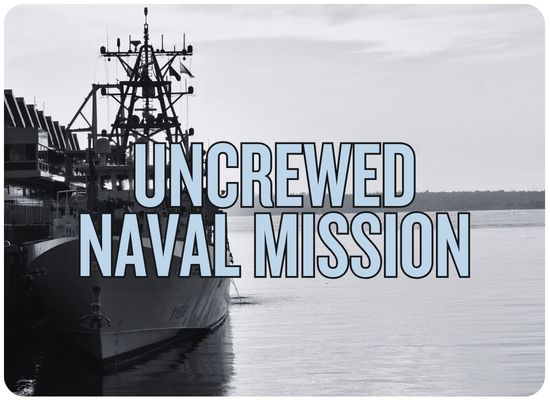
France's New Underwater Combat Drone Signals a Shift in 10 Naval Missions
Anyone who has watched a ship maneuver in restricted water knows how expensive it is to put a crewed hull in harm's way for a job a smaller craft could do. Navies are separating the task from the ship: minehunting is already moving offboard, autonomous watchers are staying at sea longer, and France has now ordered a demonstrator for an ocean-going combat drone. The hard part is making these vessels useful when the link drops, the sea turns rough and somebody still has to make the call.
2028Planned first sea trials for France's UCUV
30Medium USVs in U.S. Navy procurement plan, Sept. 2026
200+Small unmanned surface interceptors under U.S. production contract
300Uncrewed systems at NATO's REPMUS 2026 exercise
A trial, procurement announcement and operational deployment are not interchangeable. The evidence labels below make that distinction.
01 / France's underwater bet
A combat submarine without a crew
UCUV · Naval Group · France
France awarded Naval Group a demonstrator contract on November 3, 2026. Its intended roles run from intelligence gathering and surveillance to potential offensive neutralization. The craft must demonstrate long endurance and controlled decision-making autonomy; it is intended to be air-transportable and launchable from shore or a surface ship.
2023 study›2026 contract›2028 trials
Not yet an operational weapon. The ministry has not disclosed a firm production quantity, precise dimensions, an agreed weapon loadout or a fleet entry date. The first sea tests are a target, not a completed milestone.
02 / The transfer map
Ten missions, ten different maturity levels
Scan the one-line decision; expand a function for the work moving offboard, what navies have actually demonstrated and the limiting factor.
Fielded = deployed for an identified taskAt-sea trial = tested, not fully fieldedContracted / development ≠ operational
01Minehunting & clearance
Keep the crewed hull out of the minefield.
FieldedDetails
What moves offboardRemote sonar search, sweeping and selected neutralization tasks.
Evidence on the waterU.S. MCM USVs deployed with USS Canberra and USS Santa Barbara in 2025; a full offboard mine-countermeasure package is in service.
What still holds it backMine classification, clearing proof, weather limits and launch/recovery remain demanding.
02Maritime surveillance (ISR)
Keep watch without tying up a frigate.
FieldedDetails
What moves offboardPersistent surface patrols, imagery, radar tracks and suspicious-contact reporting.
Evidence on the waterNATO Task Force X-Baltic has progressed from rapid prototypes to national procurement and deployment; U.S. small USVs are supporting fleet surveillance.
What still holds it backIdentification confidence, sensor coverage and access to secure communications.
03Anti-submarine search
Put more listening stations in the water.
At-sea trialDetails
What moves offboardRemote acoustic search, tracking cues and underwater environmental sampling.
Evidence on the waterU.S. Navy Sea Hunter and Seahawk are long-endurance USV testbeds used to develop anti-submarine and fleet-sensor roles.
What still holds it backAcoustic false positives, underwater data transfer and handing a track to crewed forces.
04Seabed & cable monitoring
Monitor the ocean floor without a submarine on every patrol.
At-sea trialDetails
What moves offboardSeabed mapping, infrastructure inspection, oceanographic and anomaly data.
Evidence on the waterAustralia is integrating Ghost Shark and other unmanned underwater payloads for seabed and critical-infrastructure roles; British naval gliders recorded a 64-day Atlantic mission.
What still holds it backEnergy, revisit time, underwater positioning and confirmation of anomalies.
05Offboard strike & sea denial
Separate selected weapons from the expensive host ship.
Combat / trialDetails
What moves offboardOne-way surface attack systems and prospective undersea strike payloads.
Evidence on the waterArmed surface drones have demonstrated combat use in the Black Sea; Britain fired a heavyweight torpedo from uncrewed Excalibur in a controlled September 2026 test.
What still holds it backPositive identification, human authorization, countermeasures and reliable launch control.
06Forward interception & screening
Send cheaper boats to investigate and screen approaches.
ContractedDetails
What moves offboardForward presence, identification of suspect contacts and selected interdiction roles.
Evidence on the waterIn September 2026 the U.S. Defense Innovation Unit reported a production contract for more than 200 small unmanned surface interceptors.
What still holds it backDistinguishing civilian traffic, escalation control, endurance and attrition.
07Parts & small-load resupply
Deliver the urgent part without sending a ship.
At-sea trialDetails
What moves offboardTransfers of manufactured spares, small stores and specialized payloads between platforms.
Evidence on the waterAt RIMPAC 2026 the U.S. Navy demonstrated a digitally crewed surface vessel moving replacement parts made aboard ship; the wider chain finished in under 24 hours.
What still holds it backPayload limitations, sea-state transfer, cargo handling and spare-part qualification.
08Communications relay
Build a moving link between scattered sensors.
At-sea trialDetails
What moves offboardRelay nodes and sensor-data gateways carried by surface drones.
Evidence on the waterNATO Task Force X-Arctic tested an architecture linking and retasking diverse autonomous systems at REPMUS 2026.
What still holds it backJamming, bandwidth, interoperability and what happens when the relay disappears.
09Decoys & electronic deception
Move selected emitters away from the warship.
DevelopmentDetails
What moves offboardOffboard false signatures, electronic payloads and deception support.
Evidence on the waterU.S. large-USV test plans have included electronic-warfare payloads; operational sea-going surface decoy fleets are not established by this evidence.
What still holds it backSignature fidelity, emission control, cost and the risk of revealing the network.
10Coordinated screens & swarms
Use several simple vessels as a shared sensor screen.
At-sea trialDetails
What moves offboardCollaborative search, coverage and task redistribution across multiple craft.
Evidence on the waterREPMUS 2026 involved 300 uncrewed systems; NATO separately tested orchestration of multiple types. That is not evidence of a 300-vessel combat swarm.
What still holds it backDeconfliction, cyber resilience, tasking authority and bandwidth at scale.
03 / The control problem
The crew leaves the craft. The responsibility does not.
Issue
What changes
What still needs managing
Control and authorization
Naval crews supervise more remote platforms from ship or shore.
Engagement approval, identification and accountability.
Link resilience
Unmanned craft work beyond ship radar or radio range.
Loss-of-link behavior, cyber protection and navigation.
Maintenance
Some tasks move into a cheaper, replaceable hull.
Repair, recovery, spares, batteries or fuel at sea.
Cost
One expensive ship can coordinate several lower-cost tools.
Launch crews, sensors, attrition, logistics and communications still add costs.
Research sources · primary documentation and recent reporting