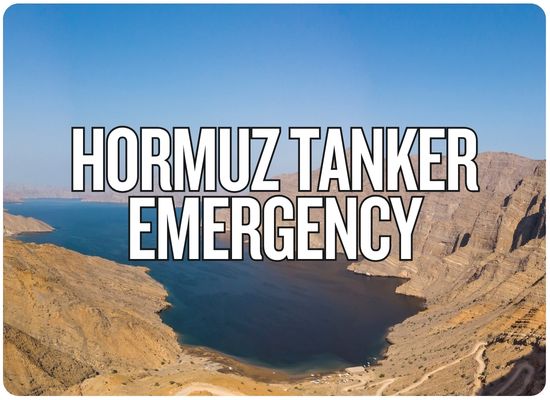
A tanker was reported burning and largely submerged in the Strait of Hormuz early on October 29, 2026, approximately nine nautical miles north of Khasab, Oman. UK Maritime Trade Operations issued warning 185-26 after the master of a passing vessel observed a ship on fire, while maritime security firm Vanguard reported that the unidentified tanker had been struck by a projectile at around 03:00 UTC and appeared mostly underwater. Another vessel was reportedly nearby and may have been assisting. The tanker has not been publicly identified, its crew's condition remains unknown, and neither its sinking nor a pollution release has been independently confirmed. The incident comes amid intensified attacks and growing navigational uncertainty in the waterway connecting the Persian Gulf with international oil markets
ShipUniverse | Maritime Security | 29 October 2026
A Burning Tanker in the Hormuz Passage
A passing master reports a vessel on fire near
Oman's Musandam Peninsula. A separate security
assessment describes a projectile strike and
severe submersion. The priority is establishing
the identity and condition of the ship and crew.
UKMTO WARNING
185-2629 OCTOBER
Unknown Crew Status
The incident report does not confirm whether
the crew has been rescued, is still aboard,
is missing or has suffered casualties.
The reported presence of another vessel
does not establish a completed rescue.
Reported Time
03:00 UTC
Approximate incident time in Vanguard reporting.
Location Reference
9 NM
North of Khasab, Oman, approximately 17 km.
Physical Condition
On Fire
Fire reported to UKMTO; near-submersion
reported by Vanguard.
Where the Incident Was Reported
Geographic relationship only. Not a navigational
chart, surveyed position or representation of
authorized transit corridors.
IRAN | Northern Shore of the Strait
REPORTED INCIDENT AREA
Unidentified Tanker
Burning vessel observed approximately
nine nautical miles north of Khasab.
Vanguard reports it appeared mostly submerged.
STRAIT OF HORMUZ
Persian Gulf ↔ Gulf of Oman
OMAN | Musandam PeninsulaKhasab coastal reference
This schematic is not drawn to scale.
The wreck position and vessel status
are not independently surveyed.
How the Initial Information Developed
Eyewitness
Passing Vessel Reports Fire
A third-party master observed another
vessel burning in the strait.
UKMTO subsequently published the report.
Vanguard
Projectile and Submersion Reported
The security firm's account describes an
unidentified projectile strike and a tanker
that appeared mostly underwater.
Independent confirmation remains pending.
Nearby Ship
Possible Assistance Observed
Another vessel was reportedly in the vicinity.
No completed rescue or transfer of survivors
was established in the initial reporting.
UKMTO
Caution Advised
Ships were advised to proceed carefully
and report suspicious activity while
authorities investigate.
Unresolved 01
Who Is on Board?
The vessel name, IMO number, flag,
crew complement and rescue status
have not been confirmed.
Unresolved 02
Is the Vessel Sunk?
Near-submersion is a witness description,
not a verified sinking or seabed survey.
Unresolved 03
What Is the Cargo?
Crude, products, ballast condition,
remaining bunkers and tank integrity
have not been established.
Unresolved 04
Is There a Pollution Release?
No confirmed spill volume, slick
measurement or environmental impact
assessment was available initially.
Evidence standard:
UKMTO Warning 185-26 establishes a report
of fire at the stated location. Vanguard
supplies the more severe reported details.
Neither an intentional attack nor a sinking,
crew loss or pollution event should be
described as independently established
from the initial information.
ShipUniverse | Casualty & Navigation Intelligence
Five Questions Will Determine the Shipping Impact
The difference between a burning vessel,
a salvageable casualty and a submerged
obstruction can transform the operational
response. Crew safety comes first;
clearance, pollution and commercial
effects depend on subsequent findings.
The Casualty Decision Chain
Each stage requires additional evidence.
None should be assumed complete merely
because another vessel was seen nearby.
01
Account for the Crew
Establish crew complement, whether abandonment
occurred, rescue arrangements, injuries
and any missing persons.
Determine whether the vessel is afloat,
grounded, submerged or sunk, including
its position and remaining stability.
Survey Pending
04
Assess Pollution Exposure
Confirm cargo type, quantity, fuel on board,
tank damage and any observed discharge
before estimating environmental consequences.
Impact Unknown
05
Establish Navigational Restrictions
Authorities must determine whether a vessel
or wreck creates a hazard and whether
traffic coordination requires changes.
No Closure Confirmed
Recent Confirmed Losses and Damage
Historical incident records from the IMO.
These cases illustrate the difference between
a sinking, vessel damage and confirmed pollution.
Date
Vessel
Location
Recorded Consequence
Environmental Status
Evidence
October 292026
Unidentified Tanker
About 9 NM north of Khasab
Fire reported. Vanguard describes
near-submersion. Crew condition
has not been established.
Unknown
Initial Report
October 132026
GFS PrideContainer ship
Strait of Hormuz
Confirmed sinking in IMO incident register.
No pollution recorded
IMO Confirmed
September 232026
Cape DaoBulk carrier
15 NM northeast of Khasab
Vessel damaged and sunk.
One seafarer fatality recorded.
No pollution recorded
IMO Confirmed
October 112026
Kition MCommercial vessel
Strait of Hormuz
Vessel damaged during a recorded incident.
Limited pollution reported
IMO Confirmed
September 122026
El GaiaCommercial vessel
Strait of Hormuz
Vessel damaged; two seafarers
recorded missing.
Pollution, extent unknown
IMO Confirmed
Historical confirmed cases do not determine the
cause or outcome of the October 29 incident.
The IMO list cited here was current through
October 27, before today's casualty.
The Strategic Oil Flow Context
U.S. EIA oil and petroleum-liquids flow estimates,
million barrels per day. Historical quarterly
averages, not today's live traffic.
Both bars share a 25 mb/d reference scale.
Fourth Quarter 2025
21.6M b/d
Pre-conflict oil movement through
the Strait of Hormuz.
Second Quarter 2026
4.9M b/d
Historical disruption-period average,
down approximately 77.3%.
Later traffic may differ materially.
A single damaged vessel does not establish
that this percentage of present-day
shipping is interrupted.
A new submerged obstruction,
salvage exclusion zone, cargo spill,
additional insurance charges
or a measurable traffic shutdown.
Commercial Bottom Line:
A tanker can create major operational costs
even if its cargo is not lost. Salvage access,
insurance terms and traffic delays could
affect multiple unrelated vessels.
The scale of today's disruption cannot
be established until the casualty
and the response are better documented.
ShipUniverse Interactive Maritime Operations Tool
The Hormuz Incident Recovery Test
If a vessel casualty reduces available
transit capacity, how much shipping builds
up and how much additional vessel time
is needed to clear it? Model alternative
traffic and recovery assumptions.
Current incident status:
No verified strait closure or quantified
traffic restriction has been established
from today's tanker report. All preset
disruptions below are hypothetical.
1. Build the Passage Scenario
Enter assumed vessel arrivals and the number
of transits that can still be accommodated
during a hypothetical restriction. These
are modeling inputs, not authorized
navigation limits or observed traffic counts.
Illustrative commercial passage demand
Hypothetical time before normal service returns
Assumed safe processing capacity;
not an actual clearance authorization
Traffic moved via other feasible arrangements
Must exceed continuing planned arrivals
to clear an existing queue
Traffic Allocation During the Restriction
Green vessels transit within the assumed
capacity, blue vessels use alternatives,
and red vessels remain queued when
the restriction ends.
Processed Through Strait
15.0
Alternative Arrangements
3.6
Vessels Queued
17.4
Results represent vessel equivalents,
which may be fractional because the tool
models average traffic rates.
2. Estimate Added Operating Costs
Price the extra vessel time and
hypothetical alternative arrangements.
Add an illustrative cargo mix to estimate
the scheduled oil shipments associated
with vessels waiting in the queue.
Illustrative vessel-time opportunity cost
Additional cost of a viable alternative
Illustrative cargo mix, not observed vessel traffic
Assumed laden cargo per tanker
RESTRICTION PHASE
3.0 days
The queue develops under reduced
handling capacity.
RECOVERY PHASE
4.4 days
Additional capacity above continuing demand
clears the accumulated vessels.
Total Planned Transits
36.0
Hypothetical transit demand during
the restriction period.
Queue at End of Restriction
17.4
Vessel equivalents requiring later passage.
Time to Clear Queue
4.4 days
Additional clearance period after
the restriction ends.
Additional Waiting Vessel-Days
63.9
Estimated aggregate queueing time,
assuming linear accumulation and clearance.
Scheduled Oil Cargo in End Queue
15.66M bbl
Hypothetical cargo associated with queued
tanker equivalents. Not lost or spilled oil.
Added Commercial Cost
$5.06M
Modeled vessel-time expense plus
alternative movement costs.
Queue Continues After the Restriction Ends
Reduced transit capacity generates a queue,
which requires additional throughput after
restrictions have been lifted.
Methodology and limitations:
Planned transits equal daily assumed arrivals
multiplied by the restriction duration.
Alternative movements equal planned transits
multiplied by the diversion share.
Through-strait traffic equals the lower of
the remaining demand and available restricted
transit capacity multiplied by duration.
The balance forms the end-of-restriction queue.
Once normal service resumes, the model assumes
the original daily arrival rate returns and no
additional diversion continues. Queue clearance
uses the difference between daily recovery
capacity and those continuing arrivals.
Vessel waiting-days use triangular average queue
accumulation during the restriction and
triangular clearance afterward.
Additional commercial cost equals vessel waiting-days
multiplied by daily time cost, plus alternative
movements multiplied by extra movement cost.
Scheduled oil cargo in the end queue equals
queued vessel equivalents multiplied by the
assumed tanker share and average barrels per tanker.
The tool excludes salvage bills, rescue operations,
pollution response, cargo damage, insurance claims,
individual vessel arrival patterns, convoy procedures,
port capacity and secondary freight-rate changes.
Alternative passage arrangements may not be
physically or legally available.
All capacity inputs, costs, cargo quantities
and disruption lengths are user assumptions.
No navigational safety distance, route authorization
or casualty status can be inferred from the tool.
USD throughout.
Feedback Welcome
We welcome your feedback, suggestions, corrections, and ideas for enhancements.