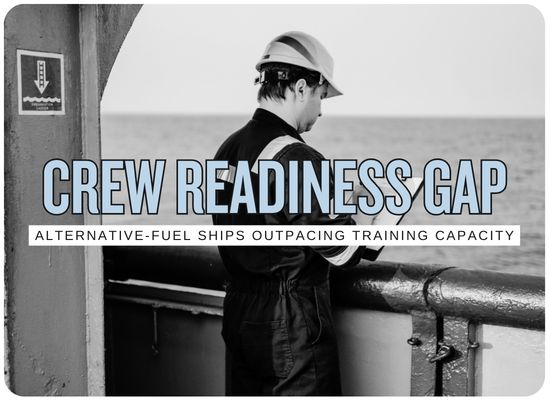
The Alternative-Fuel Fleet Is Arriving Before the Crew Pipeline Is Ready
The alternative-fuel fleet is moving from demonstration projects into
a real operating fleet. The harder scaling problem may no longer be
whether engines can burn the fuel. It may be whether enough officers,
ratings, instructors and assessors can prove they know how to handle it safely.
Alternative fuelsSeafarer competenceSTCWSeptember 2026
Fleet clock
1,032
Alternative-fuel vessel orders logged in 2024, 2025 and January-August 2026 combined.
Skills clock
2029
IMO work on additional fuel- and technology-specific training provisions continues toward this horizon.
The bottleneck is not simply course duration. It is the ability to create
globally recognized competence at scale while ships, fuels and operating
procedures are still evolving.
Shipping has already committed capital faster than the competence framework
has matured. DNV logged 515 alternative-fuel vessel orders in 2024,
another 275 in 2025 and 242 more during the first eight months of 2026.
The fleet of alternative-fuel ships is expected to almost double between
2024 and 2028 based on the current orderbook.
Crew preparation is following a different clock. IMO's generic interim
training guidelines arrived in September 2025. Methanol and ammonia
received dedicated interim training guidance in July 2026. Other fuel
and technology tracks remain under development as the wider STCW
framework is reviewed.
The most aggressive workforce scenario modeled by DNV for the Maritime
Just Transition Task Force estimated that 450,000 seafarers could require
additional alternative-fuel training by 2030 and 800,000 by the
mid-2030s. Those figures are scenario outputs rather than a current
count of people who still need training, but they illustrate the scale
of the pipeline shipping may eventually have to build.
The scale problem
Four numbers explain why crew readiness is becoming a fleet issue
Alternative-fuel orders
1,032
DNV-recorded orders from January 2024 through August 2026.
2030 training scenario
450K
Seafarers requiring additional training in the DNV zero-carbon scenario.
Mid-2030s scenario
800K
Scenario-based cumulative workforce requirement, not a current shortage count.
Training risk study
500+
Competence and risk considerations identified in cross-sector workshops.
Fleet clock
The ship pipeline did not wait for the training system
2024
515
2025
275
2026*
242
*January through August only. DNV reported that the first eight months
of 2026 were 27% above the comparable 2025 period for alternative-fuel
vessel orders.
The delivery pipeline is now material.
DNV's 2026 Maritime Forecast says there are nearly as many
alternative-fuel ships on order as already in service, putting the
fleet on course to almost double between 2024 and 2028.
Competence clock
The international training framework is still being assembled
DateTraining milestone
2024
Fuel-specific competence gaps formally mapped
Twelve expert workshops involving 116 participants examined
ammonia, methanol and hydrogen and generated more than
500 training and risk considerations.
Apr 2025
IMO Train-the-Trainer rollout begins
The first large-scale Asian course trained 35 participants
across ammonia, methanol and hydrogen topics.
Sep 2025
Generic interim training guidelines issued
STCW.7/Circ.25 established the international framework for
basic and advanced alternative-fuel training.
Jul 2026
Methanol and ammonia guidance arrives
Fuel-specific interim training guidelines were issued as
STCW.7/Circ.26 and STCW.7/Circ.27.
To 2029
Additional fuel and technology work continues
The IMO work plan includes hydrogen fuel cells, LPG,
hydrogen, batteries, wind propulsion and other technologies.
Competence pipeline
Training does not end when the classroom door opens
Scaling an alternative-fuel workforce requires several capacity
layers to expand together.
1
Harmonized syllabus
Administrations and training institutions need a common
competence baseline for each fuel and responsibility level.
2
Qualified instructors
The industry must train trainers who understand both the
theoretical hazard and actual shipboard operation.
3
Simulator and practical exercises
Bunkering, leak response, PPE, gas detection, shutdown logic,
firefighting and emergency scenarios require practical competence.
4
Qualifying shipboard exposure
Mature LNG requirements demonstrate the issue. Advanced IGF
certification includes at least one month of approved sea service
and three bunkering operations, although two bunkerings may be
replaced by simulator training.
5
Vessel-specific familiarization
Generic training cannot replace knowledge of the actual ship's
tank arrangement, ventilation, detection, ESD system,
bunkering station and emergency procedures.
This creates a feedback loop.
More experienced crews are needed to operate the first ships,
but those first ships also create the sea-time and operational
experience needed to train the next wave of crews.
Fuel-by-fuel readiness
Shipping is not facing one training transition
Each fuel creates a different competence problem and is at a different
point in the regulatory and operating-experience cycle.
Alternative-fuel crew readiness
Scroll horizontally for full operating comparison
Fuel / technology
Fleet maturity
Training status
Core competence challenge
Scaling issue
LNG / methane
~800 capable ships operating and ~600 on order as of April 2026
Established
Cryogenic fuel, gas detection, bunkering, ventilation and emergency response
Advanced qualifications include practical sea-service requirements
Methanol
450+ capable ships operating or on order in DNV's late-2025 assessment
Interim 2026
Toxicity, low-flashpoint fuel handling, bunkering and fire response
Rapid fleet growth requires more instructors with real operating experience
Ammonia
Early commercial fleet and orderbook
Interim 2026
Acute toxicity, exposure control, gas detection, PPE and emergency isolation
Storage, leakage, ignition control and fuel-system emergency response
Fuel-specific international training provisions remain under development
Battery systems
Established in some short-sea sectors
Developing
High-voltage systems, thermal events, isolation and emergency response
Training requirements must accommodate rapidly changing system designs
Who actually needs training
Not every seafarer needs the same qualification
Basic training
Safety duties
IMO's generic approach covers seafarers assigned safety duties
related to care, use or emergency response for the fuel or technology.
Advanced training
Key roles
Masters, engineer officers and personnel with immediate responsibility
for the fuel and associated systems require deeper competence.
The relevant number is larger than the crew on one ship.
A vessel needs multiple rotations, relief personnel, superintendents,
instructors and replacement officers. The trained workforce supporting
one alternative-fuel ship is therefore larger than the headcount aboard
during a single voyage.
The scaling trap
Every solution depends on another scarce resource
Ships
More vessels create more practical training opportunities
They also create immediate demand for competent crews from the day
the vessel enters service.
Trainers
Training institutions need experienced instructors
Early in a fuel's deployment cycle, the pool of people with
substantial real-world operating experience is necessarily limited.
Simulators
Simulation can remove part of the sea-time bottleneck
LNG already demonstrates how approved simulator exercises can
replace some, but not all, practical bunkering requirements.
Rules
Courses have to remain aligned with a moving regulatory target
Fuel safety standards, STCW provisions, class rules and vessel
designs are all continuing to develop.
Fleet deployment
A technically ready ship can still be operationally unready
Ship ready + crew ready
Fuel system, bunkering arrangements, certified personnel and company
procedures mature together.
Ship ready + crew short
The vessel exists, but deployment flexibility is constrained by who
can safely and legally operate the fuel system.
Crew trained + ship experience limited
Classroom knowledge exists, but practical familiarization and
type-specific experience remain thin.
Dual-fuel fallback available
A conventional-fuel fallback can reduce deployment risk, but it does
not remove the need to build competence before alternative-fuel operation.
Research anchors
Data behind the workforce case
DNV Alternative Fuels Insight
515 alternative-fuel vessel orders in 2024, 275 in 2025 and
242 through August 2026.
DNV Maritime Forecast to 2050 2026
Alternative-fuel vessels in operation and on order imply a fleet
that nearly doubles between 2024 and 2028.
Maritime Just Transition Task Force
DNV scenario modelling estimated 450,000 seafarers requiring additional
training by 2030 and 800,000 by the mid-2030s in the fastest transition case.
IMO STCW alternative-fuel programme
Generic guidance was issued in September 2025. Methanol and ammonia
interim guidelines followed in July 2026.
IMO HTW 12 work plan
Additional training provisions for hydrogen, LPG, batteries,
fuel cells and other technologies continue under a multi-year programme.
IMO IGF training experience
Advanced LNG/IGF competence demonstrates that qualifying experience
can include sea service, bunkering operations and approved simulation.
Interactive workforce model
Alternative-Fuel Training Capacity Planner
Stress-test whether a hypothetical training network can produce qualified
seafarers fast enough for a workforce target. The default settings are
illustrative capacity assumptions, not an estimate of today's global
training infrastructure.
Workforce target
450,000
0
4 years
Training infrastructure
75%
Fleet translation
36
Modeled workforce throughput
Training capacity is below the scenario requirement
Change training capacity or the deadline to see where the modeled gap closes.
67,500
annual qualification gap
Annual throughput
Required
112,500
Classroom
60,000
Fully completed
45,000
Centres required at current productivity
250
Illustrative centre count needed to hit the selected deadline.
Time to clear remaining workforce
10.0 yr
At the current modeled effective annual capacity.
Workforce backlog at deadline
270K
Remaining people not completed by the selected deadline.
Vessel-equivalent crew pools per year
1,250
Effective qualifications divided by the selected crew-pool assumption.
This model does not estimate actual global training capacity or an actual
current seafarer shortage. The 450,000 and 800,000 presets reproduce
scenario workforce figures from earlier DNV/MJTTF modelling. Centre count,
course frequency, seats and practical completion are adjustable hypothetical
assumptions. "Practical completion" can represent simulator access, sea-time,
assessment, bunkering experience, company qualification or other constraints
that prevent a classroom seat from becoming a deployable qualification.
Feedback Welcome
We welcome your feedback, suggestions, corrections, and ideas for enhancements.