CMA CGM Expands U.S. Logistics Footprint With $1.4 Billion FedEx Supply Chain Deal
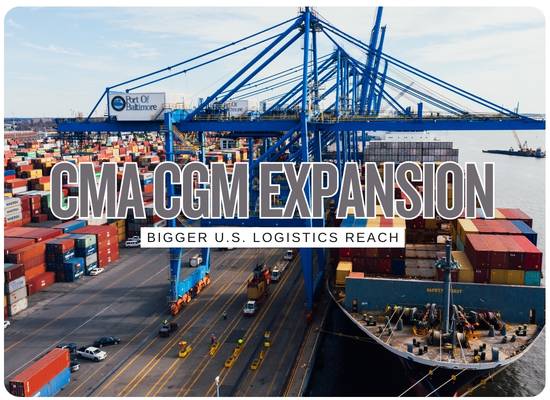
CMA CGM has agreed to acquire FedEx Supply Chain at an enterprise value of $1.4 billion in a move that materially expands its contract logistics footprint in North America through CEVA Logistics. The companies said the transaction would nearly triple CEVA’s North American contract logistics operations, add nearly 10,000 team members, and bring the combined network to about 150 warehouses and more than 240 locations across North America with a combined workforce of 20,000 people. The two groups also expect to put in place multi-year commercial agreements in ocean freight and selected air cargo capacity, with those arrangements rolling out in phases through 2028, while FedEx continues narrowing its focus around its core delivery business.
Operator Impact Snapshot
CMA CGM’s purchase of FedEx Supply Chain gives the group a much larger U.S. contract logistics base in one step. For maritime and logistics stakeholders, the immediate story is less about vessels and more about warehousing scale, inland reach, and how much more tightly one shipping group can connect ocean, air, and contract logistics services inside North America.
Quick read: The deal is not simply about adding warehouses. It strengthens CMA CGM’s U.S. inland logistics reach through CEVA while preserving room for future commercial cooperation in both ocean and air freight.
Deal Breakdown and Market Read Across Ocean Air and Warehousing
| Deal Lane | Current Detail | Importance | Who Feels It First | Next Commercial Signal |
|---|---|---|---|---|
|
Purchase structure
Enterprise value was announced at $1.4 billion.
|
The transaction is set up as a sizable but targeted contract-logistics expansion rather than a full FedEx logistics-platform transfer. | That makes the move easier to read as a warehousing and fulfillment scale play inside North America. | 3PL competitors, investors, contract-logistics buyers, and supply chain planners. | Regulatory clearance timing and how quickly integration milestones are communicated after closing. |
|
CEVA scale shift
FedEx Supply Chain would nearly triple CEVA’s North American contract logistics footprint.
|
The combined operation is expected to reach about 150 warehouses and more than 240 locations across North America with 20,000 people. | That creates a much larger U.S. inland network for a group already strong in ocean shipping and increasingly active in air cargo. | Retail logistics buyers, contract-logistics customers, port-adjacent inland operators, and warehouse competitors. | How CEVA positions the enlarged network by vertical, geography, and fulfillment capability. |
|
Ocean freight linkage
CMA CGM is expected to become a preferred ocean carrier for FedEx under a non-exclusive structure.
|
The arrangement leaves room for commercial cooperation without locking FedEx into one carrier relationship everywhere. | That can support steadier cargo alignment and more integrated selling across ocean freight and inland contract logistics. | Ocean carrier competitors, BCOs, NVOs, and customers buying door-to-door solutions. | Whether this produces visible volume shifts or remains more of a strategic framework than a dramatic cargo-transfer event. |
|
Air cargo coordination
The companies also expect phased work on selected air cargo capacity solutions.
|
That adds another connective layer between shipping, warehousing, and time-sensitive freight support. | It matters because integrated logistics groups increasingly compete on network combinations rather than on one transport mode alone. | Airfreight customers, integrated logistics buyers, and multimodal procurement teams. | How much of the air side becomes commercially material and how quickly those phases begin. |
|
FedEx portfolio shift
FedEx continues streamlining around its core delivery strengths after the FedEx Freight spin-off.
|
Selling FedEx Supply Chain narrows its structure while keeping room for commercial partnerships in freight forwarding and transport services. | This makes the transaction a strategic refocus for FedEx, not just an asset sale. | FedEx customers, equity analysts, and competitors watching portfolio simplification. | Whether FedEx uses the cleaner structure to sharpen growth in higher-value core delivery segments. |
The most important feature of this deal is that it tightens the connection between ocean shipping, warehousing, and selected air-freight coordination inside the U.S. market without turning the agreement into a single-channel exclusive arrangement. That gives CMA CGM more inland depth while allowing FedEx to stay focused on a narrower operating profile.
U.S. Logistics Impact Estimator
This tool helps estimate where this acquisition may matter most for your business across warehousing, ocean linkage, competitive pressure, and FedEx relationship changes.
Your current setup suggests the biggest effect is likely to come from the enlarged U.S. contract logistics footprint.
The transaction looks commercially meaningful for your profile rather than merely symbolic.
Competitive positioning inside North American logistics appears to be the pressure point most likely to shift first.
The deal looks large enough to change buying conversations even before full integration is complete.
This estimator is editorial and strategic. It does not model valuation, regulatory approval odds, contract economics, or company-specific revenue impact.
We welcome your feedback, suggestions, corrections, and ideas for enhancements. Please click here to get in touch.