Bunker Costs Stay Uneven as Fujairah Premium Keeps Operators on Alert
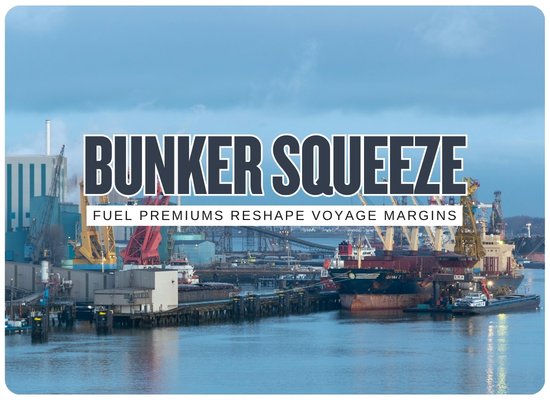
Marine fuel costs are still moving through a split market, with major bunkering hubs showing very different price behavior even as crude has eased from recent highs. The latest live price boards show Singapore and Houston below the extreme Gulf levels for VLSFO, Rotterdam still offering one of the cheaper major-hub options, and Fujairah remaining the standout premium market for both VLSFO and MGO. The current watch is not only the headline fuel number. Operators are also dealing with lead time, supplier reliability, fuel quality checks, port selection, deviation math, war-risk-linked routing, and whether fuel can be secured at the planned stem rather than at a last-minute emergency premium.
Ship Universe Fuel Market Watch
Operator Impact Snapshot
Fuel planning is now a port-by-port decision, not just a global oil-price read.
The bunker market is still being shaped by regional fuel availability, Gulf supply stress, refinery and blending constraints, and different pricing behavior across major hubs. The key operational issue is whether a vessel can secure the right fuel at the planned port, at the planned date, with acceptable quality and a price that still fits the voyage margin.
Fujairah premium exposure
Fujairah remains the standout high-cost hub, especially for MGO and VLSFO, forcing operators to compare Gulf stems against Singapore, Rotterdam, Houston, and alternate regional options.
Voyage margin pressure
A bunker move of only $50 to $150 per metric ton can change voyage economics quickly on long-haul container, tanker, bulker, and offshore support work.
Lead time and stem reliability
Price alone is not enough. Operators need to confirm physical availability, barge timing, supplier reliability, delivery window, and fallback options before fixing the voyage.
Fuel quality and debunkering risk
Tight supply periods can increase blend complexity and quality disputes, making testing, documentation, and supplier selection more important than usual.
Charter-party recovery language
Charterers and owners should recheck bunker adjustment, deviation, waiting, off-hire, war-risk, and fuel-quality clauses before assuming costs can be passed through.
Commercial Reading
Bunker buying is again becoming a competitive advantage. Operators that choose the right fuel port, confirm supply early, and protect themselves contractually can keep margins intact while others lose earnings through last-minute stems, diversions, and quality disputes.
- Owners: compare full delivered cost, not only the quoted bunker price. Include waiting time, deviation, port cost, testing, and lost fixture days.
- Charterers: avoid stale bunker assumptions in freight negotiations. A route exposed to Gulf or tight Asian supply can change quickly.
- Brokers: expect more negotiation around bunker adjustment factors, stem timing, delivery windows, and acceptable bunkering ports.
- Insurers: quality disputes, machinery risk, debunkering, and off-spec claims can rise when buyers are forced into stressed supply chains.
- Suppliers: reliability and documentation are becoming as commercially important as price during volatile bunker conditions.
Global Bunker Pricing Board
Latest Hub Prices and Operator Signals
Major bunker hubs are not moving as one market. Port selection is now directly tied to voyage profit.
Current Fuel Setup
The latest bunker price board shows a wide gap between the lower-cost Atlantic hubs and the Gulf premium market. Rotterdam and Houston are currently among the lower major-hub VLSFO options, Singapore is higher but still far below Fujairah, and Fujairah remains expensive enough to force serious port-selection analysis before every Gulf-exposed voyage.
Current benchmark level across 20 leading bunkering ports.
Distillate fuel remains the highest direct cost category for many operators.
Scrubber-equipped vessels still have a measurable fuel-cost advantage in many ports.
The Gulf premium remains large enough to reshape bunkering strategy.
Latest Hub Price Table
| Bunker Hub | VLSFO | MGO | IFO380 | Operator Signal | Cost Pressure |
|---|---|---|---|---|---|
| Singapore Asia benchmark hub |
$694/mt Up $18.50 on latest board |
$894/mt Up $11.50 |
$461.50/mt Up $2.50 |
Active Still attractive compared with Fujairah, but spot demand and lead time should be checked early. |
Medium High
|
| Rotterdam Atlantic value point |
$596.50/mt Flat on latest board |
$883.50/mt Up $8.50 |
$457.50/mt Flat |
Lower Cost Strong comparison point for Atlantic voyages and ships able to avoid Gulf premium exposure. |
Controlled
|
| Houston U.S. Gulf reference |
$582/mt Down $2 |
$922/mt Up $16.50 |
$469.50/mt Down $6.50 |
Competitive VLSFO remains attractive against major hubs, but distillate exposure should be watched. |
Controlled
|
| Fujairah Gulf premium hub |
$898.50/mt Down $21 |
$1,315/mt Down $23.50 |
$509/mt Up $3.50 |
Premium Still the main distortion point. Buyers should confirm availability, quality, and alternatives before committing. |
High
|
| LA / Long Beach U.S. West Coast |
$671.50/mt Up $13 |
$1,051.50/mt Up $42.50 |
$555.50/mt Up $36 |
Rising Distillate and HSFO moves make the West Coast more sensitive for ships without flexible stem timing. |
Medium High
|
| Hong Kong North Asia route option |
$690.50/mt Down $22.50 |
$973.50/mt Up $15 |
$480/mt Up $19 |
Mixed VLSFO eased, but distillate and HSFO moves still require active comparison with Singapore and Chinese hubs. |
Medium
|
| New York U.S. East Coast |
$619.50/mt Down $4.50 |
$1,031.50/mt Up $13.50 |
$483.50/mt Down $0.50 |
Selective VLSFO is manageable, but MGO cost remains high enough to affect short sea and auxiliary-heavy profiles. |
Medium
|
| Santos South Atlantic |
$661.50/mt Up $8 |
$1,121/mt Up $9 |
$511/mt Flat |
Costly MGO Distillate exposure remains the key planning issue for vessels with high auxiliary or port-stay burn. |
Medium High
|
Fuel Buying Sequence
The most useful bunker plan now starts before the fixture is final, not after the vessel is already committed to the route.
Bunker Port Cost Calculator
Compare two fuel ports and estimate the full voyage impact of price, deviation, waiting time, and quality risk.
Use this tool to compare a planned bunker stem against an alternate port. It is designed for owners, charterers, brokers, and operators who need a practical number before choosing whether to bunker at a premium hub, divert to a cheaper port, or renegotiate voyage terms.
Planned Stem Cost
$763,725
Fuel-only cost at the selected planned bunker port.
Alternate Stem Cost
$589,900
Fuel-only cost at the selected alternate bunker port.
Port Price Difference
$173,825
Fuel price savings or extra cost before deviation, waiting, and quality assumptions.
Net Bunker Decision Impact
$139,825
Estimated savings after deviation cost, planned waiting cost, and quality-risk allowance.
Bunker Decision Signal
The alternate stem appears to save money even after deviation and risk allowances. Confirm physical supply and timing before changing the voyage plan.
We welcome your feedback, suggestions, corrections, and ideas for enhancements. Please click here to get in touch.