Britain Pivots From Type 83 Destroyers to Drone Command Warships
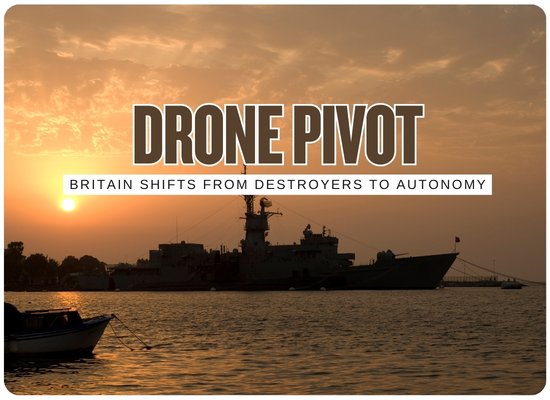
Britain is moving away from its previous plan to replace the Royal Navy’s Type 45 destroyers with a conventional next-generation Type 83 destroyer class, instead shifting toward at least six new Common Combat Vessels designed to coordinate uncrewed systems in the air, on the surface, and underwater. The new ships are expected to act less like one-for-one destroyer replacements and more like command hubs for a distributed naval force built around drones, autonomous craft, sensors, missiles, and existing crewed warships. Recent reporting says the Defence Investment Plan will remove the earlier Type 83 destroyer path and the Type 32 frigate plan from the core funding track, with the Common Combat Vessels expected to arrive from the early 2030s and operate alongside the Royal Navy’s Type 26 and Type 31 frigates. The shift is being framed around modern threats, Russian naval activity, undersea infrastructure protection, and the growing need to field cheaper, faster, and more numerous uncrewed systems instead of relying only on large traditional surface combatants.
Royal Navy planning shifts from replacement hulls to distributed combat systems
The UK move changes the signal for shipbuilders, naval integrators, drone suppliers, sensor companies, and allied fleet planners.
The previous next-generation destroyer path is being replaced by a Common Combat Vessel concept built around drone coordination and multi-domain control.
Air, surface, and underwater drone suppliers gain a stronger procurement signal as the ship becomes a control node rather than only a missile platform.
UK construction is expected, but the design, schedule, industrial split, and systems-integration workload still need sharper definition.
The fleet will need to manage air defence, escort, carrier protection, and North Atlantic tasks while transitioning into the new hybrid model.
The UK is joining a broader naval trend toward distributed force packages, cheaper attritable systems, and command ships that multiply unmanned reach.
UK naval procurement signal map
The table converts the reported shift from Type 83 replacement planning to Common Combat Vessels into practical signals for the naval market.
| Stakeholder | Current signal | Pressure point | Industrial opening | Execution risk | Signal level |
|---|---|---|---|---|---|
| UK naval shipyards | At least six Common Combat Vessels point toward a new domestic build pipeline. | Design clarity, yard allocation, schedule control, and module strategy. | Hull construction, modular mission spaces, power systems, launch areas, and support contracts. | Late design changes could slow delivery and raise cost. | Strong |
| Combat-system integrators | The vessel’s value will depend heavily on data fusion and uncrewed-system control. | Connecting sensors, drones, missiles, cyber protection, communications, and human operators. | Command software, autonomy control, tactical cloud, secure networks, and training systems. | Integration complexity may become the main schedule driver. | High |
| Drone and autonomy firms | Air, surface, and underwater systems move closer to core fleet procurement. | Endurance, launch recovery, payloads, survivability, datalinks, and maintenance at sea. | USVs, UUVs, UAVs, decoys, mine systems, surveillance packages, and autonomous payloads. | Prototype systems must mature into naval-grade equipment. | High |
| Missile and air-defence suppliers | Destroyer replacement uncertainty keeps air-defence allocation under review. | Carrier escort, missile defence, vertical launch capacity, and sensor coverage. | Upgrades to existing destroyers, distributed launch concepts, and networked interceptors. | Drone-control ships may still need heavy air-defence protection. | Watch |
| Sensor and undersea companies | Infrastructure protection and North Atlantic monitoring support demand for wide-area sensing. | Subsea cables, anti-submarine activity, seabed surveillance, and persistent patrols. | Sonar, seabed systems, UUV payloads, towed arrays, signal processing, and AI detection. | Data overload and false positives can reduce operational value. | Strong |
| Royal Navy planners | The force model shifts toward fewer crewed hubs controlling more offboard systems. | Fleet balance, crew numbers, readiness, training, doctrine, and survivability. | New deployment models and wider maritime coverage with distributed assets. | A capability gap appears if drones, ships, and air defence do not mature together. | High |
| Allied navies | The UK decision may become a test case for hybrid surface combatants. | Interoperability, NATO task groups, shared data, and common drone standards. | Joint exercises, allied drone payloads, and common control architecture. | Fragmented standards could limit coalition value. | Medium |
| Naval suppliers | The spending mix may move toward software, sensors, drones, launch systems, and power capacity. | Suppliers must position around upgrade cycles, not only ship delivery milestones. | Lifecycle support, cyber updates, autonomy refresh, training, batteries, and mission modules. | Procurement timing may remain uneven until the full plan is released. | Watch |
Hybrid Fleet Shift Calculator
A planning tool for comparing a traditional destroyer-heavy path against a drone-command warship model.
The hybrid model offers a strong increase in distributed reach, but execution depends on drone maturity, command-system integration, and protection for the crewed hubs.
We welcome your feedback, suggestions, corrections, and ideas for enhancements. Please click here to get in touch.