8 Hard Questions China’s Submarine Surge Is Forcing on Allied Shipbuilders
🔔 Subscribe to ShipUniverse Weekly →
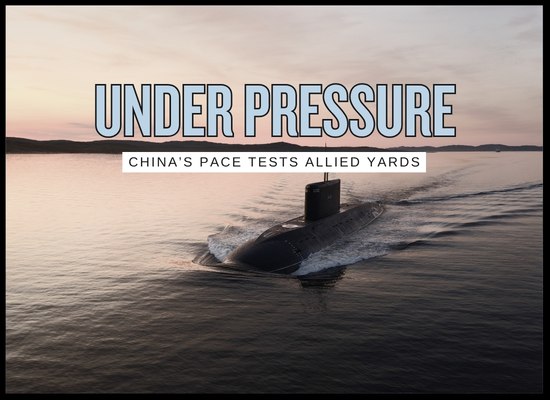
The rising pressure from China’s submarine output is not asking allied industry for another strategy deck. It is asking whether allied yards and suppliers can convert urgency into repeatable submarine throughput without breaking their own schedules, vendor bases, or sustainment promises.
That is why the most useful discussion is not simply whether China is building more. It is which industrial questions become harder for allied shipbuilders the moment China’s undersea tempo looks more sustained, more confident, and more strategically aligned than a temporary spike.
1️⃣ Can allied yards turn political urgency into weld ready capacity fast enough
The first question is not whether governments are worried. They clearly are. The real question is whether allied yards can transform that urgency into real submarine throughput through facility expansion, tooling, digital production improvement, and steadier workflow. A submarine surge on the Chinese side makes empty rhetoric easier to spot because the comparison becomes physical. It becomes about steel started, modules completed, boats delivered, and maintenance work that no longer spills into build schedules.
2️⃣ Which sub tier components become the real pacing items first
Allied industrial plans often talk at shipyard level, but submarine programs are usually slowed by narrower bottlenecks. Castings, forgings, valves, pipe fittings, electrical assemblies, precision-machined parts, and qualification-heavy components can become the true constraint. China’s surge matters here because it raises the strategic cost of assuming that enough boats will somehow appear if the primes are funded. The suppliers underneath the primes will decide whether that assumption holds.
3️⃣ Is workforce depth now a bigger strategic issue than yard square footage
A submarine yard can add infrastructure faster than it can create experienced supervisors, welders, planners, engineers, inspectors, and nuclear-grade manufacturing talent. The harder question for allied shipbuilders is whether workforce development is keeping pace with ambition. If China’s submarine momentum continues, then workforce depth stops being an HR topic and becomes an industrial deterrence topic.
4️⃣ Can allied supplier qualification move fast enough without lowering the standard
This may become one of the most practical questions in the whole submarine race. Allied governments want more suppliers inside the qualified base, but submarine-grade standards are high for a reason. The challenge is not just adding vendors. It is adding them without turning qualification into a performance risk. If China sustains higher build tempo, allies will feel stronger pressure to bring new companies in faster, especially across shared AUKUS-style supply chains.
5️⃣ Are allies separating newbuild demand from sustainment demand clearly enough
This question matters because maintenance, availability recovery, and fleet sustainment can quietly absorb the same workforce and industrial capacity needed for new submarine output. Allied shipbuilders and governments may discover that talking about more submarines is easier than deciding which scarce capacity goes to building new hulls and which goes to keeping current fleets credible. China’s surge sharpens that tradeoff because time lost in sustainment can also be time lost in strategic response.
6️⃣ Which digital and manufacturing upgrades can shorten cycle time without waiting for a new yard
Not every answer requires a giant facility project. Some of the most valuable allied responses may come from digital work packages, better planning software, advanced manufacturing, improved inspection flow, and sharper supplier data integration. The strategic question is whether allied yards can find enough cycle-time reduction from smarter execution while the larger infrastructure projects are still catching up.
7️⃣ Can allied cooperation become shared production logic instead of parallel national programs
This is the broader industrial question beneath the whole AUKUS conversation. Allied shipbuilders can talk about cooperation, but real industrial advantage comes when supplier qualification, standards, training, technology, and workshare actually reinforce one another. If China’s build pace continues to rise, parallel national efforts may start to look less efficient than a deeper allied production ecosystem with better distributed workload and stronger shared supplier development.
8️⃣ Are allied governments buying industrial resilience or just buying another plan
The last question is the hardest because it sits above the yards. Governments can announce strategies, reviews, treaties, and funding lines, but the relevant test is whether those measures are creating durable resilience in workforce, suppliers, yards, and sustainment. China’s submarine surge makes empty planning language more dangerous because the comparison will increasingly be between actual industrial velocity and well-intended allied paperwork.
| Strategic question | Pressure zone | What tightens first | Best commercial angle | Who feels it most | Bottom line read |
|---|---|---|---|---|---|
Can yards turn urgency into real capacity Prime-yard lane. |
Facilities and flow | Tooling and production rhythm | Cycle-time reduction support | Prime yards and yard-service vendors | Physical throughput still matters most |
Which sub tiers break first Supplier lane. |
Narrow categories | Specialized components | Second-source growth | Smaller qualified suppliers | Quiet bottlenecks can dominate output |
Is workforce the bigger issue Labor lane. |
Skilled talent | Supervisors and trades depth | Training and workforce support | Yards and workforce partners | Headcount is not the same as capability |
Can qualification move faster Standards lane. |
Vendor approval | Audit and technical acceptance | Qualification-assistance services | New entrants and quality teams | Speed without quality is dangerous |
Are build and sustainment separated enough Allocation lane. |
Shared resources | Dock time and skilled labor | Repair-flow and yard-support solutions | Public and private yards alike | Maintenance drag can blunt growth |
Which digital upgrades help now Execution lane. |
Process efficiency | Planning and inspection friction | Software and advanced manufacturing | Yards and productivity vendors | Near-term wins may be digital not concrete |
Can allied programs work as one ecosystem Cooperation lane. |
Cross-border alignment | Standards and workshare logic | Shared-supply-chain positioning | Export-ready suppliers | Cooperation becomes real through industry rules |
Are governments buying resilience Policy lane. |
Funding continuity | Bottleneck-targeted investment | Long-cycle capacity investment | Everyone in the chain | Plans matter only when execution sticks |
Assuming prime-yard expansion solves supplier fragility
Big-yard investment is important, but submarine output still slows if castings, valves, fittings, electrical assemblies, and qualified machining capacity do not scale with it.
Confusing workforce recruitment with workforce maturity
Hiring matters, but experienced supervisors, inspectors, planners, and submarine-grade trades take much longer to build than a recruitment campaign suggests.
Talking about alliance value without standardizing the industrial mechanics
Allied cooperation only changes output when qualification pathways, supplier expectations, and workshare structures become practical and repeatable across borders.
Move the sliders based on the environment you want to test. Faster Chinese build pressure, tighter supplier fragility, weaker workforce depth, stronger maintenance drag, and slower allied coordination will change which answer looks most urgent.
How to read the gauge
- Higher outside pressure usually pushes supplier depth and throughput higher first because prime yards cannot outrun weak sub tiers for long.
- Higher workforce strain usually makes training maturity more valuable than another headline facility announcement.
- Higher maintenance collision usually raises the need to protect newbuild flow from repair drag before schedule promises start to slip.
The strongest allied response to China’s submarine surge is unlikely to be one dramatic industrial gesture. It is more likely to be a disciplined sequence of smaller but harder actions: widening qualified supplier depth, maturing the workforce pipeline, protecting build flow from maintenance drag, and making allied industrial cooperation work at production speed instead of only at conference speed.