
🔔 Subscribe to ShipUniverse Weekly →
The Los Angeles Port Police disclosed details of an existing dock-based drone response system in a 42-page request for proposals published November 5, 2026. According to the document, unmanned aircraft are stationed in fixed docking enclosures at locations across the Port of Los Angeles and can be launched remotely from the police Threat Detection Center. The department states that it holds Federal Aviation Administration authorization for beyond-visual-line-of-sight (BVLOS) flights and approval for a Drone as First Responder program designed to reach incidents before responding officers. The new procurement seeks qualified civilian remote pilots to staff the control console 12 hours a day, seven days a week, under an expected one-year contract. Questions are due November 12, and proposals are due December 9, 2026.
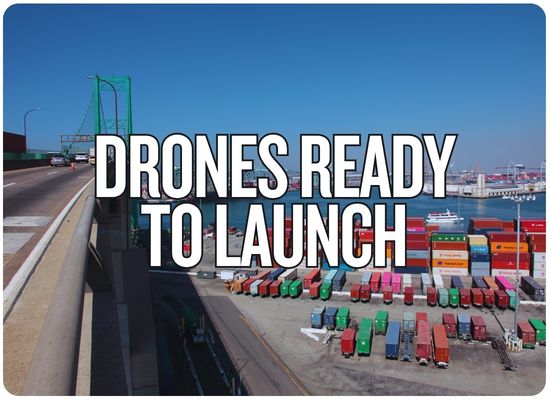
Drones Stationed and Ready to Launch Across the Port
A newly published Port Police contract describes remotely operated aircraft staged in fixed docking enclosures, connected to a central control console, with FAA-authorized beyond-visual-line-of-sight operations under Port Police supervision.
One qualified operator during scheduled coverage
84 contracted operator-hours per full week
Minimum prior pilot-in-command time
Included within the minimum 100 hours
Conceptual representation of the RFP's operating sequence. The three dock illustrations do not indicate the number, identity or physical placement of actual Port Police installations.
Dispatch traffic, cameras, communications and incident information are reviewed. Police authorize the mission. The qualified pilot conducts aviation safety checks and the flight.
Dock checks verify power, charging, communications and aircraft condition.
Nearest suitable assigned aircraft launches only after the required approval.
Aircraft returns to its dock, with flight records and imagery retained by the port.
The document describes a controlled aviation workflow, not independently launched autonomous patrols.
A call or police observation indicates aerial support may be useful.
A Port Police supervisor authorizes the specific mission.
The pilot verifies weather, airspace, aircraft and communication conditions.
The remote pilot describes hazards and conditions to responding units.
Aircraft lands, recharges and the pilot completes required records.
Supervisors approve launches, determine priorities, direct law-enforcement objectives and retain ownership of aircraft, systems and flight records.
A remote pilot must decline or terminate a flight when weather, airspace, battery, equipment or other conditions make it unsafe or unlawful. Police cannot override that safety decision.
The port says its aircraft are already staged in fixed docking enclosures and that it holds BVLOS and DFR authorizations.
The RFP seeks trained remote pilots, not a new fleet purchase or a turnkey vendor-owned drone service.
Dock count, aircraft manufacturer, model, station locations and fleet-wide readiness rates are not given.
No winning bid, final contract amount, response-time improvement or historical DFR-only mission count is supplied.
What the 42-Page RFP Actually Requires
The Port Police want a qualified human pilot continuously available at a remote console, backed by documented aviation experience, credentialing, equipment checks and controlled handling of police records.
Extracted from sections 2.2 through 2.9 of RAMP procurement #232903. This matrix distinguishes established RFP requirements from facts the document does not disclose.
The contractor is also responsible for relief personnel, payroll, benefits, insurance and replacement staff. Scheduled unstaffed hours cannot be invoiced.
These are separate historical items and must not be presented as the value of the November 2026 remote-pilot contract.
Federal funding allocated to the Drone as First Responder/Rail Security UAS project; project total with port share: $151,100.
Separately identified federal funding for the same named DFR/Rail Security UAS program in a March 2026 board agenda.
Board-listed Axon trailer-mounted drone detection equipment purchase, including applicable taxes.
Port Police flight-history reporting and equipment records show broader drone use, but do not isolate the docked-DFR subset.
Drone inventory reported for the older October 2023–December 2024 period.
Listed flights across the broader Port Police drone program.
Listed flights. Not a verified count of autonomous dock launches.
Historical reporting periods and methods differ. The figures do not establish a response-time trend, a current dock inventory or the number of missions flown using BVLOS approval.
Aircraft, batteries, docking enclosures, ground-control workstation, displays, radios, network access, police facilities, mission approval, FAA authorizations, specialized platform training and manufacturer-level aircraft maintenance.
Qualified remote pilots, staffing coverage, shift relief, employee management, payroll and benefits, applicable insurance, credentialing costs, routine authorized aircraft care and replacement personnel when needed.
Drone Operator (Remote Pilot), RAMP #232903.
3 p.m. Pacific Time, to the designated administrator.
Scheduled release of responses to bidder questions.
3 p.m. Pacific Time; award requires later approvals.
We welcome your feedback, suggestions, corrections, and ideas for enhancements.
Please click here to get in touch