
🔔 Subscribe to ShipUniverse Weekly →
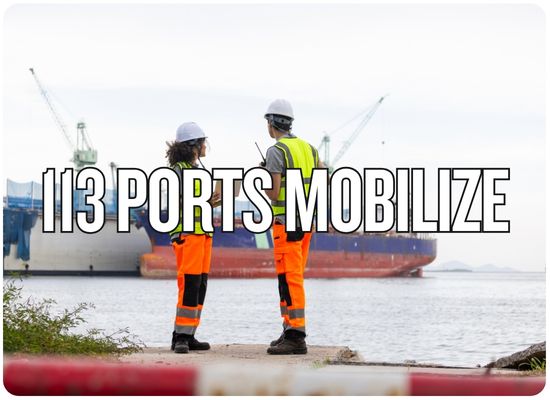
Dockworkers across five continents launched coordinated strikes, work stoppages and demonstrations on October 30, 2026, as more than 25 unions representing 113 ports in 22 countries and regions joined an international campaign opposing military cargo shipments through civilian ports. The action covers major gateways including Hamburg, Le Havre, Marseille, Genoa, Piraeus, Algeciras, Tangier Med and India's Nhava Sheva, with national 24-hour strike calls in several countries. Organizers warn that cargo worth more than $2 billion could face disruption, although the figure remains an unverified projection rather than a measured loss. The first confirmed operational effects include eight delayed vessel calls and one canceled cruise call at Le Havre, while a separate Greek seafarers' strike has halted ferry services at seven ports. The critical distinction is that 113 ports are represented in the mobilization, not 113 confirmed port shutdowns.
The World's Ports Are Acting Together. But Not All Are Stopping.
An international dockworker campaign reaches five continents on October 30, combining full-day strikes, shorter work stoppages, union demonstrations and solidarity actions. Actual terminal disruption varies sharply between locations.
Ports represented by participating unions; not 113 verified shutdowns.
Organizer's count, including a separately listed Basque region.
Supporting the coordinated international action.
Continents represented in the union announcement.
The October 30 action has a published multinational union roster, formal strike notices and independently reported participation.
No independent tally establishes 113 terminals or ports halted. Some participants are holding brief actions or demonstrations only.
France, Italy and selected unions in Greece, India and Türkiye. Actual participation may differ by port and employer.
Announced at locations including Morocco and Cyprus. Operational impact depends on timing, staffing and the specific terminal affected.
Supporting unions across Europe, the Americas, Australia and other locations are undertaking locally determined actions.
HAROPA described the overall impact as limited, even as French dockworkers carried out a 24-hour strike. This demonstrates why union participation and measured vessel disruption must be tracked separately.
Not Every Port Has the Same Strike
Major maritime hubs appear in the same international mobilization, but their operational circumstances differ. The key is to distinguish confirmed interruption from declared participation.
Organizers say participating unions have a significant role in handling Mediterranean cargo movements.
Preliminary organizer estimate cited before the action by specialist port-industry publications.
Organizers' estimate of freight involved in a possible disruption.
A delayed mother-vessel discharge can cause cargo to miss the next scheduled feeder departure, extending delivery beyond the original strike duration.
When a vessel misses its working window, terminals must fit it into later crane and berth availability alongside new scheduled arrivals.
Cargo discharged later than expected can miss trucking appointments, train loading or warehouse receiving windows.
Internationally coordinated action, formally registered strike calls, French vessel delays and cancellations, and Greek ferry disruptions from a separate labor dispute.
Total participating workers, stopped crane hours, canceled container moves, vessel waiting-days, actual cargo volumes delayed and financial losses.
The Global Dockworker Disruption Test
Model the operational difference between a short solidarity stoppage, a full-day strike and a longer interruption. Compare three independently managed terminal groups without assuming that all 113 ports have shut down.
Blue represents handling moved to other facilities. Red represents the initial backlog awaiting later terminal processing.
Combined modeled reduction across three terminal groups.
Cargo activity not immediately absorbed by other facilities.
Slowest terminal group to clear its own backlog.
Approximate TEU-days across accumulation and recovery.
Extra expense on cargo successfully diverted.
Aggregate delay and diversion expense under entered assumptions.
Adjust operating conditions above to test the potential cargo and financial consequences.
We welcome your feedback, suggestions, corrections, and ideas for enhancements.
Please click here to get in touch