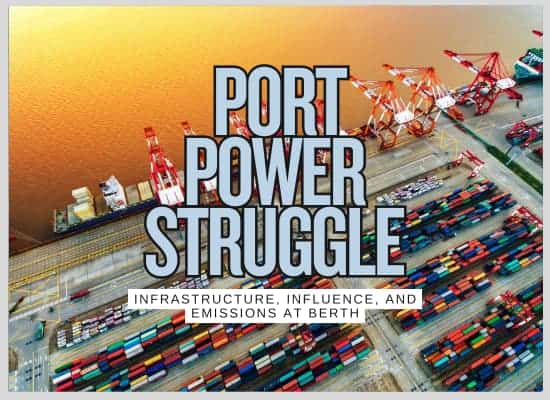
The quiet hum of a ship plugged into shore power may not sound like a revolution, but it is. What began as a voluntary green upgrade is fast becoming a regulatory requirement in major ports around the world. As governments clamp down on emissions and carbon footprints, shore power is no longer a “nice to have”—it’s a mandate, and the race is on.
Ports are scrambling to electrify their docks. Shipowners are spending millions to retrofit vessels. And behind it all, a power struggle is forming, not just between nations, but between grid operators, utility giants, regulators, and port authorities. At stake: control over who provides the electricity, who pays for it, and who profits as the maritime sector goes electric.
Welcome to the Port Power Wars—where the future of maritime energy is being decided one megawatt at a time.
🌍 The Global Race: Leading Ports in Shore Power Deployment
As the maritime industry intensifies efforts to reduce emissions, several major ports have emerged as frontrunners in implementing shore power (also known as cold ironing) solutions. These initiatives not only align with global environmental regulations but also position these ports as sustainable leaders in maritime logistics.
🇳🇱 Port of Rotterdam Shore Power Expansion (2025)
Focus Area
Details
Impact
Cruise Terminal Advancement
In March 2025, the Holland Amerikakade terminal launched its first cruise ship shore power connection. The AIDAnova was the inaugural vessel to plug in.
Establishes Rotterdam as a shore power leader for cruise ships and accelerates emission reduction in passenger shipping.
Emission Reductions
The system is expected to connect up to 75% of visiting cruise ships in its first year.
Cuts CO₂, NOₓ, and particulate emissions during port stays, enhancing air quality and regulatory compliance.
Infrastructure Development
Includes a 1.5 km sustainable power grid link and 230-meter cable duct to support high-demand vessels.
Showcases scalable, port-integrated energy infrastructure for future maritime electrification.
Source: Port of Rotterdam, Offshore Energy, Electric Hybrid Marine Technology (Q2 2025)
🇺🇸 Port of Los Angeles Shore Power Expansion (2025)
Focus Area
Details
Impact
Regulatory Compliance
The port continues to expand its Alternative Maritime Power (AMP) program, aligning with California’s CARB mandate for container, cruise, and refrigerated vessels.
Ensures regulatory alignment and positions Los Angeles as a global compliance model for emissions control.
Emission Reduction Measures
Shore power is part of a broader effort that has reduced diesel particulate matter by over 80% since 2005.
Improves public health in surrounding communities and enhances environmental credentials for port users.
Operational Integration
AMP-capable berths are standard for most terminals; the port continues to retrofit remaining terminals to support universal access.
Streamlines adoption for shipping lines and reduces scheduling complexity for compliant vessels.
Source: Port of Los Angeles, CARB Reports, Environmental Programs Update (Q2 2025)
🇨🇳 Port of Shanghai Shore Power Expansion (2025)
Focus Area
Details
Impact
International Collaboration
Shanghai has partnered with the Port of Los Angeles to co-develop shore power solutions, focusing on cruise terminal standards, regulatory alignment, and incentive models.
Strengthens cross-border emissions strategies and accelerates deployment through shared best practices.
Infrastructure Expansion
A three-year initiative is underway to expand shore power at the Baoshan Cruise Terminal and Yangshan Deepwater Port.
Extends shore power access to a broader range of vessel types and increases grid readiness across multiple terminals.
Technology Transfer
The collaboration promotes knowledge exchange on cable systems, grid integration, and emissions measurement protocols.
Boosts long-term innovation capacity and enables scalable electrification across China's busiest port hub.
Source: Port of Los Angeles–Shanghai MOU, Global Shore Power Initiatives (Q2 2025)
🇰🇷 Port of Busan Shore Power Expansion (2025)
Focus Area
Details
Impact
Hybrid Tug Integration
The Meta 7, a hybrid-electric tug built for Busan Port, utilizes full electric operation for harbor maneuvers to reduce emissions.
Reduces local air pollution and serves as a scalable template for clean tug operations in other ports.
Eco-Focused Investment
South Korea committed $10 billion to expanding Busan Port’s capacity and competitiveness, with a significant portion allocated to eco-friendly infrastructure.
Positions Busan as a next-generation green shipping hub in Northeast Asia.
Emission Control Strategy
Focus is on reducing emissions during port operations through vessel retrofits, smart grid design, and gradual shore power integration.
Demonstrates long-term national commitment to port decarbonization while balancing industrial throughput needs.
Source: Korea Ministry of Oceans and Fisheries (Q2 2025), Maritime Reports
🇸🇬 Port of Singapore Shore Power Expansion (2025)
Focus Area
Details
Impact
Electric Harbour Craft Charging Pilot
In April 2024, MPA launched its first pilot trial for electric harbour craft (e-HC) charging at Marina South Pier, deploying a 150-kW DC fast charger capable of charging a 500 kWh battery in approximately 3 hours.
Lays the groundwork for a national e-HC charging infrastructure, supporting Singapore's maritime decarbonization goals.
Green Port Programme Incentives
From January 2025 to December 2027, MPA offers up to 100% port dues concession for ocean-going vessels utilizing zero-emission or low-carbon fuels, including electrification technologies.
Encourages adoption of cleaner energy solutions among shipping lines, promoting sustainable port operations.
Tuas Mega Port Development
The upcoming Tuas Mega Port, set to be fully operational by 2040, is designed with sustainability in mind, incorporating automation and energy-efficient technologies.
Positions Singapore as a leading global hub for sustainable and efficient maritime trade.
Source: Maritime and Port Authority of Singapore (MPA), Maritime Reports (Q2 2025)
⚡ Follow the Power:
When a vessel plugs into shore power, it’s easy to assume the port is in control. But behind the scenes, a complex network of ownership governs who actually delivers the electricity and who profits from it. In many major ports, the real power lies not with the port authority but with public utilities, private energy firms, or hybrid consortiums. These behind-the-scenes players influence everything from connection timelines to energy pricing, creating strategic advantages and bottlenecks in the global rollout of shore power. Understanding who controls the plug is key to understanding the future of port electrification.
Shore Power Ownership Models (2025)
Ownership Model
Description
Example Ports
Risks & Considerations
Public Utility-Owned
Electricity infrastructure is owned and operated by a government or state-controlled utility provider. Ports depend on the utility’s capacity, approval cycles, and rate structures.
Los Angeles (LADWP), Busan (KEPCO)
Regulated rates offer stability, but timelines for upgrades can be slow. Utilities may prioritize citywide demands over port efficiency.
Port Authority-Owned
The port develops and controls its own electrical grid connections, substations, and pricing schemes. Infrastructure is funded through public investment or port revenues.
More agile and responsive to maritime needs, but requires significant upfront capital and ongoing technical expertise.
Private Consortium-Owned
Private energy firms or investor-backed infrastructure companies own and operate shore power systems under long-term concession or lease agreements.
Select terminals in Shanghai; independent operators in Southern Europe
Innovation is faster, but transparency may suffer. Ports and shipowners can be locked into high-cost agreements with limited renegotiation power.
Hybrid Public-Private
Infrastructure is co-developed by port authorities and private firms or utilities. Agreements may involve revenue sharing, maintenance splits, or co-governance models.
Singapore (Marina South), Long Beach (via grant-based partnerships)
Shared risk and funding enable progress, but coordination issues can slow deployment or confuse access rules for shipping lines.
Note: Based on analysis of global port electrification models and governance structures as of Q2 2025.
Real-World Power Struggles: Behind the Scenes of Port Electrification
Even at some of the world’s most advanced ports, the fight over power isn’t just electrical it’s political and operational. Control of grid infrastructure often determines the pace, pricing, and availability of shore power:
⚡ Los Angeles (USA) The Port of LA depends heavily on the Los Angeles Department of Water and Power (LADWP) for energy supply. While LADWP has supported major emission reduction initiatives, any shore power expansion must compete with broader city energy priorities, creating friction over funding, capacity, and timelines.
⚡ Shanghai (China) In Shanghai, state-run utilities dominate energy distribution. This centralization means that connection standards and expansion schedules are dictated by state policy, not port needs. Shipowners may find shore power technically available, but not yet connected due to bureaucratic delays.
⚡ Rotterdam (Netherlands) Unlike many other ports, Rotterdam has secured partial control of its terminal grid infrastructure, allowing the port authority to rapidly test and implement its own shore power systems, particularly at the cruise terminal. This autonomy has made Rotterdam a fast mover in Europe’s green port race.
Strategic Implications for Shipowners: It’s Not Just About Plugging In
Shore power access isn’t just about whether a port has the infrastructure it’s about who controls it.
Access Restrictions: Even at electrified terminals, some ships are blocked from connecting due to non-standard hardware, utility red tape, or unapproved vessel profiles.
Price Discrepancies: Energy costs at berth are not set by fuel prices or green ambition they’re often determined by who owns the last mile of infrastructure.
Negotiation Power: Ports with full or partial grid control can offer tailored contracts, flexible pricing, and real-time upgrades. Ports reliant on outside utilities may pass on expensive grid markups with little recourse.
For shipowners, the key question isn't just "Is there shore power?" it’s "Who controls the plug?" That answer could decide the ROI of costly vessel retrofits and determine operational flexibility for years to come.
🔍 Hidden Bottlenecks: Why Many Ports Are Falling Behind
Shore power may be gaining momentum, but progress is anything but even. Behind the headlines of high-tech terminals and ribbon-cutting ceremonies lies a growing backlog of stalled projects, hesitant stakeholders, and fragmented regulation. For many ports especially outside of the top-tier hubs the reality isn’t electrification, it’s gridlock. These hidden bottlenecks are slowing the transition from diesel at berth to plug-in power and threatening to widen the divide between the ports that can electrify and the ones that can’t.
Bottlenecks Slowing Shore Power Deployment (2025)
Bottleneck
Explanation
Regulatory Ambiguity
Many national and local governments have no clear legal requirements or technical standards for shore power, making long-term planning difficult for ports and shipowners alike.
Capital Constraints
Shore power infrastructure requires major upfront investment in substations, grid upgrades, trenching, and load management — often tens of millions per terminal. Smaller ports simply can’t justify the spend without grants or cargo incentives.
Utility Pushback
In many cities, electric utilities resist grid expansions that prioritize maritime needs. Some view ship connections as temporary or volatile, making them low-priority clients for infrastructure upgrades.
Terminal Tenant Delays
Even when a port authority is on board, tenant operators (e.g., private terminal operators) may delay implementation due to fears of added costs, downtime, or compatibility issues.
Fragmented Standards
There’s no universal plug-and-play solution. From frequency mismatches (50Hz vs. 60Hz) to incompatible connectors and safety systems, global standardization remains elusive.
Risk of Stranded Assets
Some ports hesitate to build multimillion-dollar systems today that may become outdated if vessel electrification preferences change (e.g., move toward hydrogen or LNG hybrids instead of shore power).
Note: Based on analysis of global infrastructure delays, port authority reports, and regulatory gaps as of Q2 2025.
📊 Economics Snapshot (2025)
While regulators push for port electrification, shipowners and terminal operators face one unavoidable question: does the math work? From steep retrofit costs to volatile electricity rates, the economics of shore power vary wildly by vessel type, port location, and ownership structure. Here's where the real numbers matter.
Shore Power Economics Snapshot (2025)
Category
Typical Range / Estimate
Financial Considerations
⚙️ Ship Retrofit Costs
$300,000 – $1.5M per vessel
Costs depend on vessel size, electrical compatibility, and onboard grid space. ROI hinges on number of port calls at shore-power-enabled terminals.
🔌 Port Shore Power Access Fees
$1,500 – $10,000 per call
Access fees vary by region, berth size, and utility provider. Some ports offer incentives; others pass full cost to vessels.
⚡ Electricity Cost at Berth
$0.10 – $0.45 per kWh
Electricity pricing is volatile and often higher than marine fuel on a per-kWh basis. Ports with utility monopolies tend to charge more.
📉 Payback Period
3–7 years (frequent callers)
Depends on port rotation. Ships calling regularly at shore-powered terminals can recoup retrofit costs faster through fuel savings and regulatory compliance.
🧾 Emissions Credit Value
Up to $50–$200 per call (varies)
Some jurisdictions offer carbon offset or green credit rebates for shore power usage. Inclusion in ESG scoring can boost long-term charter appeal.
Note: Figures reflect estimates from port authorities, shipping lines, and classification societies as of Q2 2025.
Shore Power at a Crossroads
The global push for port electrification is no longer a fringe movement, it’s a regulatory wave sweeping across maritime logistics. But as this transition unfolds, it’s clear that success isn’t just about installing cables or cutting emissions. It’s about ownership, access, and economics.
Some ports are racing ahead, controlling their grids, lowering costs, and creating competitive advantages. Others are stuck, tangled in red tape, struggling to finance upgrades, or beholden to utilities with little maritime urgency. For shipowners, the picture is equally complex: investing in shore power retrofits makes sense at the right ports, under the right conditions but the financial returns are deeply tied to where you sail and who controls the plug.
Shore power isn’t just an environmental solution. It’s a battleground of policy, pricing, and positioning — and the next five years will determine who plugs in, who gets left behind, and who profits from the power shift.