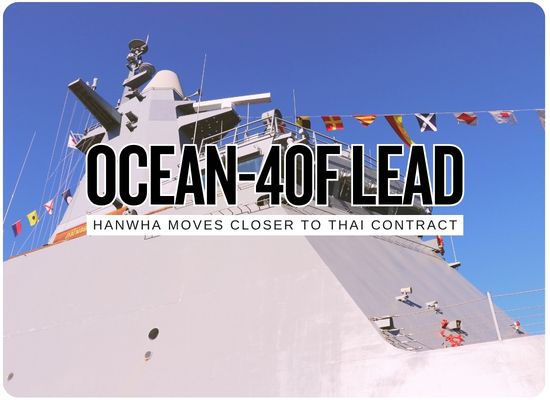
Hanwha Ocean Takes Lead in Thailand’s $509M Frigate Deal With OCEAN-40F
🔔 Subscribe to ShipUniverse Weekly →
Hanwha Ocean has been selected as the preferred bidder for the Royal Thai Navy's next-generation frigate program, putting the South Korean shipbuilder in position to build a new 4,000-ton-class warship under a package priced at THB16.73 billion, about $509 million. The procurement covers one frigate plus combat and ship systems, spares, tools, documentation, testing, training, logistics support, warranty and delivery to Sattahip Naval Base. Thailand approved the selection on September 7 and publicly identified Hanwha Ocean on September 8, but a statutory appeal period remains open and detailed contract negotiations are still required. The Navy plans a fuller briefing on September 18.
Operator Impact Snapshot
Hanwha Ocean has cleared the main competitive hurdle
Thailand has formally selected Hanwha Ocean for negotiations, but the statutory appeal period and detailed contract talks still have to be completed before a final construction contract is fully locked in.
The price covers much more than the hull
The THB16.73 billion firm-price package includes one frigate, systems, equipment, spare parts, training, testing, logistics, warranty, transport and insurance through delivery in Thailand.
Domestic shipbuilding participation is built into the procurement
Thailand's tender requires at least 20 percent domestic shipbuilding participation, with technology transfer, workforce development and industrial offsets forming part of the evaluation.
Hanwha's proposal uses a heavily European combat package
The OCEAN-40F shown for Thailand includes MBDA air-defense and anti-ship weapons, a Naval Group combat-management architecture and a layered sonar and counter-drone suite. Final configuration can still change in negotiations.
The first hull could become the opening ship of a larger renewal
Thailand has outlined a long-term objective of operating eight frigates by 2037 while only four are currently operational. The present procurement covers just one ship, leaving room for future follow-on competition and orders.
More Firepower Than Thailand's Existing Korean Frigate
Hanwha's proposal increases displacement, missile capacity, underwater sensors and counter-drone capability while retaining a design lineage familiar to the Royal Thai Navy.
| System / Metric | OCEAN-40F Proposal | Operational Role | Supplier / Technology | Commercial / Integration Read |
|---|---|---|---|---|
| Displacement | Approximately 4,000 tonnes | Multi-purpose frigate | Hanwha Ocean | Roughly 250 tonnes heavier than HTMS Bhumibol Adulyadej. |
| Length | Approximately 124 m | Ocean-going surface combatant | Hanwha Ocean | Similar overall length to the existing Thai Korean-built frigate but with more internal margin. |
| Air Defense VLS | 16 cells for VL MICA NG | AIR DEFENSE | MBDA | Provides a modern point and local-area air-defense layer. |
| Anti-Ship Strike | Exocet MM40 Block 3C | Surface and coastal strike | MBDA | European missile architecture is a major feature of Hanwha's Thai configuration. |
| Close Air Defense | Two SIMBAD RC launchers | Short-range missile defense | MBDA | Adds another defensive layer beyond the main VLS battery. |
| Main Gun | 76 mm naval gun | Surface, air and shore engagement | Final supplier configuration subject to contract | Conventional multi-role frigate gun capability. |
| Counter-Drone | 30 mm guns plus RF jamming and GNSS spoofing | C-UAS | Integrated hard-kill and soft-kill package | One of the more distinctive features highlighted in Hanwha's proposal. |
| Underwater Sensors | Hull sonar, towed array and intercept sonar | ASW | Cohort-linked integration package | Designed for submarines, divers and smaller unmanned underwater threats. |
| Combat Management | SETIS proposed | Sensor and weapon integration | Naval Group | Allows the European missile and sensor package to be integrated around an established CMS. |
| Crew | More than 145 personnel | Ship operation and combat systems | Royal Thai Navy configuration | Above the approximately 136-person baseline of HTMS Bhumibol Adulyadej. |
Approximately 3,750 tonnes and 123 meters long. Hanwha's predecessor delivered the frigate in 2018, giving the bidder an existing operational reference inside the Royal Thai Navy.
Approximately 4,000 tonnes and 124 meters long, with increased missile, sensor, survivability and future-growth capacity.
Frigate Program, Local Content & Follow-On Value Calculator
Model the value of a one-ship frigate award, potential follow-on construction, Thai industrial participation and long-term maintenance support.
Industrial Value Split
Compare modeled Thai shipbuilding participation, foreign construction value and long-term support.
We welcome your feedback, suggestions, corrections, and ideas for enhancements.
Please click here to get in touch