Houston Ship Channel Tonnage Jump Signals Stronger Gulf Export Momentum
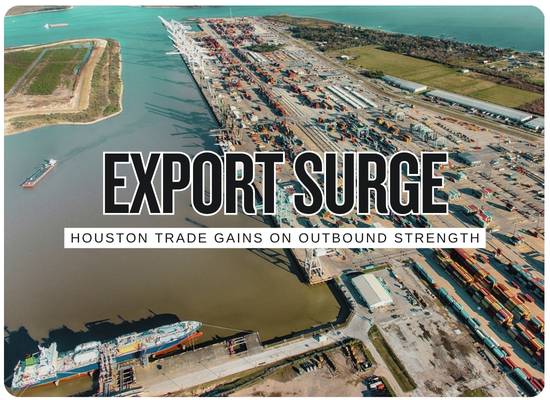
The Houston Ship Channel is showing another strong trade signal as regional tonnage climbed 16% year over year in the first half of 2026, driven by a sharp rise in exports even as import tonnage eased. The wider channel complex, covering more than 200 private terminals and Port Houston’s eight public terminals, handled 135.1 million short tons through June, with exports reaching 109.5 million short tons and continuing to dominate the cargo mix. Vessel movement also strengthened, with deep-draft transits and barge transits both higher through July, while Port Houston’s public terminals handled about 2.60 million TEUs, kept loaded imports growing, and saw East Asia remain the main driver of inbound container volume.
Houston’s Export Engine Is Carrying the Channel
Regional tonnage is rising fast, but the gains are not evenly spread across imports, containers, steel and general cargo.
Export Tonnage Strength
Exports climbed 22% through the first half, showing strong demand for Houston’s energy, industrial and bulk-export base.
Import Tonnage Softness
Imports fell 4%, creating a different signal from the headline tonnage gain and pointing to a more export-led channel cycle.
More Vessel Movement
Deep-draft and barge transits both increased, adding pressure to berth planning, pilots, tugs, line handlers and terminal coordination.
Container Growth Slows
Port Houston’s public-terminal TEUs remain up for the year, but growth has moderated after stronger earlier frontloading.
Steel Still Trails
General cargo is rising sharply, but steel volumes remain below last year, keeping breakbulk performance mixed.
The operating read is that Houston’s trade story is stronger than the container headline alone. The wider channel is being lifted by exports and vessel activity, while individual public-terminal cargo categories are moving in different directions.
Houston Trade Flow Board
The headline tonnage gain is export-led, while public terminals show a more mixed container, steel and general-cargo pattern.
Houston’s latest numbers separate the channel-wide industrial story from the public-terminal container story. The full channel complex is seeing large tonnage growth from exports, while Port Houston’s public terminals are posting steadier TEU growth and a noticeable cargo-mix shift.
Houston Ship Channel regional trade tonnage through the first half of 2026.
Export tonnage growth, reaching 109.5 million short tons.
Port Houston public-terminal container volume through July, up 1% year to date.
Barge transits through July, up 6% year over year.
Trade and Terminal Signal Table
| Signal | Latest Number | Commercial Read | Stakeholders | Status |
|---|---|---|---|---|
| Total channel tonnage | 135.1 million short tons through June, up 16% year over year. | The wider Houston Ship Channel is outperforming many cargo indicators because exports are doing the heavy lifting. | Bulk exporters, terminal operators, pilots, tugs, agents, logistics firms | Strong |
| Export tonnage | 109.5 million short tons, up 22% from 89.9 million tons a year earlier. | Houston’s role as an energy, petrochemical and industrial export gateway remains the core growth driver. | Energy exporters, resin shippers, bulk carriers, tanker operators, rail and truck providers | Strong |
| Import tonnage | 25.5 million short tons, down 4% year over year. | The import side is softer by weight, even though loaded container imports are still up at the public terminals. | Retail importers, industrial buyers, container lines, forwarders | Mixed |
| Deep-draft traffic | 10,859 transits through July, up 7% year over year. | More vessel movement can increase demand for pilots, escort tugs, berth windows, line handling and channel coordination. | Shipowners, pilots, tug operators, terminals, schedulers | Strong |
| Barge traffic | 129,814 transits through July, up 6% year over year. | Inland and coastal cargo links remain active, reinforcing Houston’s role as a waterway-connected industrial hub. | Barge operators, terminals, refineries, chemical plants, fleeting providers | Strong |
| Public-terminal containers | 2.60 million TEUs through July, up 1% year to date. | Container growth remains positive but slower, reflecting a moderation after earlier frontloading. | Container lines, BCOs, chassis providers, warehouses, drayage firms | Moderate |
| Loaded import containers | 1.21 million TEUs, up 5% year to date. | Consumer and industrial goods still support inbound container flow, especially from East Asia. | Importers, retailers, machinery buyers, drayage firms, warehouses | Strong |
| Loaded export containers | 925,781 TEUs, down 1% year to date. | Export strength is much clearer in tonnage than in loaded container count. | Resin exporters, container lines, beneficial cargo owners, freight forwarders | Watch |
| General cargo | 796,982 tons, up 35% year to date. | Breakbulk and non-containerized cargo are gaining, even as steel remains under pressure. | Breakbulk terminals, heavy-lift carriers, project cargo firms, equipment suppliers | Strong |
| Steel | 2.34 million tons, down 18% year to date. | Steel continues to trail last year, reflecting sourcing, demand and trade-flow changes. | Steel importers, breakbulk operators, warehouses, rail providers | Watch |
Houston Ship Channel Throughput Pressure Tool
Estimate cargo-flow pressure from export growth, vessel traffic, barge movement, container growth and terminal mix.
Estimated operating pressure from tonnage, vessels, barges and terminal mix.
Estimated added tonnage versus the prior-year base.
Approximate average daily regional tonnage across the first half.
Combined deep-draft and barge transits entered for the period.
The modeled case shows strong export-driven pressure, with vessel and barge activity adding operating intensity.
Capacity coordination favoredThis tool is for editorial and commercial sensitivity only. It does not replace terminal data, port authority reports, berth windows, pilot schedules, carrier bookings, customs data, vessel lineups, drayage capacity models or professional port-planning analysis.
We welcome your feedback, suggestions, corrections, and ideas for enhancements.
Please click here to get in touch