Fatal Hormuz Engine-Room Strike Puts Crew Risk in Focus
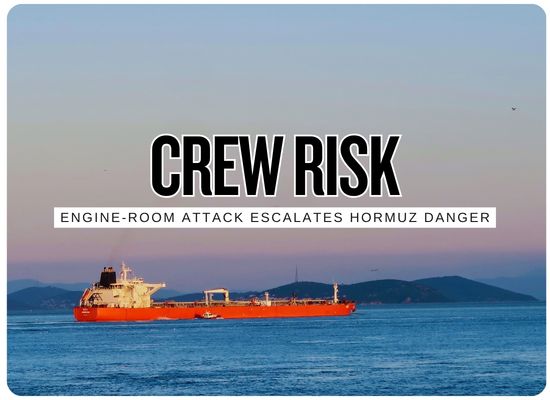
A merchant vessel transiting out of the Strait of Hormuz was struck by an unidentified projectile off the coast of Oman, damaging the engine room and causing a crew casualty in the latest attack on commercial shipping through the Gulf chokepoint. UKMTO reported the incident early Tuesday and said the Omani Coast Guard was assisting the remaining crew while authorities investigated. Maritime security specialist Vanguard Tech, cited by Splash247, identified the ship as the Liberia-flagged Panamax bulker Minoan Dignity and reported that the vessel’s chief engineer was killed after the projectile hit the engine room about five nautical miles off Oman. The attack follows a series of recent incidents involving Hormuz transits, including attacks on ADNOC-linked vessels, continued claims over transit control, lower commodity-vessel movement, and growing concern that even ships using designated routes may still face direct engine-room, crew-safety, rescue and insurance exposure.
Hormuz Crew Risk Moves Back to the Front
The latest strike turns the chokepoint story from traffic management into a direct seafarer-safety and machinery-damage event.
Crew Casualty Risk
The reported engine-room hit places seafarer safety, evacuation timing, medical response and casualty reporting at the center of the incident.
Engine-Room Damage
A strike into machinery spaces can quickly affect propulsion, electrical systems, firefighting, blackout recovery and vessel control.
Oman Rescue Track
Omani Coast Guard assistance keeps attention on crew recovery, casualty handling, ship status and whether the vessel can be moved safely.
Insurance and Claims
The incident can trigger war-risk review, crew claims, machinery damage claims, deviation costs and charter-party timing disputes.
Transit Confidence
Another casualty incident makes normal Hormuz passage harder to price, even for vessels trying to follow designated routing.
The operating signal is blunt: Hormuz risk is no longer only about delays, route permissions or fees. The latest strike shows that engine-room survival, crew protection and rescue access are now immediate voyage variables.
Hormuz Casualty and Transit Risk Board
The latest strike adds a fatal crew-risk layer to an already unstable Gulf passage environment.
The incident sits inside a pattern of lower traffic, disputed transit control, repeated projectile strikes and more selective scrutiny of vessels moving through the strait. The immediate concern is the casualty and machinery damage. The wider commercial concern is whether operators can still treat Hormuz as a managed-risk corridor or must treat every transit as a live casualty, towage and claims scenario.
Vanguard Tech reporting cited by Splash247 said the chief engineer was killed after the engine-room strike.
The vessel was reported struck close to Oman while transiting through the Strait of Hormuz area.
The ship identified by maritime security reporting was the Liberia-flagged Panamax bulker Minoan Dignity.
Incident Pressure Table
| Risk Area | Latest Signal | Commercial Read | Stakeholders | Status |
|---|---|---|---|---|
| Crew safety | Engine-room strike caused a crew casualty, with maritime-security reporting saying the chief engineer was killed. | Crew risk is now the central feature of the Hormuz story, not a secondary effect of traffic disruption. | Seafarers, owners, managers, P&I clubs, unions, flag states | High |
| Machinery damage | The projectile reportedly damaged the engine room. | Loss of propulsion, power, steering support or fire control can turn a transit strike into a salvage and towage case. | Hull insurers, salvors, class, engine makers, ship managers | High |
| Rescue response | Omani Coast Guard assistance was reported for the remaining crew. | Coastal-state response capacity becomes a direct part of the route-risk calculation. | Coast guards, naval forces, port agents, medical response teams | Watch |
| Traffic confidence | Recent Kpler data showed Hormuz transits below the August daily average. | Lower movement suggests many commercial desks are still waiting for safer passage conditions. | VLCC owners, LNG carriers, dry bulk operators, charterers | Medium |
| Energy-linked shipping | ADNOC-linked vessels were attacked days earlier, with the UAE accusing Iran. | Gulf energy operators face added route scrutiny even when vessels are not carrying headline-sensitive cargo. | Oil companies, gas exporters, refiners, traders, tanker operators | High |
| Transit regime claims | Iran-linked reporting has described authorization, route and service-fee expectations for safe passage. | Any fee or permission structure can create legal, sanctions, insurance and charter-party uncertainty. | Legal teams, banks, insurers, charterers, cargo owners | Watch |
| Environmental exposure | UKMTO/AP reported no environmental damage in the latest attack. | No spill signal limits one immediate risk, but machinery strikes still carry fire, fuel and salvage exposure. | Coastal states, insurers, salvors, environmental responders | Medium |
Hormuz Crew and Voyage Exposure Tool
Estimate crew-risk severity, machinery exposure, waiting cost and net voyage impact after a chokepoint strike.
Severity score based on casualties, rescue complexity and route confidence.
Estimated unrecovered exposure after selected recovery assumptions.
Estimated damage exposure tied to asset value and machinery severity.
Estimated waiting, rescue and operational delay exposure.
The modeled incident combines crew loss, machinery damage and route uncertainty.
Senior incident reviewThis tool is for editorial and commercial sensitivity only. It does not replace live naval guidance, coast-guard instructions, insurer approval, casualty response, medical evacuation planning, salvage advice, class review, legal advice or professional security assessment.
We welcome your feedback, suggestions, corrections, and ideas for enhancements.
Please click here to get in touch