Grimaldi’s Grande Shanghai Opens 10-Ship PCTC Series With 9,000 CEU and 50% Lower Fuel Use
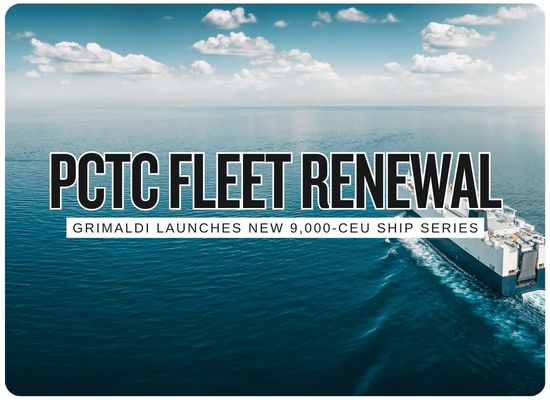
Grimaldi Group has taken delivery of the Grande Shanghai, the first of ten next-generation Pure Car & Truck Carrier vessels ordered from China Merchants Heavy Industries Jiangsu. Delivered on August 27, 2025, the 220-meter vessel can carry up to 9,000 CEU across 14 decks and is the lead ship in a series that will eventually increase capacity to 9,800 CEU on the final five vessels. The Grande Shanghai is equipped with a 5 MWh battery system, 2,500 square meters of solar panels, shore-power capability, air lubrication and an unusual twin-foil gate rudder, while its RINA Ammonia Ready notation allows for future conversion to ammonia propulsion. Its first commercial voyage carried 7,000 linear meters of rolling cargo from China to East Africa before the vessel was scheduled to move into Grimaldi's expanding Asia-Europe network.
Newbuild Impact Snapshot
Grande Shanghai is the lead vessel in Grimaldi's ten-ship China Merchants PCTC program. The design combines substantially greater vehicle capacity with a package of technologies intended to reduce energy use both underway and alongside.
The new vessel increases Grimaldi's deep-sea automotive transport capacity while retaining the ability to carry both electric and conventional vehicles.
Grimaldi and the Shippax jury cite an efficiency improvement of up to 50% on a transported-cargo basis compared with earlier PCTCs.
Battery storage supports onboard electrical loads and forms part of the vessel's low-emission port operating package.
Solar generation is integrated alongside batteries, shore power and energy-management systems.
The second half of the ten-vessel China Merchants series increases vehicle capacity by another 800 CEU per ship.
7,600 CEU to 9,000 CEU to 9,800 CEU
Grimaldi's current fleet program is increasing vehicle capacity while adding technologies that were not central features of the company's earlier deep-sea car-carrier generation.
| Fleet Feature | Earlier 7,600 CEU Generation | Grande Shanghai | 9,800 CEU Follow-On | Change in Fleet Capability | Technology Status |
|---|---|---|---|---|---|
| Vehicle Capacity | Approximately 7,600 CEU on ships such as Grande Texas. | 9,000 CEU | 9,800 CEU | Grande Shanghai adds about 18.4% capacity. The 9,800-CEU version adds about 28.9% versus 7,600 CEU. | SCALE UP |
| Vehicle Decks | 12 decks on Grande Texas. | 14 decks | Final arrangement depends on vessel specification. | More internal vehicle space supports the larger nominal CEU figure. | HIGH CAPACITY |
| Vessel Length | 199.9 metres on Grande Texas. | 220 metres | Part of the same next-generation design family. | Longer hull contributes to the additional deck area and vehicle intake. | LARGER HULL |
| Ammonia Conversion | Not part of the highlighted original specification. | RINA Ammonia Ready notation. | RINA Ammonia Ready specification retained. | Machinery-space and vessel-design provisions allow later conversion if ammonia becomes commercially practical. | FUTURE FUEL |
| Battery Storage | Not a headline feature of the earlier generation. | 5 MWh lithium-ion system. | 5 MWh system specified on announced 9,800-CEU ships. | Electrical storage becomes an integrated component of port and auxiliary-energy management. | HYBRID ENERGY |
| Solar Generation | Not highlighted in the earlier ship specification. | 2,500 m² of solar panels. | 2,500 m² also specified on announced follow-on ships. | Solar contributes auxiliary electrical generation rather than main propulsion power. | AUXILIARY POWER |
| Shore Power | Not highlighted as part of the 2021 vessel specification. | Cold-ironing capability installed. | Included in announced 9,800-CEU specification. | Allows onboard generators to be shut down when compatible shore electricity is available. | PORT EMISSIONS |
| Gate Rudder | Conventional rudder arrangement. | Twin foil blades positioned around the propeller. | Retained in announced follow-on vessel specification. | Intended to improve propulsion efficiency and manoeuvrability by recovering energy around the propeller flow. | PCTC FIRST |
| Unit Fuel Efficiency | Comparison baseline. | Up to 50% lower fuel consumption per transported CEU according to Grimaldi and Shippax. | High-efficiency design package continues, although actual performance depends on operating profile. | Larger cargo intake allows propulsion energy to be spread across more vehicles. | EFFICIENCY |
PCTC Fleet Capacity and Revenue Uplift Calculator
Compare a previous-generation car carrier with a 9,000-CEU or 9,800-CEU PCTC and estimate the additional annual vehicle lift created by higher-capacity vessels.
We welcome your feedback, suggestions, corrections, and ideas for enhancements.
Please click here to get in touch