Nuclear Boxship Design Moves From Concept Talk to Class Review
🔔 Subscribe to ShipUniverse Weekly →
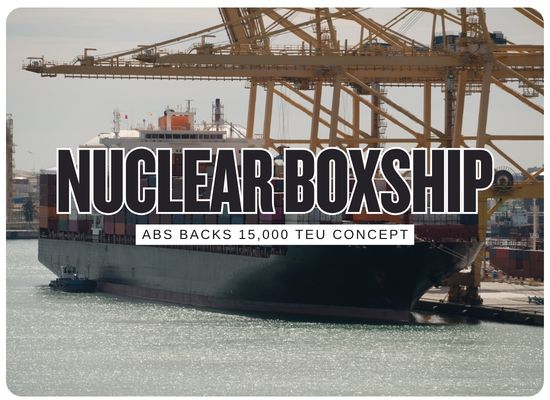
A 15,000 TEU nuclear-powered containership concept has received Approval in Principle from ABS, giving one of the most closely watched zero-carbon ship ideas a formal early-stage class review. The design was developed by Korea’s ship and nuclear research teams with Samsung Heavy Industries, combining a large Neo-Panamax-style container hull with marine molten salt reactor technology and an energy storage system for propulsion support. The concept is built around long-range operation without conventional fuel tanks or funnels, central reactor placement to improve protection and layout efficiency, and a high-speed operating profile reported around 25 knots. The approval does not mean a commercial nuclear boxship is ready for orders, port calls, or insurance placement, but it does show that classification work is moving from theory into structured design review.
Ship Universe Nuclear Propulsion Watch
Operator Impact Snapshot
The ABS approval moves nuclear container propulsion into a more formal design-review lane.
The approval is early stage, but it gives operators and suppliers a clearer view of the technical direction: large container capacity, nuclear-electric propulsion, reactor-protected vessel layout, and reduced reliance on conventional bunker fuel infrastructure.
Class-review milestone
Approval in Principle gives the concept a formal technical checkpoint, even though commercial operation remains several steps away.
Fuel-system disruption
A nuclear-powered boxship design removes the conventional fuel-tank and funnel assumptions that shape today’s containership architecture.
Regulatory gatekeeping
Port access, flag-state rules, nuclear licensing, emergency response, liability, and crew certification remain major gating issues.
Shipyard supply chain signal
Reactors, shielding, power conversion, control systems, cybersecurity, energy storage, and class documentation would create new procurement layers.
Zero-emission operating concept
The design targets long-range propulsion without onboard combustion emissions from marine fuel, changing the economics of carbon exposure and bunker dependency.
Commercial Reading
This is not a near-term fleet order story. It is a design-readiness story for a technology that could change fuel planning, vessel layouts, port risk files, insurance review, and shipyard engineering packages.
- Liner operators: track route suitability, port acceptance, class rules, cargo capacity, and long-term fuel-risk exposure.
- Shipyards: monitor reactor integration, shielding, layout, power conversion, testing, and specialist subcontractor requirements.
- Ports: prepare for future questions around access rules, emergency response, security zones, and public acceptance.
- Insurers: review nuclear liability, casualty response, cargo claims, crew exposure, and port-state limitations.
- Suppliers: watch demand around sensors, energy storage, digital controls, radiation monitoring, cybersecurity, and safety systems.
Nuclear Boxship Concept Board
Vessel Scale, Reactor Layout, and Commercial Gates
The AIP places a large nuclear-powered boxship design into structured class review, with major commercial barriers still ahead.
Concept Setup
Large containership concept aimed at major deep-sea liner trades.
High-speed operating target supported by nuclear propulsion and energy storage.
Reported twin molten salt small modular reactor arrangement for propulsion power.
Approval in Principle confirms early technical feasibility, subject to further conditions and development.
Adoption Table
| Issue Area | Latest Detail | Market Effect | Stakeholder Move | Pressure Meter |
|---|---|---|---|---|
| Class Milestone Approval in Principle | ABS reviewed the concept at an early design stage and granted AIP for the nuclear-powered containership. | Gives shipyards, regulators, investors, and operators a more concrete technical reference point. | Track follow-on class requirements, safety cases, flag-state engagement, and design maturity. |
High
|
| Reactor Integration Molten salt SMR layout | The concept uses marine molten salt reactor technology with reactors placed centrally in the vessel layout. | Reactor placement, shielding, cooling, containment, access control, and machinery arrangement become central design issues. | Review collision protection, maintenance access, class safety case, emergency isolation, and system redundancy. |
High
|
| Fuel Infrastructure Shift No conventional fuel tanks | The concept removes traditional fuel tanks and funnels, changing ship layout and cargo-space assumptions. | Reduces bunker dependency but replaces fuel logistics with nuclear licensing, fuel-cycle, and service infrastructure. | Compare bunker savings against reactor capital cost, lifecycle service, refueling strategy, insurance, and port restrictions. |
Medium High
|
| Port Access Major operating gate | Nuclear merchant vessels would need acceptance from ports, coastal states, flag states, and emergency-response authorities. | Even a technically viable ship needs a tradable network of approved port calls before liner deployment works. | Map port-policy risk, public acceptance, security zones, pilotage rules, cargo-owner restrictions, and contingency ports. |
Watch
|
| Insurance and Liability Coverage architecture | Nuclear propulsion adds unusual casualty, cargo, pollution, crew, port, and third-party liability questions. | Insurance structure could decide whether commercial deployment remains theoretical or becomes financeable. | Follow P&I treatment, nuclear liability conventions, reinsurer appetite, cargo exclusions, and hull coverage terms. |
High
|
| Supplier Opportunity New technical stack | Nuclear-electric propulsion would require specialized controls, energy storage, monitoring, cybersecurity, shielding, and safety equipment. | Creates high-value supplier niches beyond traditional engines, scrubbers, tanks, and bunker systems. | Prepare for demand around power conversion, sensors, battery support, digital twins, simulation, radiation detection, and safety cases. |
Medium High
|
Nuclear Boxship Readiness Calculator
Estimate fuel savings, carbon exposure change, port-readiness friction, and adoption score for a nuclear-powered container route.
This tool helps liner operators, ports, insurers, yards, and equipment suppliers screen the commercial readiness of a nuclear-powered containership concept against a conventional fuel case.
Conventional Fuel Cost
$30.6M
Estimated annual fuel cost avoided or reduced under a nuclear propulsion case.
CO2 Exposure Avoided
121,446 mt
Estimated combustion-related CO2 avoided before lifecycle and nuclear-service adjustments.
Carbon Cost Avoided
$11.5M
Estimated avoided carbon cost using the selected CO2 price.
Net Operating Delta
$24.1M
Estimated annual fuel and carbon benefit after nuclear power system service cost.
Route Readiness Signal
The operating-cost case may be interesting, but port access, insurance, liability, and regulation remain the main barriers under these assumptions.
We welcome your feedback, suggestions, corrections, and ideas for enhancements.
Please click here to get in touch